
使用多个二维激光雷达在室内环境中进行活动检测
Activity Detection in Indoor Environments Using Multiple 2D Lidars.
作者信息
Bouazizi Mondher, Mora Alejandro Lorite, Feghoul Kevin, Ohtsuki Tomoaki
机构信息
Faculty of Science and Technology, Keio University, Yokohama 223-8522, Japan.
Graduate School of Science and Technology, Keio University, Yokohama 223-8522, Japan.
出版信息
Sensors (Basel). 2024 Jan 18;24(2):0. doi: 10.3390/s24020626.
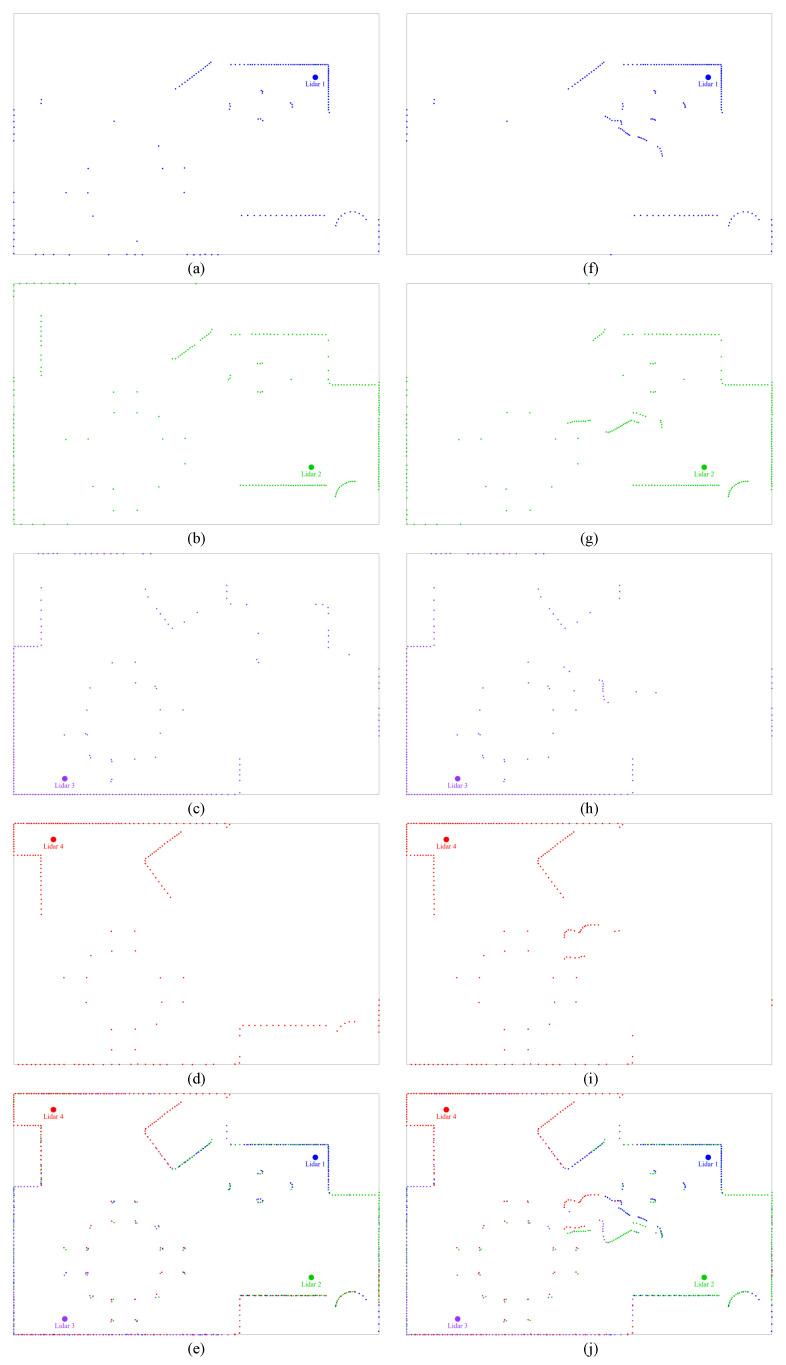
In health monitoring systems for the elderly, a crucial aspect is unobtrusively and continuously monitoring their activities to detect potentially hazardous incidents such as sudden falls as soon as they occur. However, the effectiveness of current non-contact sensor-based activity detection systems is limited by obstacles present in the environment. To overcome this limitation, a straightforward yet highly efficient approach involves utilizing multiple sensors that collaborate seamlessly. This paper proposes a method that leverages 2D Light Detection and Ranging (Lidar) technology for activity detection. Multiple 2D Lidars are positioned in an indoor environment with varying obstacles such as furniture, working cohesively to create a comprehensive representation of ongoing activities. The data from these Lidars is concatenated and transformed into a more interpretable format, resembling images. A convolutional Long Short-Term Memory (LSTM) Neural Network is then used to process these generated images to classify the activities. The proposed approach achieves high accuracy in three tasks: activity detection, fall detection, and unsteady gait detection. Specifically, it attains accuracies of 96.10%, 99.13%, and 93.13% for these tasks, respectively. This demonstrates the efficacy and promise of the method in effectively monitoring and identifying potentially hazardous events for the elderly through 2D Lidars, which are non-intrusive sensing technology.
在老年人健康监测系统中,一个关键方面是在不引人注意的情况下持续监测他们的活动,以便在潜在危险事件(如突然跌倒)一旦发生时就能立即检测到。然而,当前基于非接触式传感器的活动检测系统的有效性受到环境中存在的障碍物的限制。为了克服这一限制,一种简单而高效的方法是利用多个能无缝协作的传感器。本文提出了一种利用二维激光雷达(Lidar)技术进行活动检测的方法。多个二维激光雷达放置在存在诸如家具等各种障碍物的室内环境中,协同工作以创建正在进行活动的全面表示。来自这些激光雷达的数据被拼接并转换为更易于解释的格式,类似于图像。然后使用卷积长短期记忆(LSTM)神经网络来处理这些生成的图像以对活动进行分类。所提出的方法在活动检测、跌倒检测和不稳定步态检测这三项任务中都取得了高精度。具体而言,这些任务的准确率分别达到了96.10%、99.13%和93.13%。这证明了该方法通过二维激光雷达(一种非侵入式传感技术)有效监测和识别老年人潜在危险事件的有效性和前景。




 Zotero 插件