Banerjee Deb Sankar, Freedman Simon L, Murrell Michael P, Banerjee Shiladitya
Department of Physics, Carnegie Mellon University, Pittsburgh, PA 15213, USA.
James Franck Institute, University of Chicago, Chicago, IL 60637, USA.
bioRxiv. 2024 Jan 10:2024.01.09.574885. doi: 10.1101/2024.01.09.574885.
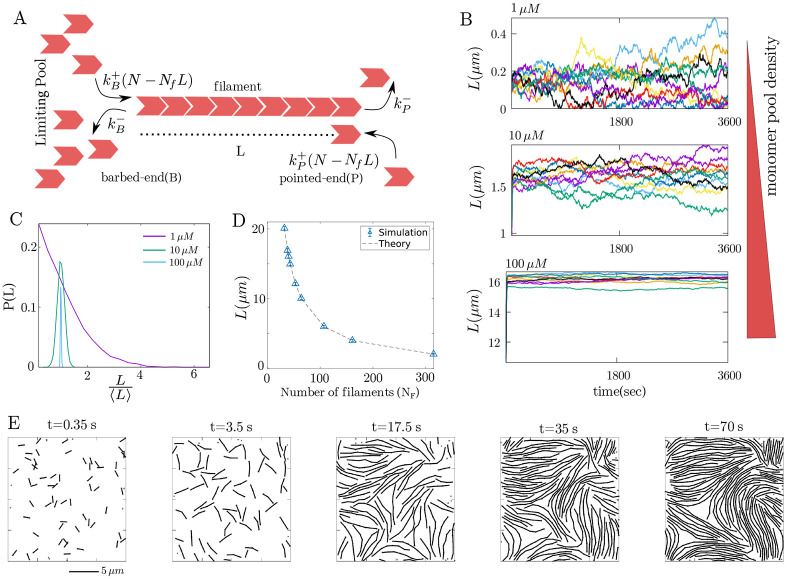
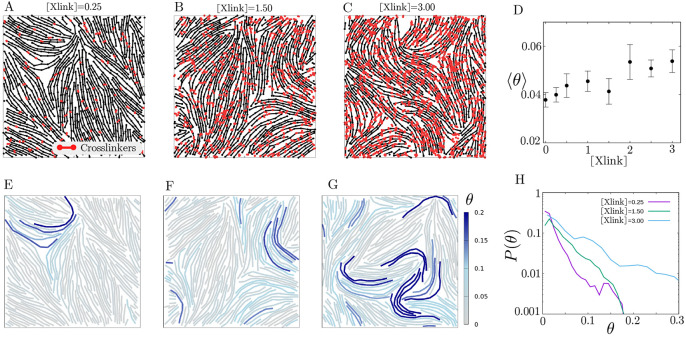
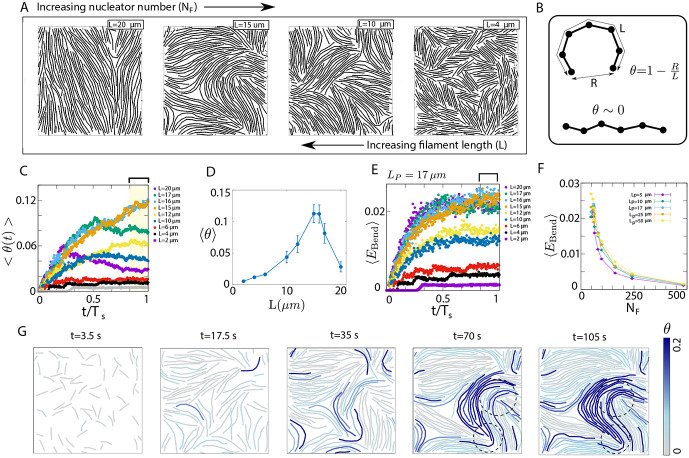
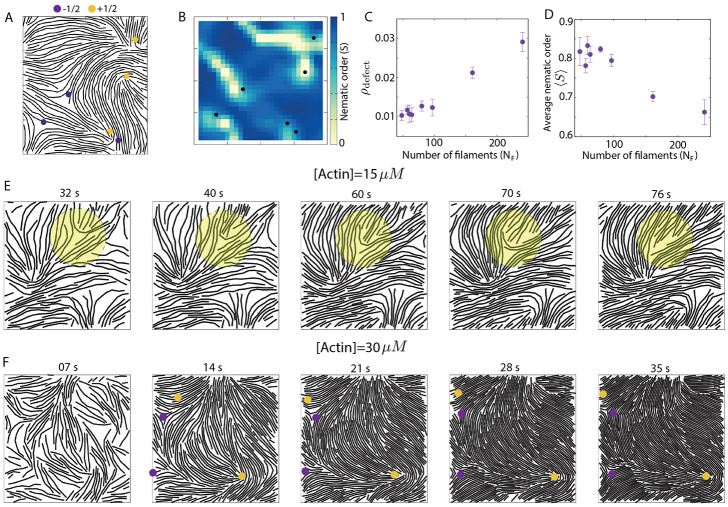
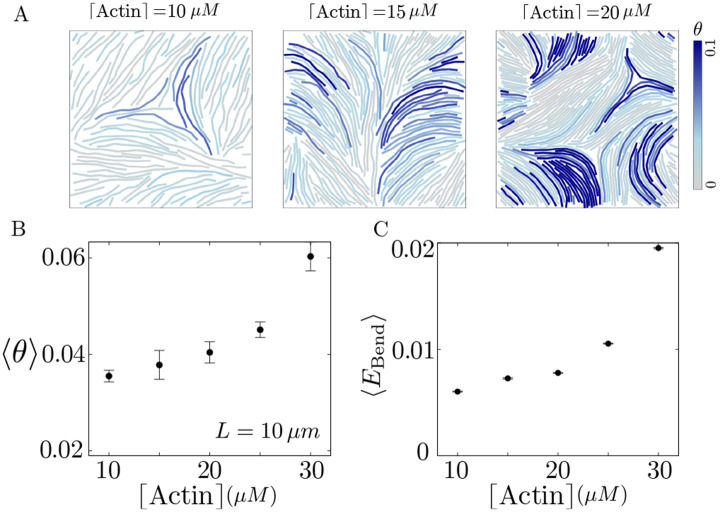
Growth and turnover of actin filaments play a crucial role in the construction and maintenance of actin networks within cells. Actin filament growth occurs within limited space and finite subunit resources in the actin cortex. To understand how filament growth shapes the emergent architecture of actin networks, we developed a minimal agent-based model coupling filament mechanics and growth in a limiting subunit pool. We find that rapid filament growth induces kinetic trapping of highly bent actin filaments. Such collective bending patterns are long-lived, organized around nematic defects, and arises from competition between filament polymerization and bending elasticity. The stability of nematic defects and the extent of kinetic trapping are amplified by an increase in the abundance of the actin pool and by crosslinking the network. These findings suggest that kinetic trapping is a robust consequence of growth in crowded environments, providing a route to program shape memory in actin networks.
肌动蛋白丝的生长和周转在细胞内肌动蛋白网络的构建和维持中起着关键作用。肌动蛋白丝的生长发生在肌动蛋白皮质的有限空间和有限亚基资源内。为了理解丝的生长如何塑造肌动蛋白网络的涌现结构,我们开发了一个基于最小代理的模型,该模型在有限的亚基池中耦合了丝的力学和生长。我们发现,快速的丝生长会诱导高度弯曲的肌动蛋白丝的动力学捕获。这种集体弯曲模式寿命很长,围绕向列型缺陷组织,并且源于丝聚合和弯曲弹性之间的竞争。向列型缺陷的稳定性和动力学捕获的程度通过增加肌动蛋白池的丰度和交联网络而放大。这些发现表明,动力学捕获是拥挤环境中生长的一个稳健结果,为在肌动蛋白网络中编程形状记忆提供了一条途径。