Department of Critical Care, Christian Medical College, Vellore, 632004, India.
Department of Clinical Hematology, Christian Medical College, Vellore, India.
Sci Rep. 2024 Jan 23;14(1):2011. doi: 10.1038/s41598-024-51908-9.
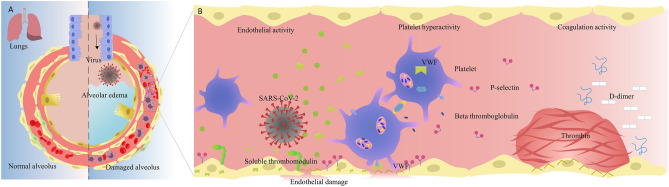
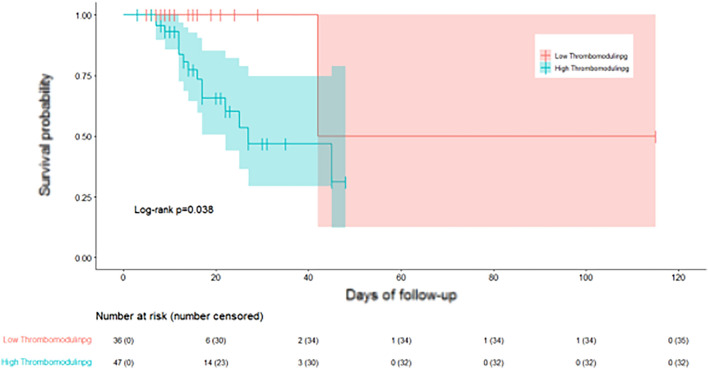
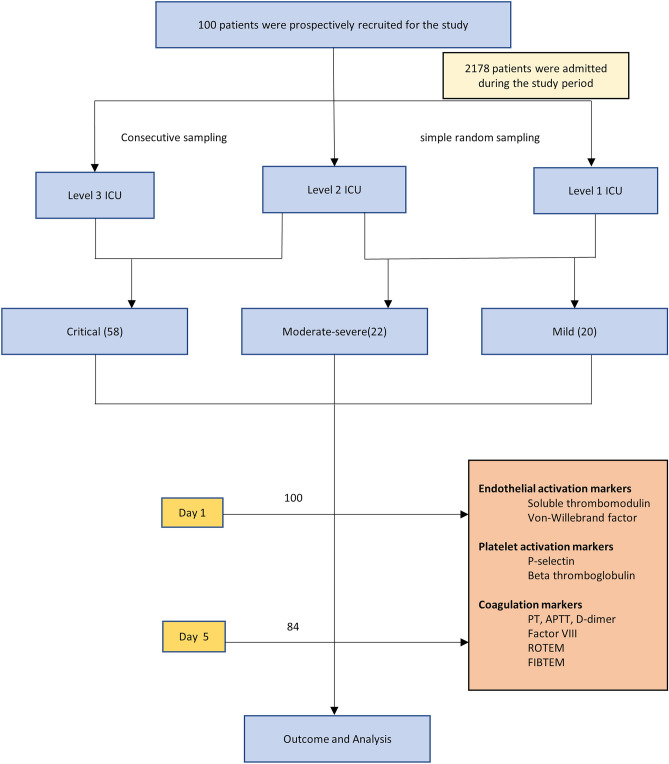
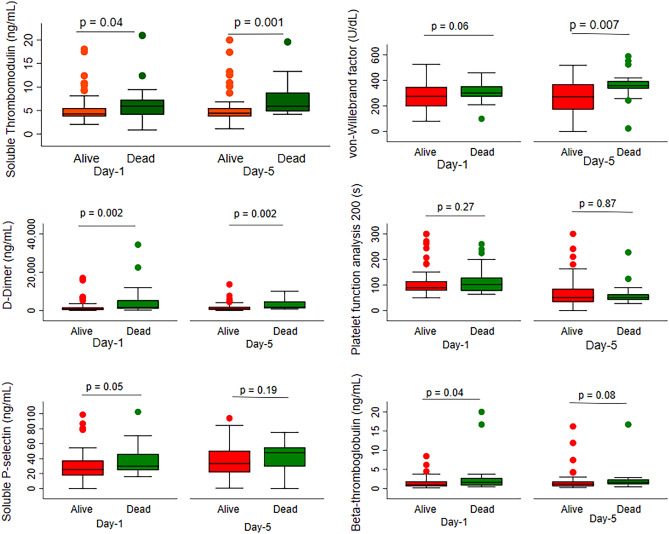
Prospective and sequential evaluation of homeostatic changes leading to thrombosis across COVID 19 disease severity spectrum are limited. In this prospective observational study, haemostasis was evaluated in patients with mild, moderate-severe, and critical COVID-19 infection. Markers of endothelial activation [Soluble thrombomodulin (sTM), von Willebrand Factor (VWF)], platelet activation [Soluble P-selectin, beta-thromboglobulin (BTG)] and global haemostasis [Rotational thromboelastometry (ROTEM)] were evaluated on days 1 and 5 after admission. The study cohort comprised of 100 adult patients (mild = 20, moderate-severe = 22, critical = 58). Sixty-five patients received anticoagulation for 10 (7-14) days. Thrombotic events were seen in 9 patients. In-hospital mortality was 21%. Endothelial activation markers were elevated at baseline in all subgroups, with levels in moderate-severe (sTM = 4.92 ng/ml, VWF = 295 U/dl) [reference-ranges: sTM = 2.26-4.55 ng/ml; Soluble P-selectin = 13.5-31.5 ng/ml; BTG = 0.034-1.99 ng/ml] and critical patients (sTM = 6.07 ng/ml, VWF = 294 U/dl) being significantly higher than in the mild group (sTM = 4.18 ng/ml, VWF = 206 U/dl). In contrast, platelet activation markers were elevated only in critically ill patients at baseline (Soluble P-selectin = 37.3 ng/ml, BTG = 2.51 ng/ml). The critical group had significantly lower fibrinolysis on days 1 and 5 when compared with the moderate-severe arm. COVID-19 infection was associated with graded endothelial activation and lower fibrinolysis that correlated with illness severity.
COVID-19 疾病严重程度谱中导致血栓形成的体内平衡变化的前瞻性和连续评估是有限的。在这项前瞻性观察研究中,评估了轻度、中重度和危重新冠感染患者的止血情况。在入院后第 1 天和第 5 天评估了内皮细胞激活标志物[可溶性血栓调节蛋白 (sTM)、血管性血友病因子 (VWF)]、血小板激活标志物[可溶性 P-选择素、β-血栓球蛋白 (BTG)]和整体止血标志物[旋转血栓弹性测定法 (ROTEM)]。研究队列包括 100 名成年患者(轻度=20 例,中重度=22 例,危重症=58 例)。65 名患者接受了为期 10(7-14)天的抗凝治疗。9 名患者发生血栓事件。住院死亡率为 21%。所有亚组的基线内皮激活标志物均升高,中重度患者(sTM=4.92ng/ml,VWF=295U/dl)[参考范围:sTM=2.26-4.55ng/ml;可溶性 P-选择素=13.5-31.5ng/ml;BTG=0.034-1.99ng/ml]和危重症患者(sTM=6.07ng/ml,VWF=294U/dl)水平显著高于轻度组(sTM=4.18ng/ml,VWF=206U/dl)。相比之下,只有危重症患者的基线血小板激活标志物升高(可溶性 P-选择素=37.3ng/ml,BTG=2.51ng/ml)。与中重度组相比,危重组在第 1 天和第 5 天的纤溶活性显著降低。COVID-19 感染与逐渐加重的内皮激活和与疾病严重程度相关的纤溶降低有关。