Tran Minh-Hoang, van Zwieten Anita, Kiely Kim M, Blyth Fiona M, Naganathan Vasi, Le Couteur David G, Handelsman David J, Seibel Markus J, Waite Louise M, Cumming Robert G, Khalatbari-Soltani Saman
School of Public Health, Faculty of Medicine and Health, University of Sydney, Sydney, NSW, Australia.
NTT Hi-Tech Institute, Nguyen Tat Thanh University, HCMC, Viet Nam.
SSM Popul Health. 2023 Dec 11;25:101581. doi: 10.1016/j.ssmph.2023.101581. eCollection 2024 Mar.
We examined associations between intra-generational social mobility (reflected in life-course socioeconomic trajectories) and mortality, among older men.
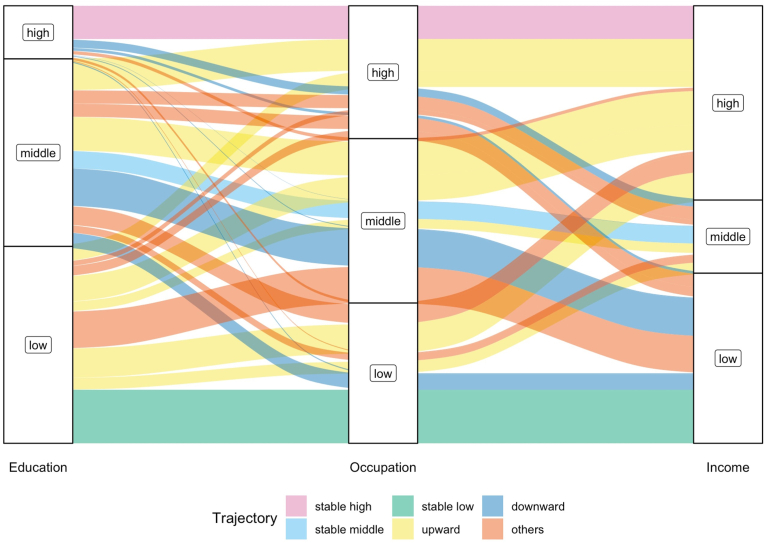
Data came from a prospective Australian community-based cohort of older men. Social mobility was defined by socioeconomic indicators from three points in the life-course: educational attainment (late adolescence-early adulthood), occupation (mid-life), and current sources of income (older age). We defined indicators of social mobility trajectory (6 categories; reflecting the direction of social mobility) and social mobility status (2 categories; mobile or non-mobile). We used Cox regression to examine associations with mortality, adjusting for age, country of birth, and living arrangement.
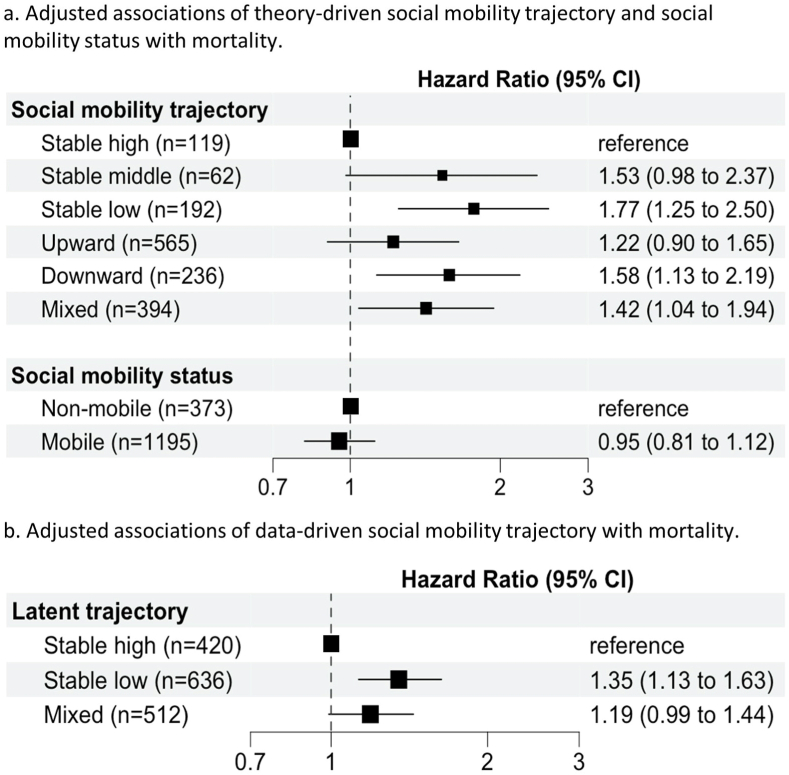
We followed 1568 men (mean age 76.8, SD 5.4) for a mean duration of 9.1 years, with 797 deaths recorded. Moving upward was the predominant social mobility trajectory (36.0%), followed by mixed trajectories (25.1%), downward (15.1%), stable low (12.2%), stable high (7.6%), and stable middle (4.0%). Men with downward (Hazard ratio 1.58, 95% CI 1.13 to 2.19) and stable low socioeconomic trajectories (1.77, 1.25 to 2.50) had higher mortality risks than men with stable high socioeconomic trajectories, while men with upward trajectories had similar risks to those with stable high trajectories. 76.2% of the participants were classified as having mobile status; no associations were evident between binary social mobility status and mortality.
These findings suggest cumulative and persistent exposure to disadvantaged socioeconomic conditions across the life-course, rather than social mobility, is associated with increased mortality. For each stage of the life-course, addressing socioeconomic disadvantage may reduce inequities in mortality.
我们研究了老年男性代内社会流动(反映在生命历程中的社会经济轨迹)与死亡率之间的关联。
数据来自澳大利亚一个基于社区的老年男性前瞻性队列。社会流动由生命历程中三个时间点的社会经济指标定义:教育程度(青春期后期至成年早期)、职业(中年)和当前收入来源(老年)。我们定义了社会流动轨迹指标(6类;反映社会流动方向)和社会流动状态指标(2类;流动或不流动)。我们使用Cox回归来研究与死亡率的关联,并对年龄、出生国家和居住安排进行了调整。
我们对1568名男性(平均年龄76.8岁,标准差5.4)进行了平均9.1年的随访,记录到797例死亡。向上流动是主要的社会流动轨迹(36.0%),其次是混合轨迹(25.1%)、向下流动(15.1%)、稳定低水平(12.2%)、稳定高水平(7.6%)和稳定中等水平(4.0%)。社会经济轨迹向下(风险比1.58,95%置信区间1.13至2.19)和稳定低水平(1.77,1.25至2.50)的男性比社会经济轨迹稳定高水平的男性有更高的死亡风险,而向上流动轨迹的男性与稳定高水平轨迹的男性风险相似。76.2%的参与者被归类为具有流动状态;二元社会流动状态与死亡率之间没有明显关联。
这些发现表明,生命历程中累积和持续暴露于不利的社会经济条件而非社会流动与死亡率增加有关。对于生命历程的每个阶段,解决社会经济劣势可能会减少死亡率方面的不平等。