
代际社会流动性与体重指数轨迹——来自芬兰的一项随访研究。
Intergenerational social mobility and body mass index trajectories - A follow-up study from Finland.
作者信息
Salmela J, Lallukka T, Kanerva N, Pietiläinen O, Rahkonen O, Mauramo E
机构信息
Department of Public Health, University of Helsinki, P.O. Box 20, 00014, Helsinki, Finland.
Finnish Institute of Occupational Health, P.O. Box 18, 00032, Helsinki, Finland.
出版信息
SSM Popul Health. 2020 Dec 22;13:100723. doi: 10.1016/j.ssmph.2020.100723. eCollection 2021 Mar.
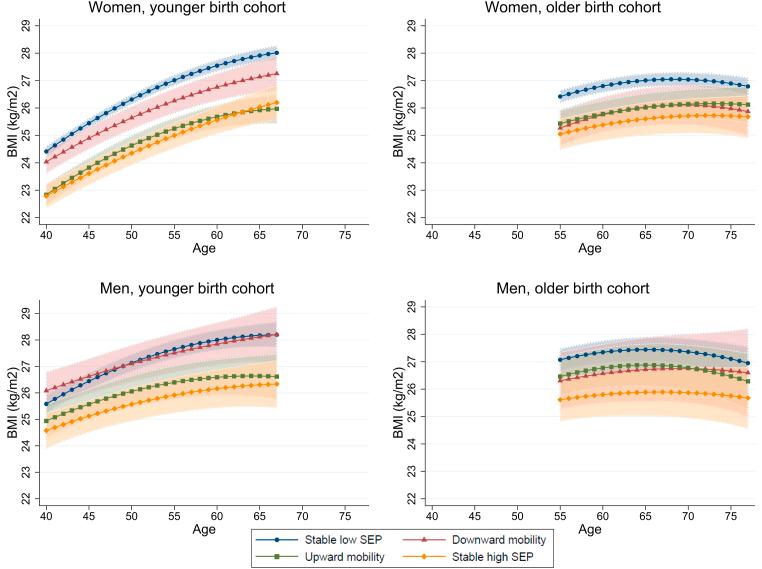
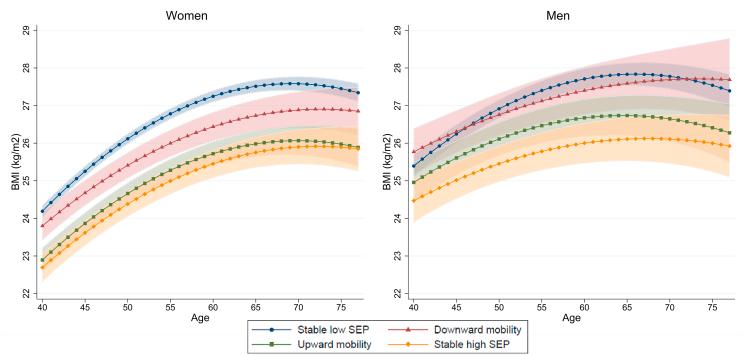
Evidence remains unclear on how intergenerational social mobility is associated with body mass index (BMI) and its long-term changes. Our study identified BMI trajectories from middle to older age by intergenerational social mobility groups and stratified the analyses by gender and two birth cohorts (birth years 1940‒1947 and 1950-1962). We used questionnaire-based cohort data that consists of four survey phases: 2000-2002, 2007, 2012, and 2017. In Phase 1, participants were 40-60-year-old employees of the City of Helsinki, Finland. Our analytical sample consisted of 6,971 women and 1,752 men. Intergenerational social mobility was constructed based on self-reported parental and own education-both divided into high and low-yielding four groups: stable high socioeconomic position (SEP) (high-high), upward social mobility (low-high), downward social mobility (high-low), and stable low SEP (low-low). BMI was calculated from self-reported height and weight from all four phases. Using mixed-effects linear regression, we found increasing BMI trajectories in all four social mobility groups until the age of 65. Women and men with stable high SEP had lower BMI trajectories compared to those with stable low SEP. In the younger birth cohort, women with upward social mobility had a lower BMI trajectory than women with stable low SEP. Additionally, women and men with downward social mobility had higher BMI trajectories than those with stable high SEP. In the older birth cohort, however, the BMI trajectories of upward and downward social mobility groups were somewhat similar and settled between the BMI trajectories of stable high and stable low SEP groups. Our results indicate that the associations between intergenerational social mobility and BMI may depend on gender and birth cohort. Nevertheless, to reduce socioeconomic inequalities in unhealthy weight gain, obesity prevention actions that focus on people who are likely to remain in low SEP might be worthwhile.
关于代际社会流动如何与体重指数(BMI)及其长期变化相关联,证据仍不明确。我们的研究按代际社会流动群体确定了从中年到老年的BMI轨迹,并按性别和两个出生队列(出生年份1940 - 1947年和1950 - 1962年)进行分层分析。我们使用了基于问卷的队列数据,该数据由四个调查阶段组成:2000 - 2002年、2007年、2012年和2017年。在第一阶段,参与者是芬兰赫尔辛基市40 - 60岁的员工。我们的分析样本包括6971名女性和1752名男性。代际社会流动是根据自我报告的父母和自身教育情况构建的——两者都分为高收益和低收益四组:稳定的高社会经济地位(SEP)(高 - 高)、向上社会流动(低 - 高)、向下社会流动(高 - 低)和稳定的低SEP(低 - 低)。BMI是根据所有四个阶段自我报告的身高和体重计算得出的。使用混合效应线性回归,我们发现所有四个社会流动群体的BMI轨迹在65岁之前都呈上升趋势。与稳定的低SEP者相比,稳定的高SEP的女性和男性的BMI轨迹较低。在较年轻的出生队列中,向上社会流动的女性的BMI轨迹低于稳定的低SEP的女性。此外,向下社会流动的女性和男性的BMI轨迹高于稳定的高SEP的女性和男性。然而,在较年长的出生队列中,向上和向下社会流动群体的BMI轨迹有些相似,且处于稳定的高SEP群体和稳定的低SEP群体的BMI轨迹之间。我们的结果表明,代际社会流动与BMI之间的关联可能取决于性别和出生队列。尽管如此,为了减少不健康体重增加方面的社会经济不平等,针对可能仍处于低SEP的人群开展肥胖预防行动可能是值得的。
 Zotero 插件