Department of Obstetrics and Gynecology, Maternal and Child Health Center, The First Affiliated Hospital of Xi'an Jiaotong University, Xi'an, China.
Continuing Education and Training Center, The First Affiliated Hospital of Xi'an Jiaotong University, Xi'an, China.
Front Public Health. 2024 Jan 9;11:1282451. doi: 10.3389/fpubh.2023.1282451. eCollection 2023.
Neonatal disorders are facing serious public health challenges. Previous studies were based on limited data sources and had a narrow geographical scope. We aim to understand the trends of alteration in the burden of neonatal disorders from 1990 to 2019 in 204 countries and territories.
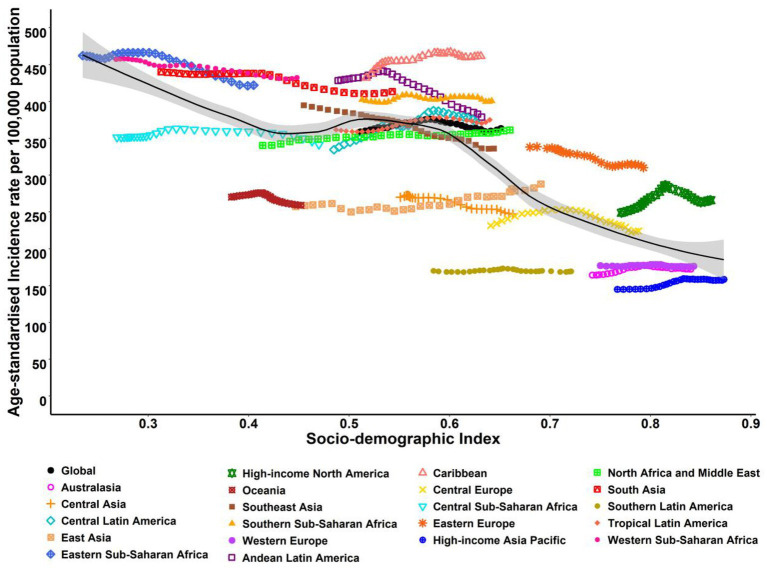
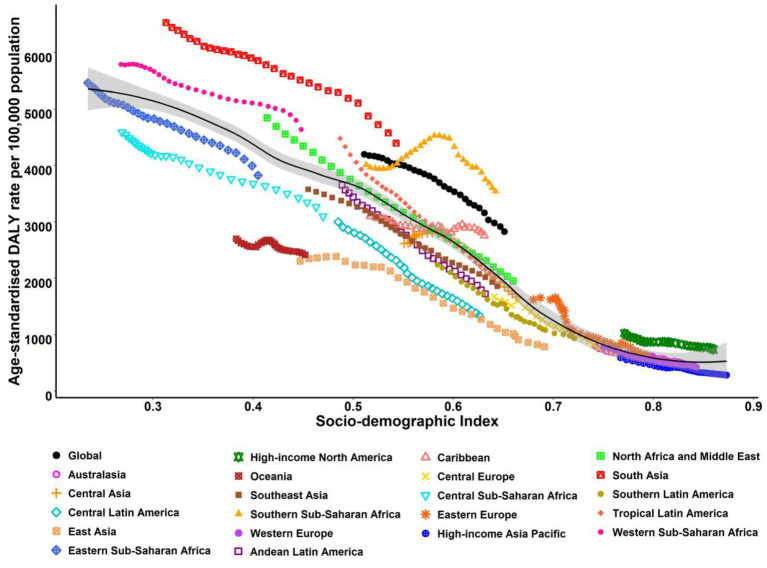
Data were investigated from the Global Burden of Disease Study 2019. First, we visualized the burden of neonatal disorders using the number of cases and the age-standardized incidence rate (ASIR), death rate (ASDR), and disability-adjusted life years (ASR-DALYs) from 1990 to 2019. Second, estimated annual percentage changes (EAPCs) were used to evaluate the temporal trends of disease burden during different periods. Finally, the sociodemographic index (SDI) and human development index (HDI) were used to determine whether there exists a correlation between socioeconomic development level, human development level, and potential burden consequences.
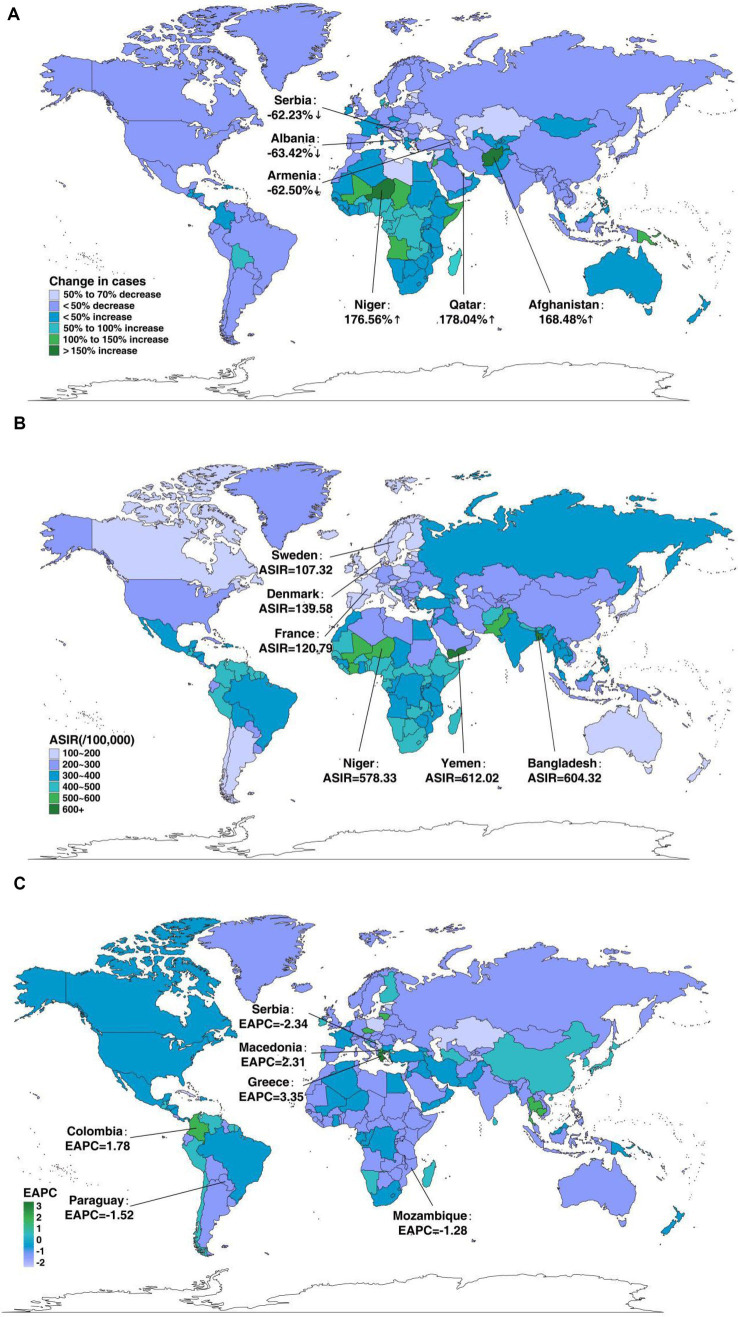
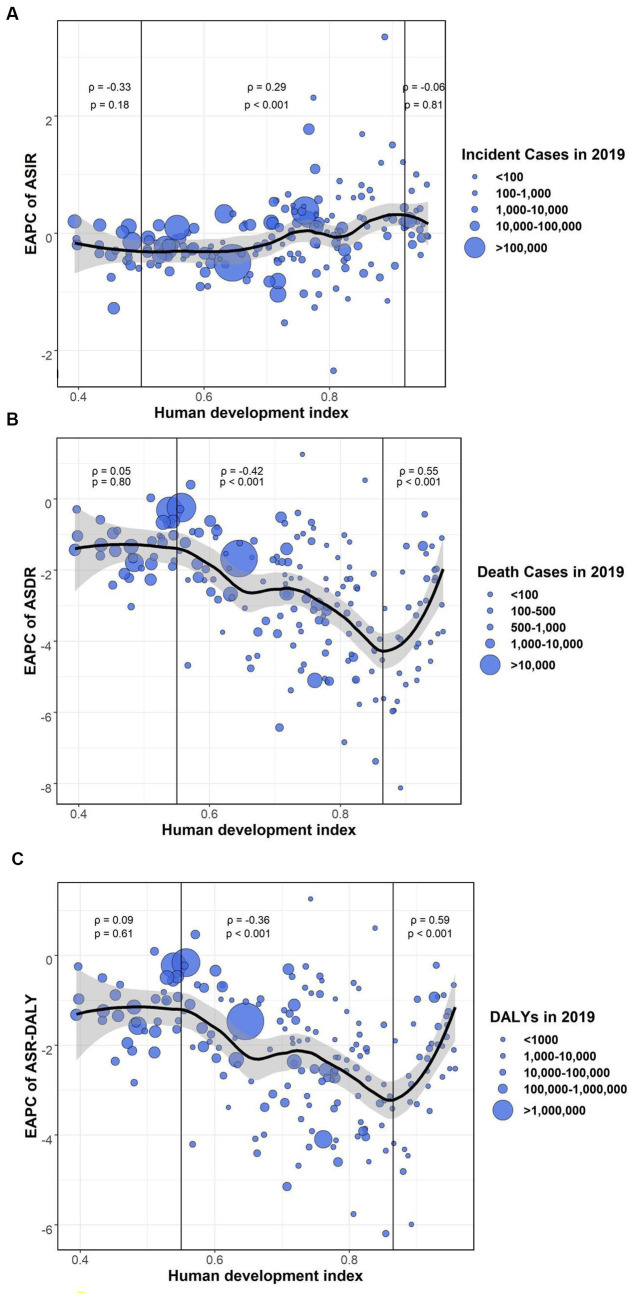
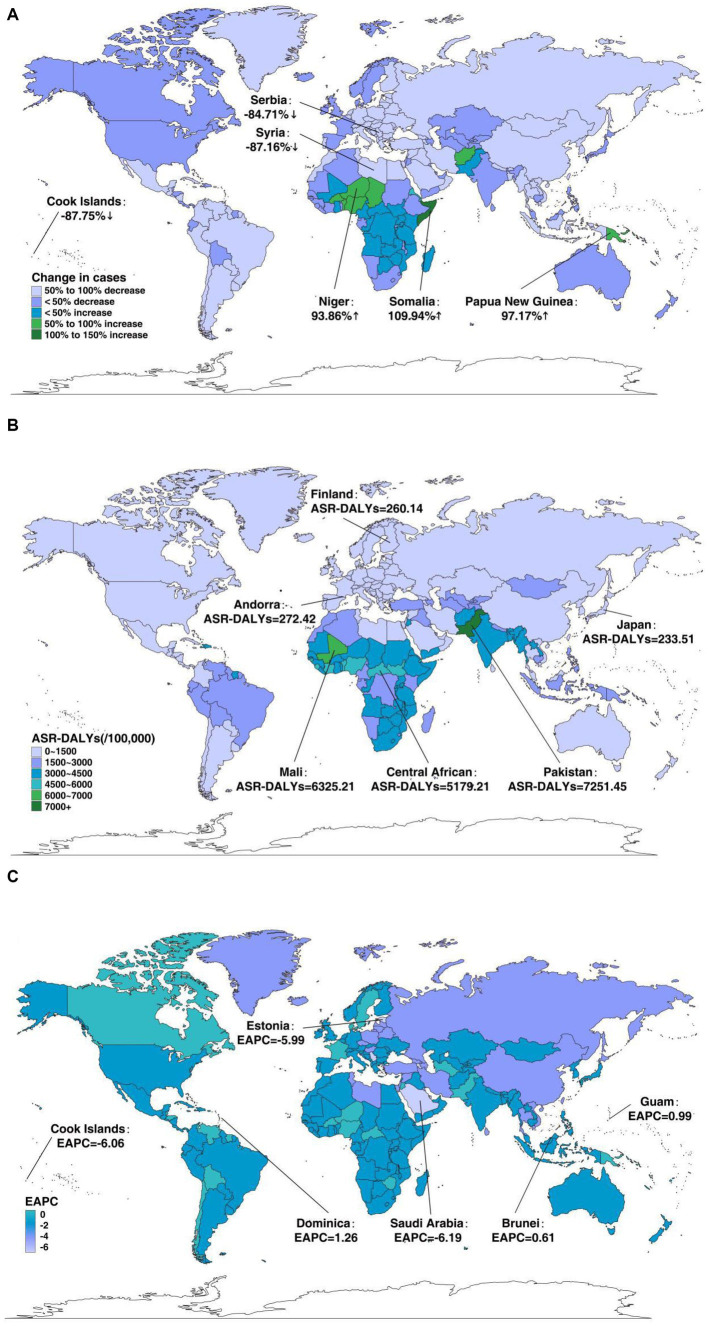
Overall, in the past 30 years, the ASIR trends have remained relatively steady, whereas the ASDR and ASR-DALYs have declined. However, the burden of neonatal disorders varied greatly in various regions and countries. Among 21 regions, the ASIR trend had the largest increase in Central Latin America (EAPC = 0.42, 95%CI = 0.33-0.50). Conversely, the ASDR and ASR-DALYs experienced the largest decrease in Central Europe (EAPC = -5.10, 95%CI = -5.28 to 4.93) and East Asia (EAPC = -4.07, 95%CI = -4.41 to 3.73), respectively. Among 204 countries, the ASIR (EAPC = 3.35, 95%CI = 3.13-3.56) trend in Greece displayed the most significant increase, while the ASDR (EAPC = 1.26, 95%CI = 1.01-1.50) and ASR-DALYs (EAPC = 1.26, 95%CI = 1.03-1.49) trends in Dominica experienced the most substantial increase. Furthermore, there was a strong correlation between the EAPCs in ASIR, ASDR, ASR-DALYs, and SDI or HDI in 2019, with some exceptions. In addition, countries with elevated levels of HDI experienced a faster increase in ASDR and ASR-DALYs for neonatal disorders.
Although the burden of neonatal disorders shows a downward trend from 1990 to 2019, it is still not optimistic. It is necessary to implement a multi-pronged approach to reduce the increasing burden of neonatal disorders.
新生儿疾病正面临严峻的公共卫生挑战。以往的研究基于有限的数据源,且地域范围狭窄。我们旨在了解 1990 年至 2019 年 204 个国家和地区新生儿疾病负担变化的趋势。
数据来自 2019 年全球疾病负担研究。首先,我们使用病例数和年龄标准化发病率(ASIR)、死亡率(ASDR)和伤残调整生命年(ASR-DALYs),从 1990 年至 2019 年可视化新生儿疾病负担。其次,使用估计年度百分比变化(EAPC)评估不同时期疾病负担的时间趋势。最后,使用社会人口指数(SDI)和人类发展指数(HDI)来确定社会经济发展水平、人类发展水平与潜在负担后果之间是否存在相关性。
总体而言,在过去 30 年中,ASIR 趋势相对稳定,而 ASDR 和 ASR-DALYs 则呈下降趋势。然而,新生儿疾病的负担在不同地区和国家存在很大差异。在 21 个地区中,中拉丁美洲的 ASIR 趋势增长最大(EAPC=0.42,95%CI=0.33-0.50)。相反,中欧(EAPC=-5.10,95%CI=-5.28 至 4.93)和东亚(EAPC=-4.07,95%CI=-4.41 至 3.73)的 ASDR 和 ASR-DALYs 降幅最大。在 204 个国家中,希腊的 ASIR(EAPC=3.35,95%CI=3.13-3.56)趋势增长最为显著,而多米尼克的 ASDR(EAPC=1.26,95%CI=1.01-1.50)和 ASR-DALYs(EAPC=1.26,95%CI=1.03-1.49)趋势增长最为显著。此外,2019 年 ASIR、ASDR 和 ASR-DALYs 的 EAPC 与 SDI 或 HDI 之间存在很强的相关性,但也存在一些例外。此外,人类发展指数较高的国家,新生儿疾病的 ASDR 和 ASR-DALYs 增加速度更快。
尽管新生儿疾病的负担从 1990 年到 2019 年呈下降趋势,但情况仍不容乐观。需要采取多管齐下的方法来减轻不断增加的新生儿疾病负担。