
RUNX1 靶向 AKT3 促进 LPS 诱导的 ARDS 中肺泡过度凝血和纤维蛋白溶解抑制。
RUNX1 targeting AKT3 promotes alveolar hypercoagulation and fibrinolytic inhibition in LPS induced ARDS.
机构信息
Department of Intensive Care Unit, The Affiliated Hospital of Guizhou Medical University, Guiyang, China.
Department of Emergency, The Affiliated Hospital of Guizhou Medical University, Guiyang, China.
出版信息
Respir Res. 2024 Jan 24;25(1):54. doi: 10.1186/s12931-024-02689-2.
BACKGROUND
Alveolar hypercoagulation and fibrinolytic inhibition are mainly responsible for massive alveolar fibrin deposition, which are closely related with refractory hypoxemia in acute respiratory distress syndrome (ARDS). Our previous study testified runt-related transcription factor (RUNX1) participated in the regulation of this pathophysiology in this syndrome, but the mechanism is unknown. We speculate that screening the downstream genes associated with RUNX1 will presumably help uncover the mechanism of RUNX1.
METHODS
Genes associated with RUNX1 were screened by CHIP-seq, among which the target gene was verified by Dual Luciferase experiment. Then the efficacy of the target gene on alveolar hypercoagulation and fibrinolytic inhibition in LPS-induced ARDS was explored in vivo as well as in vitro. Finally, whether the regulatory effects of RUNX1 on alveolar hypercoagulation and fibrinolytic in ARDS would be related with the screened target gene was also sufficiently explored.
RESULTS
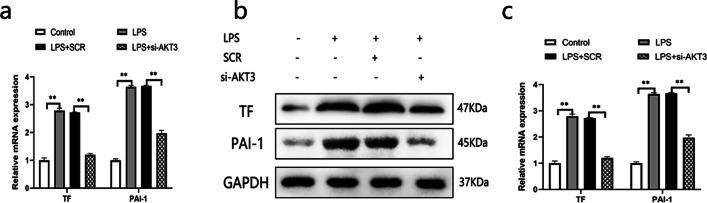
Among these screened genes, AKT3 was verified to be the direct target gene of RUNX1. Results showed that AKT3 was highly expressed either in lung tissues of LPS-induced rat ARDS or in LPS-treated alveolar epithelia cell type II (AECII). Tissue factor (TF) and plasminogen activator inhibitor 1 (PAI-1) were increasingly expressed both in lung tissues of ARDS and in LPS-induced AECII, which were all significantly attenuated by down-regulation of AKT3. Inhibition of AKT3 gene obviously ameliorated the LPS-induced lung injury as well as the collagen I expression in ARDS. RUNX1 overexpression not only promoted the expressions of TF, PAI-1, but also boosted AKT3 expression in vitro. More importantly, the efficacy of RUNX1 on TF, PAI-1 were all effectively reversed by down-regulation of AKT3 gene.
CONCLUSION
AKT3 is an important target gene of RUNX1, through which RUNX1 exerted its regulatory role on alveolar hypercoagulation and fibrinolytic inhibition in LPS-induced ARDS. RUNX1/ATK3 signaling axis is expected to be a new target for the exploration of ARDS genesis and treatment.
背景
肺泡过度凝血和纤维蛋白溶解抑制主要负责大量肺泡纤维蛋白沉积,这与急性呼吸窘迫综合征(ARDS)中的难治性低氧血症密切相关。我们之前的研究证明 runt 相关转录因子(RUNX1)参与了该综合征中这一病理生理学的调节,但机制尚不清楚。我们推测,筛选与 RUNX1 相关的下游基因,可能有助于揭示 RUNX1 的作用机制。
方法
通过 CHIP-seq 筛选与 RUNX1 相关的基因,其中靶基因通过双荧光素酶实验进行验证。然后,在体内和体外探索靶基因对脂多糖诱导的 ARDS 中肺泡过度凝血和纤维蛋白溶解抑制的作用。最后,充分探讨 RUNX1 对 ARDS 中肺泡过度凝血和纤维蛋白溶解的调节作用是否与筛选出的靶基因有关。
结果
在筛选出的基因中,AKT3 被验证为 RUNX1 的直接靶基因。结果表明,LPS 诱导的 ARDS 大鼠肺组织和 LPS 处理的肺泡上皮细胞 II 型(AECII)中 AKT3 表达水平均升高。组织因子(TF)和纤溶酶原激活物抑制剂 1(PAI-1)在 ARDS 肺组织和 LPS 诱导的 AECII 中表达均增加,下调 AKT3 表达可明显减轻 LPS 诱导的肺损伤和 ARDS 中的胶原 I 表达。RUNX1 过表达不仅促进了 TF、PAI-1 的表达,还促进了体外 AKT3 的表达。更重要的是,下调 AKT3 基因可有效逆转 RUNX1 对 TF、PAI-1 的作用。
结论
AKT3 是 RUNX1 的重要靶基因,RUNX1 通过该基因调控 LPS 诱导的 ARDS 中肺泡过度凝血和纤维蛋白溶解抑制。RUNX1/AKT3 信号轴有望成为探索 ARDS 发病机制和治疗方法的新靶点。


 Zotero 插件