Hamdan Anas, Mosleh Rami
Faculty of Medicine and Health Sciences, Department of Anesthesia and Resuscitation Technology, An-Najah National University, Nablus, Palestine.
Faculty of Medicine and Health Sciences, Department of Pharmacy, An-Najah National University, Nablus, Palestine.
SAGE Open Med. 2024 Jan 22;12:20503121231223442. doi: 10.1177/20503121231223442. eCollection 2024.
Pain perception and management vary across cultural contexts; yet, little is known about pain approaches in the general population of Palestine. Existing research lacks specific knowledge about how pain is coped with in this region.
To explore pain management among Palestine's general population, studying prevalence, characteristics, and sociodemographic influences. It aims to uncover treatment choices and understand cultural impacts on pain experiences, offering insights into Palestinian pain perception and coping strategies.
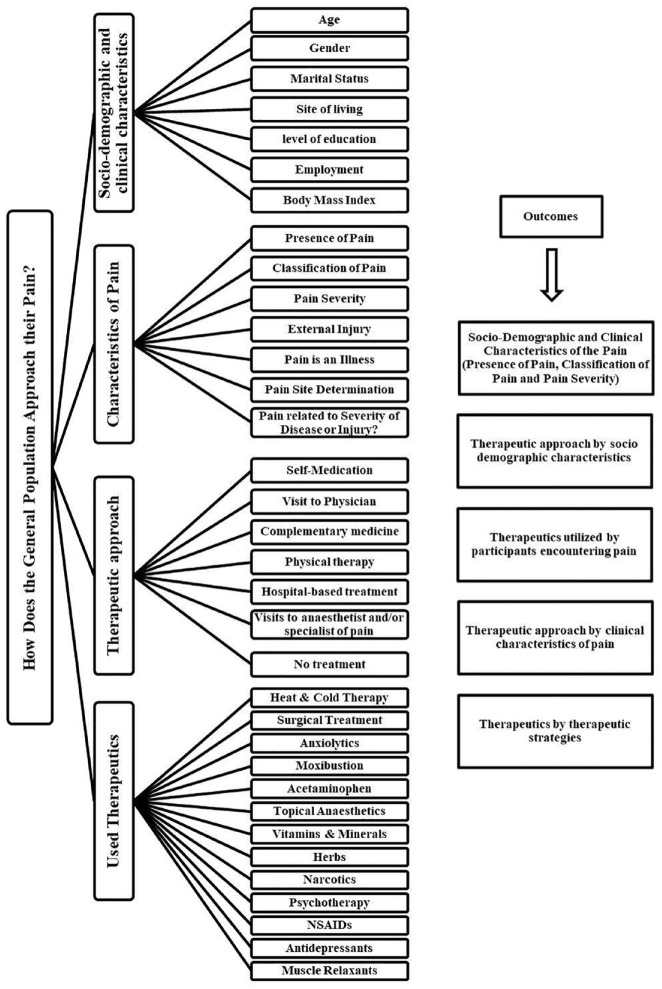
Convenience and snowball sampling methods were employed to collect data from 646 adults in Palestine. Participants' sociodemographic characteristics, pain experiences, and pain management strategies were examined. Descriptive statistics, chi-square tests, and binary logistic regression followed by multiple logistic regressions were used for data analysis.
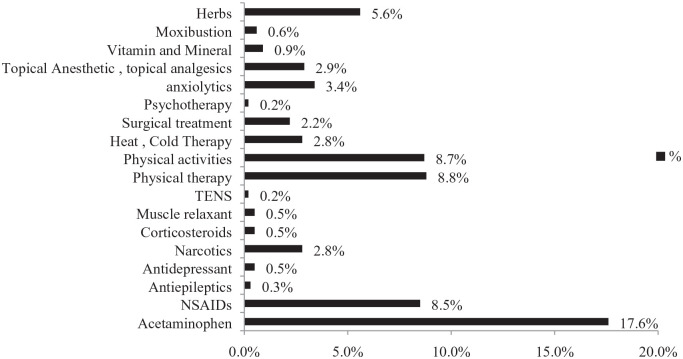
A significant portion of participants reported experiencing pain, with chronic pain being predominant. Pain prevalence varied across age groups, with higher rates in the elderly, followed by middle-aged and younger participants. Marital status and education level were linked to pain prevalence. Participants employed diverse pain management strategies, such as self-medication, physician visits, complementary medicine, and physical therapy. Age, gender, marital status, and education level influenced choices in pain management approaches. For instance, the elderly favored traditional medical interventions, while higher education levels were associated with reduced inclination toward conventional treatments.
This study underscores the complex interaction of sociodemographic factors, pain experiences, and treatment preferences in pain management. It emphasizes personalized strategies considering age, marital status, education, and gender. Integrating these aspects improves treatment and satisfaction. The findings empower healthcare providers to create precise strategies, enhancing patient experiences for better outcomes.
疼痛感知和管理在不同文化背景下存在差异;然而,对于巴勒斯坦普通人群的疼痛应对方式知之甚少。现有研究缺乏关于该地区如何应对疼痛的具体知识。
探讨巴勒斯坦普通人群的疼痛管理情况,研究其患病率、特征以及社会人口学影响因素。旨在揭示治疗选择,并了解文化对疼痛体验的影响,深入了解巴勒斯坦人的疼痛感知和应对策略。
采用便利抽样和滚雪球抽样方法,从巴勒斯坦的646名成年人中收集数据。对参与者的社会人口学特征、疼痛经历和疼痛管理策略进行了调查。数据分析采用描述性统计、卡方检验、二元逻辑回归,随后进行多元逻辑回归。
很大一部分参与者报告经历过疼痛,其中慢性疼痛占主导。疼痛患病率在不同年龄组中有所不同,老年人的患病率较高,其次是中年人和年轻人。婚姻状况和教育水平与疼痛患病率有关。参与者采用了多种疼痛管理策略,如自我用药、看医生、补充替代医学和物理治疗。年龄、性别、婚姻状况和教育水平影响了疼痛管理方法的选择。例如,老年人更喜欢传统医学干预,而较高的教育水平与对传统治疗的倾向降低有关。
本研究强调了社会人口学因素、疼痛经历和治疗偏好在疼痛管理中的复杂相互作用。它强调了考虑年龄、婚姻状况、教育和性别的个性化策略。整合这些方面可以改善治疗效果和满意度。这些发现使医疗保健提供者能够制定精确的策略,提升患者体验以获得更好的结果。