Walker Department of Mechanical Engineering, The University of Texas at Austin, Austin, TX 78712-1591.
Pathokinesiology Laboratory, Rancho Los Amigos National Rehabilitation Center, Downey, CA 90242; Rehabilitation Engineering, Rancho Los Amigos National Rehabilitation Center, Downey, CA 90242.
J Biomech Eng. 2024 Apr 1;146(4). doi: 10.1115/1.4064590.
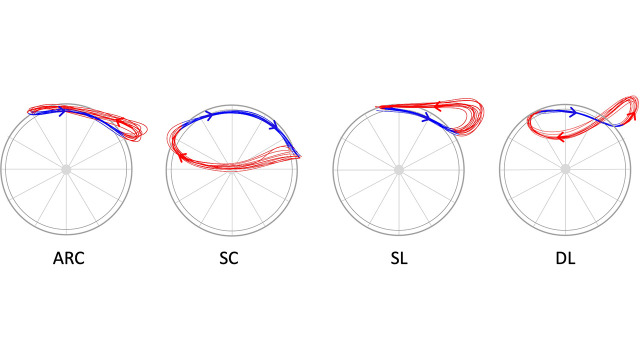
The majority of manual wheelchair users (MWCU) develop shoulder pain or injuries, which is often caused by impingement. Because propulsion mechanics are influenced by the recovery hand pattern used, the pattern may affect shoulder loading and susceptibility to injury. Shoulder muscle weakness is also correlated with shoulder pain, but how shoulder loading changes with specific muscle group weakness is unknown. Musculoskeletal modeling and simulation were used to compare glenohumeral joint contact forces (GJCFs) across hand patterns and determine how GJCFs vary when primary shoulder muscle groups are weakened. Experimental data were analyzed to classify individuals into four hand pattern groups. A representative musculoskeletal model was then developed for each group and simulations generated to portray baseline strength and six muscle weakness conditions. Three-dimensional GJCF peaks and impulses were compared across hand patterns and muscle weakness conditions. The semicircular pattern consistently had lower shear (anterior-posterior and superior-inferior) GJCFs compared to other patterns. The double-loop pattern had the highest superior GJCFs, while the single-loop pattern had the highest anterior and posterior GJCFs. These results suggest that using the semicircular pattern may be less susceptible to shoulder injuries such as subacromial impingement. Weakening the internal rotators and external rotators resulted in the greatest increases in shear GJCFs and decreases in compressive GJCF, likely due to decreased force from rotator cuff muscles. These findings suggest that strengthening specific muscle groups, especially the rotator cuff, is critical for decreasing the risk of shoulder overuse injuries.
大多数手动轮椅使用者(MWCU)会出现肩部疼痛或损伤,这通常是由于撞击引起的。由于推进力学受到使用的恢复手模式的影响,因此该模式可能会影响肩部的负荷和受伤的易感性。肩部肌肉无力也与肩部疼痛有关,但特定肌肉群无力如何改变肩部负荷尚不清楚。使用肌肉骨骼建模和模拟来比较盂肱关节接触力(GJCFs)在不同手模式下的变化,并确定主要肩部肌肉群减弱时 GJCFs 如何变化。对实验数据进行了分析,以将个体分为四个手模式组。然后为每个组开发了一个代表性的肌肉骨骼模型,并生成模拟以描绘基线强度和六种肌肉无力状况。比较了手模式和肌肉无力状况下的三维 GJCF 峰值和冲量。与其他模式相比,半圆形模式始终具有较低的剪切(前后和上下)GJCF。双环模式具有最高的上 GJCF,而单环模式具有最高的前 GJCF 和后 GJCF。这些结果表明,使用半圆形模式可能不太容易发生肩部损伤,例如肩峰下撞击。削弱内旋肌和外旋肌会导致剪切 GJCF 增加最大,压缩 GJCF 减少,这可能是由于肩袖肌肉的力量下降所致。这些发现表明,加强特定肌肉群,特别是肩袖,对于降低肩部过度使用损伤的风险至关重要。