
成瘾的经济人模型。
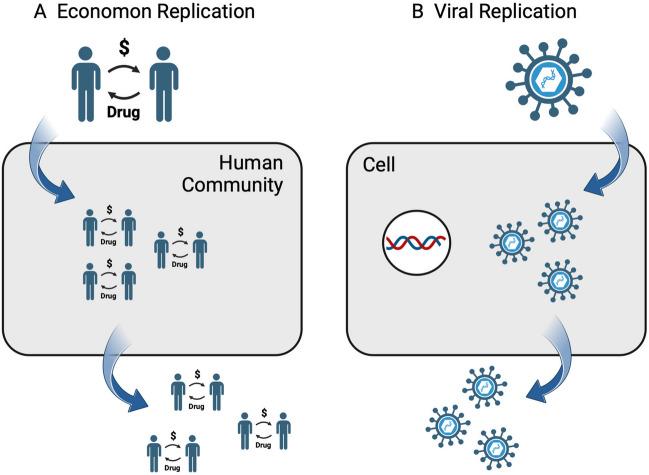
An economon model of drug addiction.
机构信息
Department of Pharmacology and Toxicology, Virginia Commonwealth University, 410 N. 12 St, Richmond, VA, 23298, USA.
出版信息
Psychopharmacology (Berl). 2024 Mar;241(3):417-425. doi: 10.1007/s00213-024-06535-7. Epub 2024 Jan 26.
The term "economon" (i:'ka.nə.muhn; plural: economa) is introduced here to describe an economic unit composed of two participants engaged in mutually reinforcing operant behavior. Economa are basic building blocks of transactional behavior that aggregate in social networks called economies. In a drug-addiction economon, operant behavior by one participant (the "supplier") provides an addictive drug as a reinforcer to the second participant (a "Person with Substance Use Disorder; PwSUD"). Reciprocal operant behavior by the PwSUD usually provides money as a reinforcer to the supplier. After defining the features of the drug-addiction economon, this article discusses its implications for (1) prevalence and virulence of drug addiction, (2) opportunities for drug-addiction research in general, (3) the "brain-disease model of addiction" in particular, and (4) factors that mitigate harm or promote risk of drug addiction. The economon model is intended to provide a novel perspective on the uniquely human disorder of drug addiction.
“经济单一体”(i:'ka.nə.muhn; 复数:economas)这一术语在此被引入,用于描述由两个参与者组成的经济单位,他们从事相互加强的操作性行为。经济单一体是交易行为的基本组成部分,它们在被称为经济的社会网络中聚合。在药物成瘾的经济单一体中,一个参与者(“供应者”)的操作性行为提供成瘾药物作为对第二个参与者(“物质使用障碍者;PwSUD”)的强化物。PwSUD 的互惠操作性行为通常提供金钱作为对供应者的强化物。本文在定义药物成瘾经济单一体的特征后,讨论了其对以下几个方面的意义:(1)药物成瘾的普遍性和严重性,(2)药物成瘾研究的机会,(3)“成瘾的大脑疾病模型”,以及(4)减轻药物成瘾危害或促进其风险的因素。经济单一体模型旨在为药物成瘾这一独特的人类障碍提供一个新的视角。



 Zotero 插件