Robert H. Lurie Comprehensive Cancer Center, Northwestern University, Chicago, IL, USA.
Dana-Farber Cancer Institute, The Lank Center for Genitourinary Oncology, Boston, MA, USA.
Oncologist. 2024 Jun 3;29(6):511-518. doi: 10.1093/oncolo/oyae003.
In CheckMate 214 (median follow-up, 25.2 months), nivolumab plus ipilimumab yielded greater overall survival (OS) benefit than sunitinib in patients with intermediate-/poor-risk advanced renal cell carcinoma (aRCC). Health-related quality of life (HRQoL) assessed by the Functional Assessment of Cancer Therapy-Kidney Symptom Index-19 (FKSI-19) was also more favorable for the nivolumab plus ipilimumab group than the sunitinib group. We investigated whether HRQoL scores can predict OS of patients with 5 years follow-up in CheckMate 214.
CheckMate 214 was an open-label, phase III trial in previously untreated aRCC (N = 1096). Patients with intermediate-/poor-risk disease (International mRCC Database Consortium prognostic score ≥ 1; n = 847) were randomized to either nivolumab plus ipilimumab or sunitinib monotherapy. Pooled data for OS and FKSI-19 total and subscales (disease-related symptoms [DRS], DRS-physical [DRS-P], and function/well-being [FWB]) were analyzed. Relationships between HRQoL and OS were assessed using Cox proportional hazard models with baseline and longitudinal scores. Associations between HRQoL changes and OS were assessed by landmark analyses.
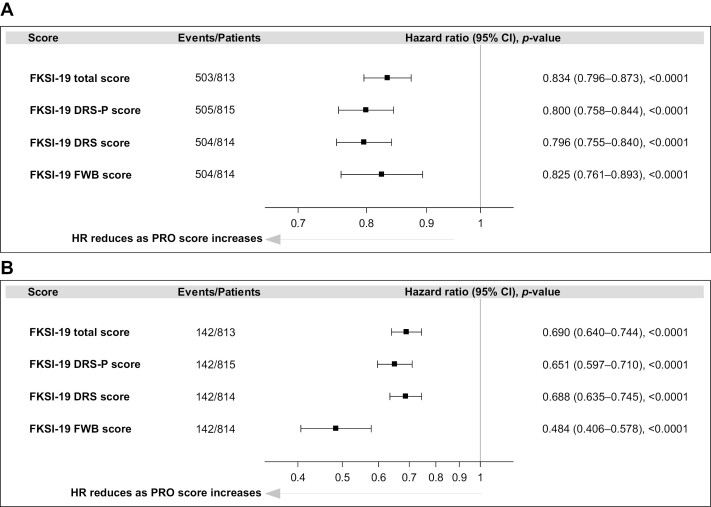
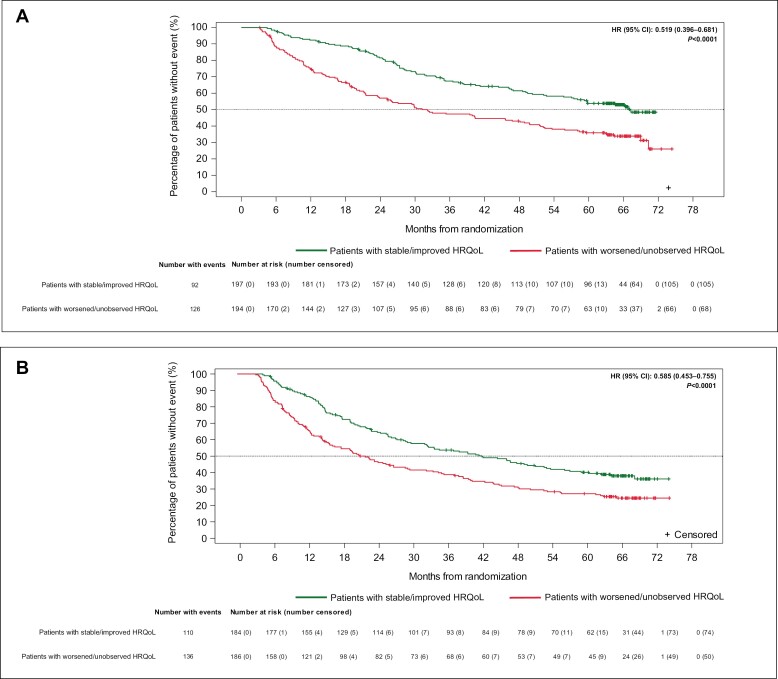
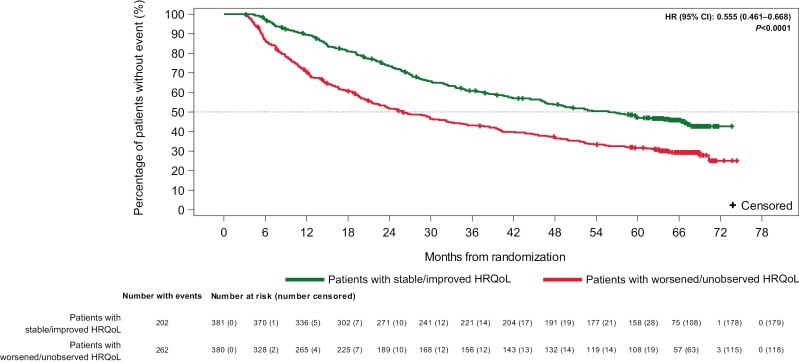
Patients with higher FKSI-19 total and subscale scores at baseline had longer OS than patients with lower scores (HR ≤ 0.834; P < .0001). Longitudinal models indicated stronger associations between HRQoL and OS (HR ≤ 0.69; P < .001 for each). At 3 months after randomization, patients with stable/improved HRQoL versus baseline had longer median OS than patients with worsened/unobserved HRQoL versus baseline (55.9 and 26.0 months, respectively; HR = 0.56; 95% CI, 0.46-0.67; P < .0001). Results at 6-, 9-, and 12-month landmarks were consistent with these findings.
In aRCC, patient-reported outcomes are important for HRQoL and prognostic evaluation.
CLINICALTRIALS.GOV IDENTIFIER: NCT02231749; https://clinicaltrials.gov/ct2/show/NCT02231749.
在 CheckMate 214 研究(中位随访时间 25.2 个月)中,纳武利尤单抗联合伊匹木单抗治疗中高危晚期肾细胞癌(aRCC)患者的总生存期(OS)获益优于舒尼替尼。纳武利尤单抗联合伊匹木单抗组的患者健康相关生活质量(HRQoL)也得到了改善,通过肾脏症状指数-19 功能性评估量表(FKSI-19)评估。我们调查了在 CheckMate 214 中接受 5 年随访的患者的 HRQoL 评分是否可以预测 OS。
CheckMate 214 是一项未经治疗的 aRCC 的开放性 III 期临床试验(N = 1096)。中高危疾病患者(国际 mRCC 数据库联盟预后评分≥1;n = 847)随机分为纳武利尤单抗联合伊匹木单抗或舒尼替尼单药治疗。对 OS 和 FKSI-19 总评分和子量表(疾病相关症状[DRS]、DRS-身体[DRS-P]和功能/健康状况[FWB])进行了汇总数据分析。使用 Cox 比例风险模型评估 HRQoL 与 OS 之间的关系,使用基线和纵向评分。通过 landmark 分析评估 HRQoL 变化与 OS 的关系。
基线时 FKSI-19 总评分和子量表评分较高的患者 OS 较长,而评分较低的患者 OS 较短(HR≤0.834;P <.0001)。纵向模型表明 HRQoL 与 OS 之间存在更强的关联(每个 HR ≤ 0.69;P <.001)。随机分组后 3 个月,与基线相比,HRQoL 稳定/改善的患者中位 OS 长于 HRQoL 恶化/未观察到的患者(分别为 55.9 和 26.0 个月;HR = 0.56;95%CI,0.46-0.67;P <.0001)。6、9 和 12 个月时的结果与这些发现一致。
在 aRCC 中,患者报告的结果对于 HRQoL 和预后评估很重要。
NCT02231749;https://clinicaltrials.gov/ct2/show/NCT02231749。