La Marca M A, Dinoto E, Rodriquenz E, Pecoraro F, Turchino D, Mirabella D
Vascular Surgery Unit - AOUP Policlinico 'P. Giaccone', Palermo, Italy.
Vascular Surgery Unit - AOUP Policlinico 'P. Giaccone', Palermo, Italy.
Int J Surg Case Rep. 2024 Feb;115:109306. doi: 10.1016/j.ijscr.2024.109306. Epub 2024 Jan 26.
Brachial artery aneurysm (BAA) following long-standing arteriovenous fistula (AVF) ligation after renal transplantation is odd.
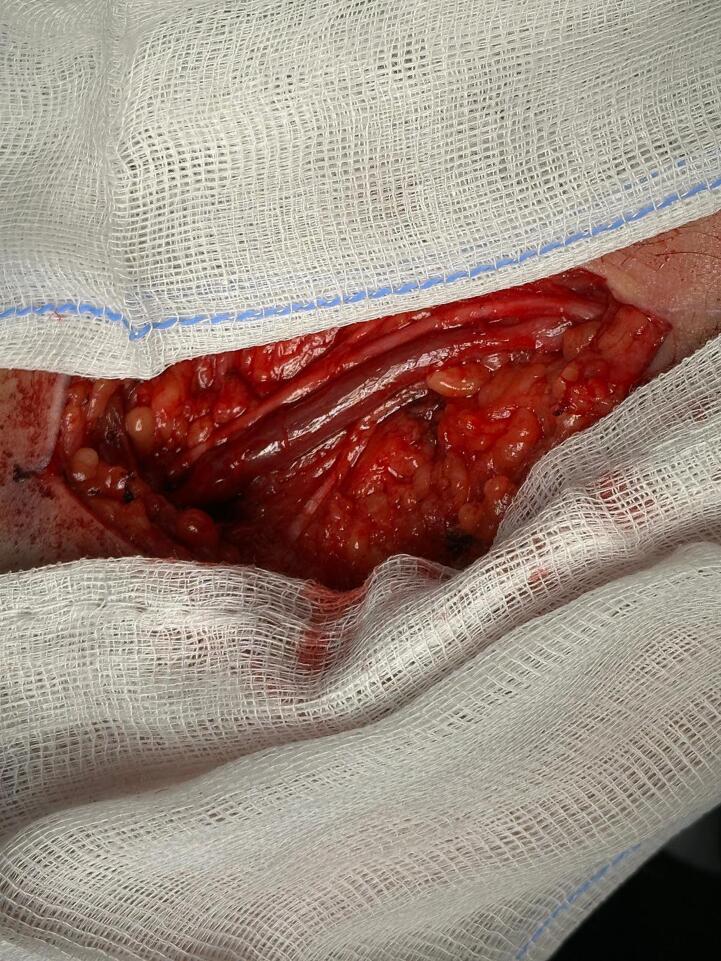
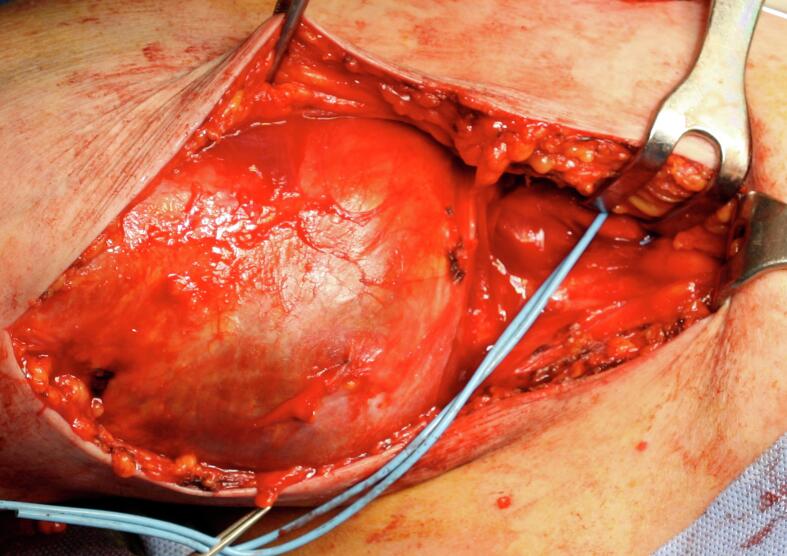
Two cases of brachial artery aneurysm treated with bypass (a saphenous vein graft and a PTFE graft). In the first patient no complications were recorded whereas an infection was diagnosed after 6 months from the procedure in the second treatment.
Multiple factors activated by stress on the vessel wall followed by fistula ligation are the cause of vascular remodeling of the three layers making up the wall with possible evolution in aneurysmatic lesions. In literature the gold standard for this lesion is the surgical approach, only one endovascular procedure is reported. The traditional surgical approach uses the autologous vein or prosthetic PTFE grafts.
Brachial artery aneurysm is a complication that affects patients undergoing renal transplantation who have already undergone AVF ligation. In our experience autologous vein graft represented the best solution.
肾移植后长期动静脉瘘(AVF)结扎后出现肱动脉瘤(BAA)较为罕见。
两例肱动脉瘤患者接受了旁路手术(分别使用大隐静脉移植物和聚四氟乙烯移植物)。第一例患者未记录到并发症,而第二例患者在手术后6个月被诊断出感染。
血管壁因压力激活多种因素,继而动静脉瘘结扎,这是构成血管壁的三层发生血管重塑的原因,可能发展为动脉瘤病变。文献中该病变的金标准是手术方法,仅报告了一例血管内手术。传统手术方法使用自体静脉或人工聚四氟乙烯移植物。
肱动脉瘤是一种影响已接受动静脉瘘结扎的肾移植患者的并发症。根据我们的经验,自体静脉移植物是最佳解决方案。