
用于检测年龄相关性黄斑变性中新生地图样萎缩的深度学习方法
Deep Learning Approaches for Detecting of Nascent Geographic Atrophy in Age-Related Macular Degeneration.
作者信息
Yao Heming, Wu Zhichao, Gao Simon S, Guymer Robyn H, Steffen Verena, Chen Hao, Hejrati Mohsen, Zhang Miao
机构信息
gRED Computational Science, Genentech, Inc., South San Francisco, California.
Centre for Eye Research Australia, Royal Victorian Eye and Ear Hospital, East Melbourne, Victoria, Australia.
出版信息
Ophthalmol Sci. 2023 Nov 17;4(3):100428. doi: 10.1016/j.xops.2023.100428. eCollection 2024 May-Jun.
PURPOSE
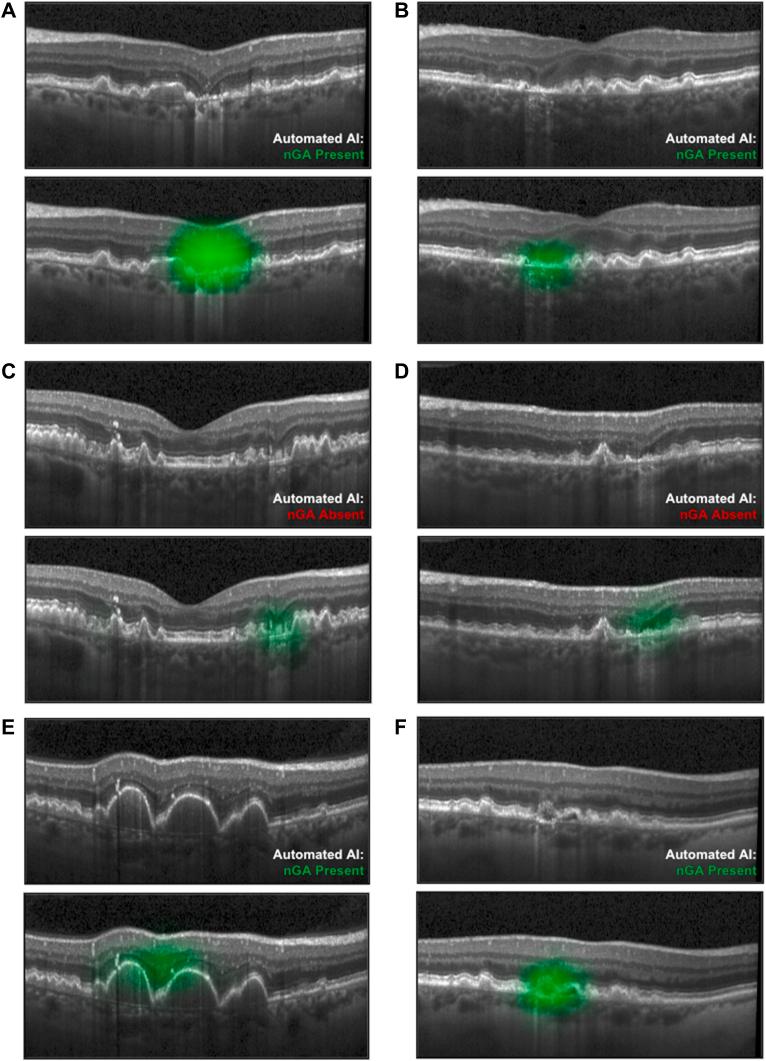
Nascent geographic atrophy (nGA) refers to specific features seen on OCT B-scans, which are strongly associated with the future development of geographic atrophy (GA). This study sought to develop a deep learning model to screen OCT B-scans for nGA that warrant further manual review (an artificial intelligence [AI]-assisted approach), and to determine the extent of reduction in OCT B-scan load requiring manual review while maintaining near-perfect nGA detection performance.
DESIGN
Development and evaluation of a deep learning model.
PARTICIPANTS
One thousand eight hundred and eighty four OCT volume scans (49 B-scans per volume) without neovascular age-related macular degeneration from 280 eyes of 140 participants with bilateral large drusen at baseline, seen at 6-monthly intervals up to a 36-month period (from which 40 eyes developed nGA).
METHODS
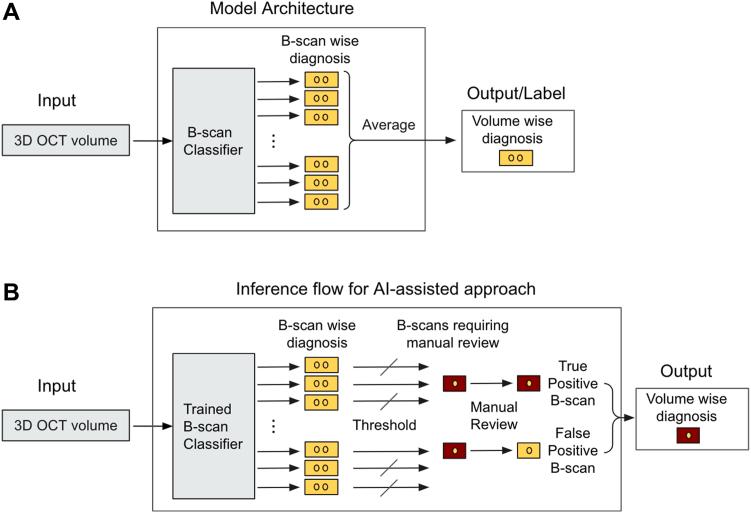
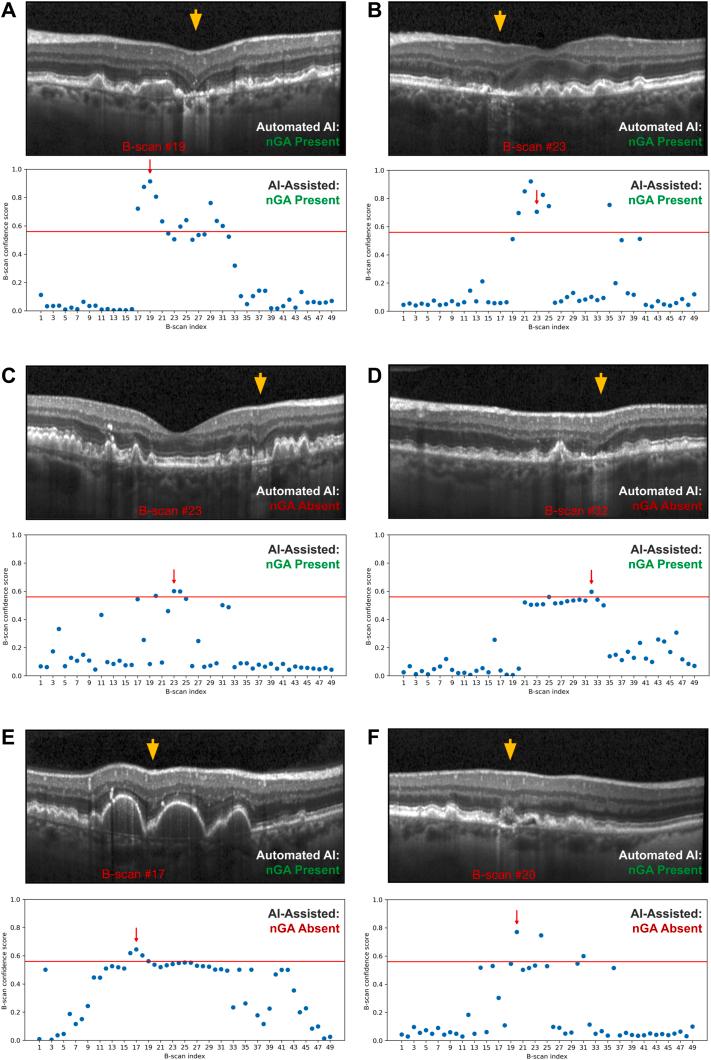
OCT volume and B-scans were labeled for the presence of nGA. Their presence at the volume scan level provided the ground truth for training a deep learning model to identify OCT B-scans that potentially showed nGA requiring manual review. Using a threshold that provided a sensitivity of 0.99, the B-scans identified were assigned the ground truth label with the AI-assisted approach. The performance of this approach for detecting nGA across all visits, or at the visit of nGA onset, was evaluated using fivefold cross-validation.
MAIN OUTCOME MEASURES
Sensitivity for detecting nGA, and proportion of OCT B-scans requiring manual review.
RESULTS
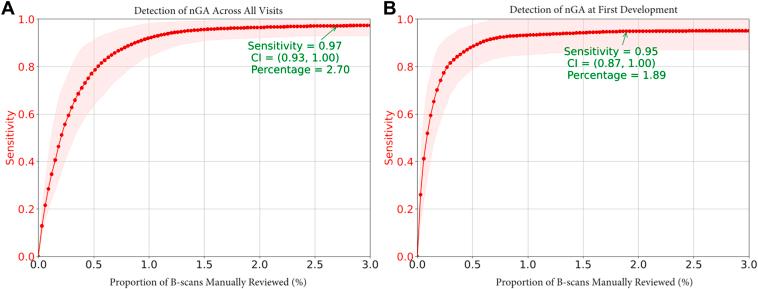
The AI-assisted approach (utilizing outputs from the deep learning model to guide manual review) had a sensitivity of 0.97 (95% confidence interval [CI] = 0.93-1.00) and 0.95 (95% CI = 0.87-1.00) for detecting nGA across all visits and at the visit of nGA onset, respectively, when requiring manual review of only 2.7% and 1.9% of selected OCT B-scans, respectively.
CONCLUSIONS
A deep learning model could be used to enable near-perfect detection of nGA onset while reducing the number of OCT B-scans requiring manual review by over 50-fold. This AI-assisted approach shows promise for substantially reducing the current burden of manual review of OCT B-scans to detect this crucial feature that portends future development of GA.
FINANCIAL DISCLOSURES
Proprietary or commercial disclosure may be found in the Footnotes and Disclosures at the end of this article.
目的
新生地理萎缩(nGA)指光学相干断层扫描(OCT)B 扫描中所见的特定特征,与地理萎缩(GA)的未来发展密切相关。本研究旨在开发一种深度学习模型,用于筛查需要进一步人工复查的 OCT B 扫描中的 nGA(一种人工智能[AI]辅助方法),并确定在保持近乎完美的 nGA 检测性能的同时,需要人工复查的 OCT B 扫描量减少的程度。
设计
深度学习模型的开发与评估。
参与者
140 名基线时有双侧大玻璃膜疣的参与者的 280 只眼睛的 1884 次 OCT 容积扫描(每次容积 49 次 B 扫描),无新生血管性年龄相关性黄斑变性,每 6 个月观察一次,为期 36 个月(其中 40 只眼睛发展为 nGA)。
方法
对 OCT 容积和 B 扫描进行 nGA 存在情况的标记。它们在容积扫描层面的存在情况为训练深度学习模型提供了真实数据,以识别可能显示需要人工复查的 nGA 的 OCT B 扫描。使用提供 0.99 灵敏度的阈值,通过 AI 辅助方法为识别出的 B 扫描分配真实标签。使用五重交叉验证评估该方法在所有就诊时或 nGA 发病就诊时检测 nGA 的性能。
主要观察指标
检测 nGA 的灵敏度以及需要人工复查的 OCT B 扫描的比例。
结果
AI 辅助方法(利用深度学习模型的输出指导人工复查)在所有就诊时检测 nGA 的灵敏度为 0.97(95%置信区间[CI]=0.93 - 1.00),在 nGA 发病就诊时检测 nGA 的灵敏度为 0.95(95%CI = 0.87 - 1.00),此时分别仅需人工复查所选 OCT B 扫描的 2.7%和 1.9%。
结论
深度学习模型可用于近乎完美地检测 nGA 发病,同时将需要人工复查的 OCT B 扫描数量减少 50 倍以上。这种 AI 辅助方法有望大幅减轻目前人工复查 OCT B 扫描以检测这一预示 GA 未来发展的关键特征的负担。
财务披露
专有或商业披露信息可在本文末尾的脚注和披露中找到。
 Zotero 插件