Fougère Bertrand, Puisieux François, Chevalet Pascal, Annweiler Cédric, Michel Emeline, Joly Laure, Blanc Frédéric, Azouzi Abdelghani El, Desré-Follet Valérie, Cacoub Patrice
Division of Geriatric Medicine, Tours University Hospital, Tours, France.
CHRU Tours - Pôle Vieillissement, Hôpital Bretonneau, 2 Boulevard Tonnelé, 37044, Tours Cedex 9, France.
BMC Geriatr. 2024 Jan 30;24(1):112. doi: 10.1186/s12877-024-04719-6.
Iron deficiency (ID) is often associated with other comorbidities in older patients and is a factor of morbimortality. However, the prevalence of ID remains poorly documented in this population.
The CARENFER PA study was a French multicenter cross-sectional study whose objective was to evaluate ID in patients (> 75 years) admitted to a geriatric unit. The primary endpoint was the ID prevalence defined as: serum ferritin < 100 µg/L and/or transferrin saturation coefficient (TSAT) < 20%. The Short Physical Performance Battery (SPPB) test was used to identify older patients at high risk of adverse events (e.g., disability, falls, hospitalization, death).
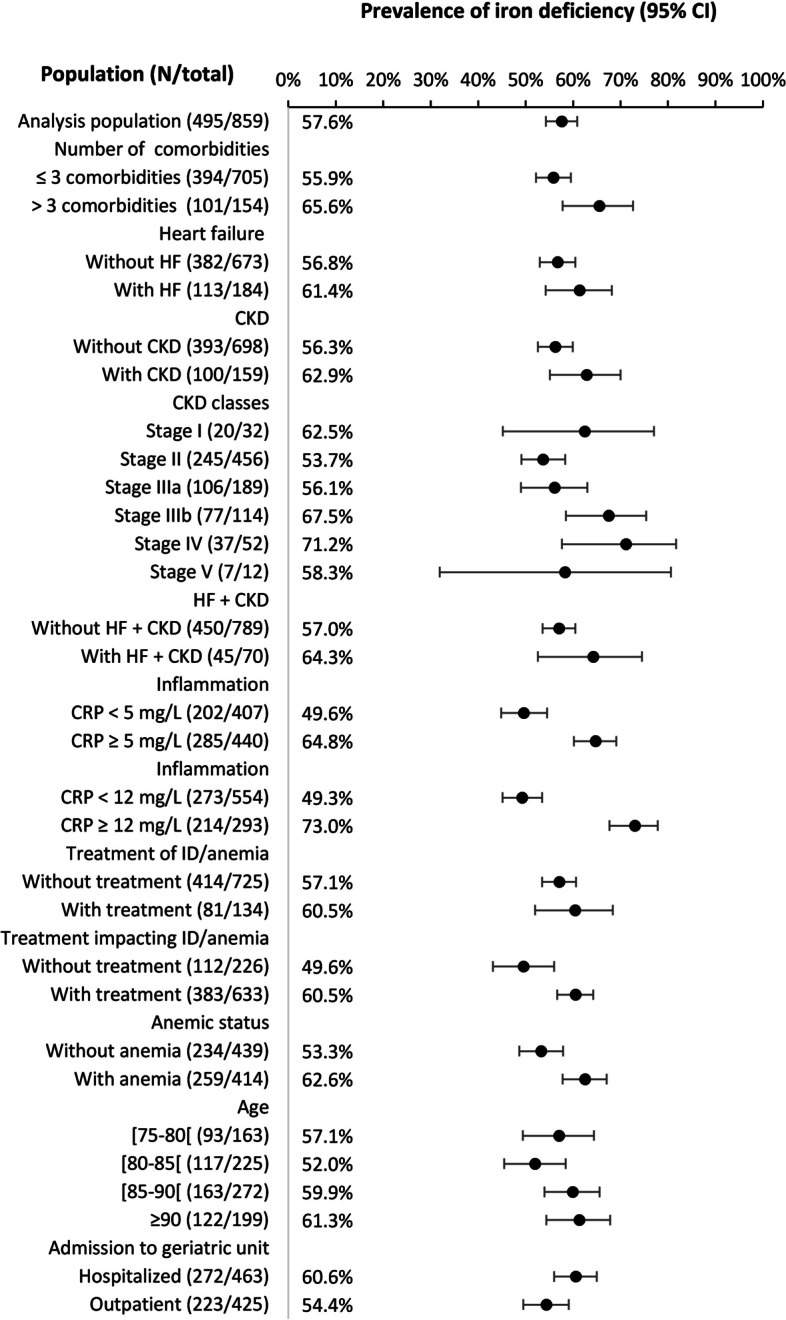
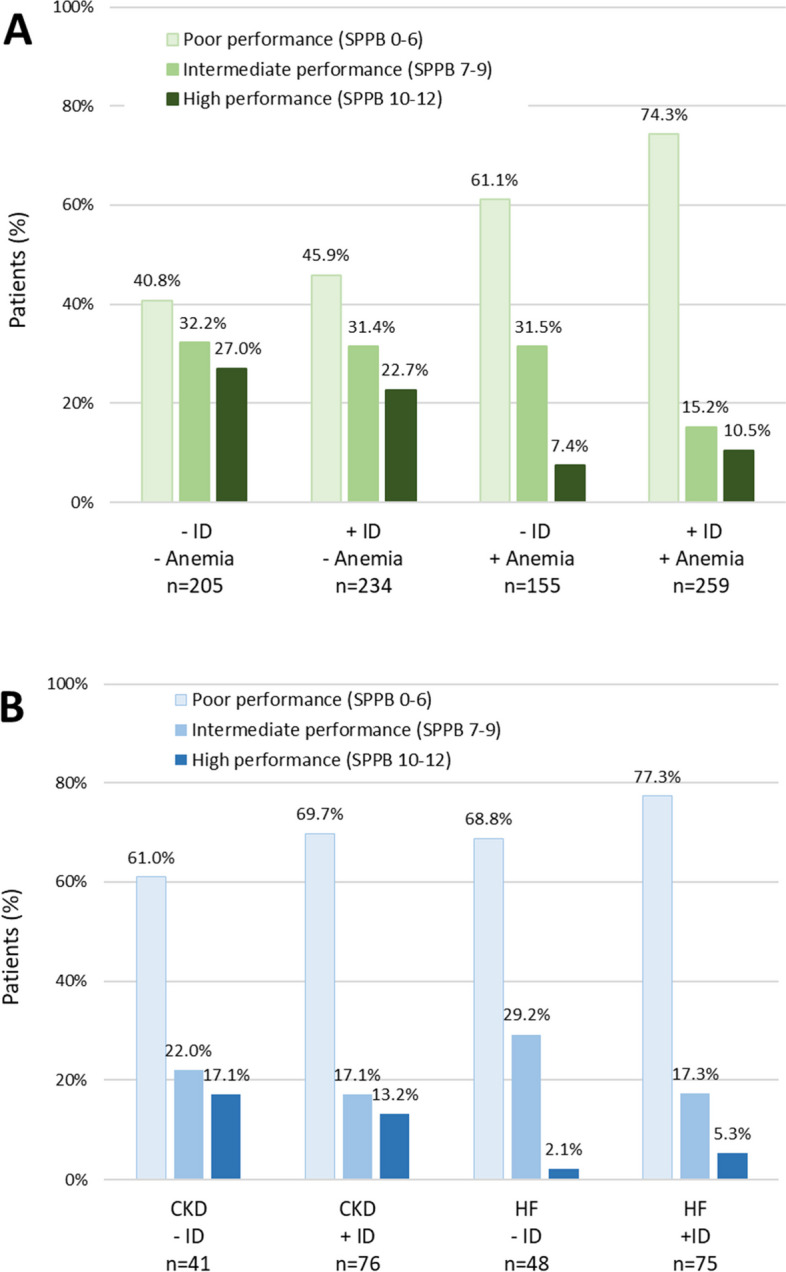
A total of 888 patients (mean age, 85.2 years; women, 63.5%) from 16 French centers were included from October 2022 to December 2022. The prevalence of ID was 57.6% (95% CI, 54.3-60.9) in the cohort of older patients (62.6% in anemic and 53.3% in non-anemic patients; p = 0.0062). ID prevalence increased significantly with the presence of more than three comorbidities (65.6% vs. 55.9%; p = 0.0274), CRP ≥ 12 mg/L (73.0% vs. 49.3%; p < 0.001) and treatment that may influence ID/anemia (60.5% vs. 49.6%; p = 0.0042). In multivariate analysis, only CRP ≥ 12 mg/L was an independent predictive factor of ID (odds ratio, 2.78; 95% CI, 1.92-4.08; p < 0.001). SPPB scores were low (0-6) in 60.5% of patients with ID versus 48.6% of patients without ID (p = 0.0076).
More than half of older patients had ID, including non-anemic patients. ID was associated with the presence of inflammation and a low SPPB score.
NCT05514951.
缺铁(ID)在老年患者中常与其他合并症相关,是一个影响发病和死亡的因素。然而,该人群中铁缺乏症的患病率仍缺乏充分记录。
CARENFER PA研究是一项法国多中心横断面研究,其目的是评估入住老年病房的患者(>75岁)的缺铁情况。主要终点是缺铁患病率,定义为:血清铁蛋白<100μg/L和/或转铁蛋白饱和度系数(TSAT)<20%。采用简短体能状况量表(SPPB)测试来识别有不良事件(如残疾、跌倒、住院、死亡)高风险的老年患者。
2022年10月至2022年12月,来自法国16个中心的888例患者(平均年龄85.2岁;女性占63.5%)被纳入研究。老年患者队列中铁缺乏症的患病率为57.6%(95%CI,54.3 - 60.9)(贫血患者中为62.6%,非贫血患者中为53.3%;p = 0.0062)。随着合并症超过三种(65.6%对55.9%;p = 0.0274)、CRP≥12mg/L(73.0%对49.3%;p < 0.001)以及可能影响缺铁/贫血的治疗(60.5%对49.6%;p = 0.0042),缺铁患病率显著增加。在多变量分析中,只有CRP≥12mg/L是缺铁的独立预测因素(比值比,2.78;95%CI,1.92 - 4.08;p < 0.001)。60.5%的缺铁患者SPPB评分较低(0 - 6),而无缺铁患者中这一比例为48.6%(p = 0.0076)。
超过一半的老年患者存在缺铁,包括非贫血患者。缺铁与炎症的存在以及较低的SPPB评分相关。
NCT05514951。