Department of Physical Activity and Health, Swedish School of Sport and Health Sciences GIH, Stockholm, Sweden
Department of Physical Activity and Health, Swedish School of Sport and Health Sciences GIH, Stockholm, Sweden.
Br J Sports Med. 2024 Mar 21;58(7):366-372. doi: 10.1136/bjsports-2023-107007.
To examine the associations between changes in cardiorespiratory fitness (CRF) in adulthood and prostate cancer incidence and mortality.
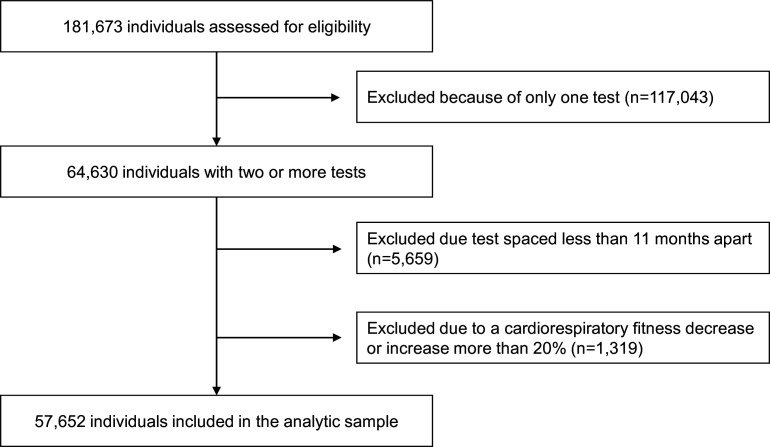
In this prospective study, men who completed an occupational health profile assessment including at least two valid submaximal CRF tests, performed on a cycle ergometer, were included in the study. Data on prostate cancer incidence and mortality were derived from national registers. HRs and CIs were calculated using Cox proportional hazard regression with inverse probability treatment weights of time-varying covariates.
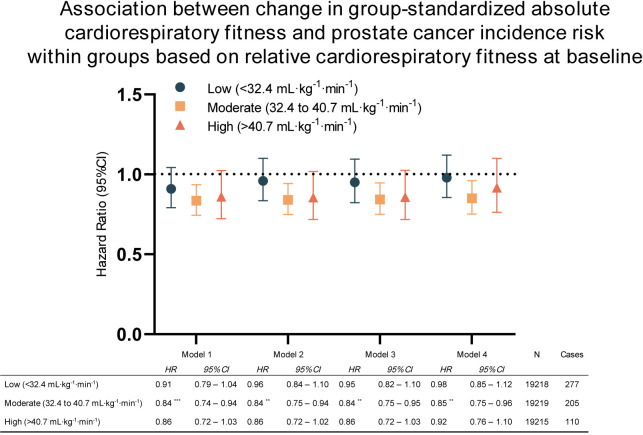
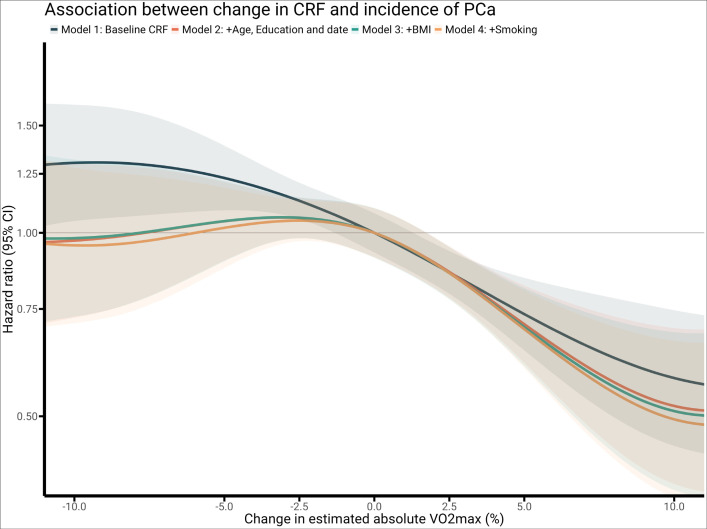
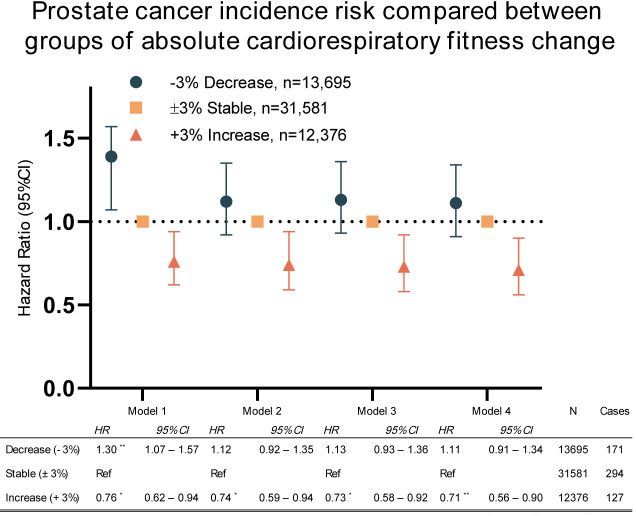
During a mean follow-up time of 6.7 years (SD 4.9), 592 (1%) of the 57 652 men were diagnosed with prostate cancer, and 46 (0.08%) died with prostate cancer as the primary cause of death. An increase in absolute CRF (as % of L/min) was associated with a reduced risk of prostate cancer incidence (HR 0.98, 95% CI 0.96 to 0.99) but not mortality, in the fully adjusted model. When participants were grouped as having increased (+3%), stable (±3%) or decreased (-3%) CRF, those with increased fitness also had a reduced risk of prostate cancer incidence compared with those with decreased fitness (HR 0.65, 95% CI 0.49 to 0.86), in the fully adjusted model.
In this study of employed Swedish men, change in CRF was inversely associated with risk of prostate cancer incidence, but not mortality. Change in CRF appears to be important for reducing the risk of prostate cancer.
探讨成年人心肺适能(CRF)变化与前列腺癌发病和死亡的关系。
在这项前瞻性研究中,纳入了完成包括至少两次有效次最大 CRF 测试的职业健康评估的男性,这些测试是在功率自行车上进行的。前列腺癌发病和死亡的数据来自国家登记处。使用 Cox 比例风险回归和时变协变量的逆概率治疗权重计算 HR 和 95%CI。
在平均 6.7 年(SD 4.9)的随访期间,57652 名男性中有 592 名(1%)被诊断为前列腺癌,46 名(0.08%)死于前列腺癌,是主要死因。绝对 CRF(以 L/min 计)的增加与前列腺癌发病风险的降低相关(HR 0.98,95%CI 0.96 至 0.99),但与死亡率无关,在完全调整的模型中。当参与者被分为 CRF 增加(+3%)、稳定(±3%)或降低(-3%)时,与 CRF 降低的参与者相比,CRF 增加的参与者也具有较低的前列腺癌发病风险(HR 0.65,95%CI 0.49 至 0.86),在完全调整的模型中。
在这项对瑞典就业男性的研究中,CRF 的变化与前列腺癌发病风险呈负相关,但与死亡率无关。CRF 的变化似乎对降低前列腺癌的风险很重要。