Istituto Nazionale Tumori di Napoli, IRCCS "G. Pascale", 80131, Naples, Italy.
Division of Medical Oncology, Department of Precision Medicine, University of Campania Luigi Vanvitelli, 80138, Naples, Italy.
J Transl Med. 2024 Jan 30;22(1):119. doi: 10.1186/s12967-024-04889-2.
Vitamin D (VD) is implicated in various health conditions, including colorectal cancer (CRC). To investigate potential relationships between pre-chemotherapy VD levels and the time-to-outcome in metastatic CRC patients, we conducted a systematic review and meta-analysis.
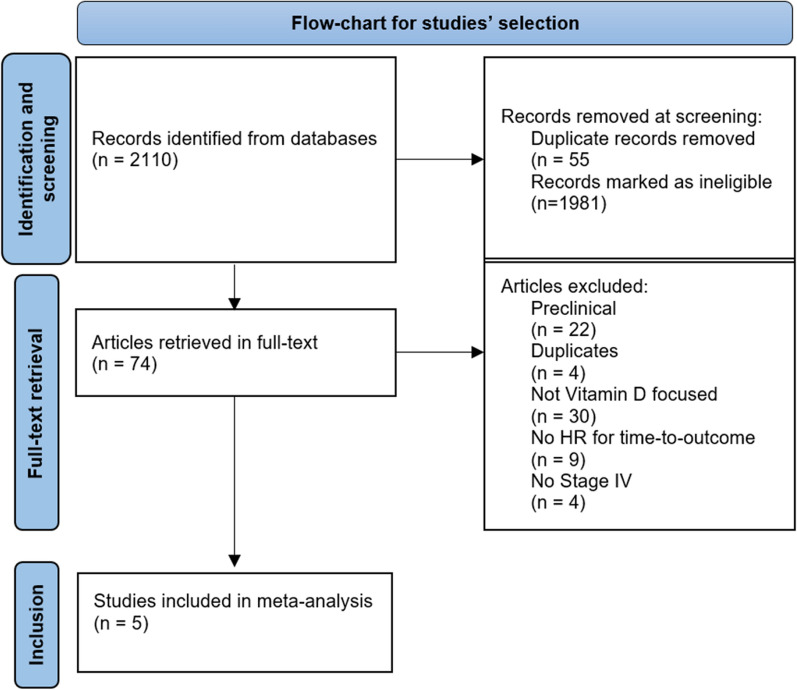
Following the PRISMA 2020 guidelines, we performed thorough searches in PubMed/MEDLINE and Scopus/ELSEVIER databases (covering the years 2002 to 2022). Inclusion criteria mandated studies to report on individuals aged 18 years and above with histologically confirmed stage IV CRC. Additionally, studies needed to provide data on VD levels before chemotherapy, along with hazard ratios (HR) and 95% confidence intervals (CIs) for overall survival (OS) and/or progression-free survival (PFS). Five articles were identified with the aim of establishing a combined risk estimate for death and progression based on pre-chemotherapy VD levels. Heterogeneity among studies and publication bias were evaluated using Tau, I statistics, and a Funnel plot.
Although no significant heterogeneity was observed in time-to-outcome among the selected studies, variations in technical assessments and serum VD concentration measurements were noted. The pooled analysis, involving 1712 patients for OS and 1264 patients for PFS, revealed a 47% increased risk of death (HR: 1.47, 95% CI: 1.21-1.79) and a 38% increased risk of progression (HR: 1.38, 95% CI: 1.13-1.70) for patients with lower VD levels, as indicated by fixed-effects models.
Our results emphasize the adverse effects of low VD concentration on the time-to-outcome in metastatic CRC patients. This underscores the importance of investigating VD supplementation as an innovative approach in this clinical setting to enhance patient outcomes.
维生素 D(VD)与多种健康状况有关,包括结直肠癌(CRC)。为了研究转移性 CRC 患者化疗前 VD 水平与结局时间之间的潜在关系,我们进行了系统评价和荟萃分析。
根据 PRISMA 2020 指南,我们在 PubMed/MEDLINE 和 Scopus/ELSEVIER 数据库中进行了全面检索(涵盖 2002 年至 2022 年)。纳入标准要求研究报告年龄在 18 岁及以上、组织学证实为 IV 期 CRC 的个体。此外,研究还需要提供化疗前 VD 水平的数据,以及总生存(OS)和/或无进展生存(PFS)的危险比(HR)和 95%置信区间(CI)。确定了 5 篇文章,旨在根据化疗前 VD 水平建立死亡和进展的综合风险估计。使用 Tau、I 统计量和漏斗图评估研究之间的异质性和发表偏倚。
尽管所选研究在结局时间上没有观察到显著的异质性,但在技术评估和血清 VD 浓度测量方面存在差异。涉及 OS 的 1712 例患者和 PFS 的 1264 例患者的汇总分析显示,VD 水平较低的患者死亡风险增加 47%(HR:1.47,95%CI:1.21-1.79),进展风险增加 38%(HR:1.38,95%CI:1.13-1.70),这表明采用固定效应模型。
我们的结果强调了低 VD 浓度对转移性 CRC 患者结局时间的不利影响。这凸显了在这种临床环境中研究 VD 补充作为一种创新方法以提高患者结局的重要性。