Xu Xin, Fang Yuan, Nowsheen Somaira, Li Ye-Xiong, Lou Zhenkun, Deng Min
State Key Laboratory of Molecular Oncology and Department of Radiation Oncology, National Cancer Center/National Clinical Research Center for Cancer/Cancer Hospital, Chinese Academy of Medical Sciences and Peking Union Medical College, Beijing 100021, China.
Department of General Surgery, Shanghai General Hospital, Shanghai Jiaotong University School of Medicine, Shanghai 200080, China.
Genes Dis. 2023 Jul 14;11(3):101035. doi: 10.1016/j.gendis.2023.05.022. eCollection 2024 May.
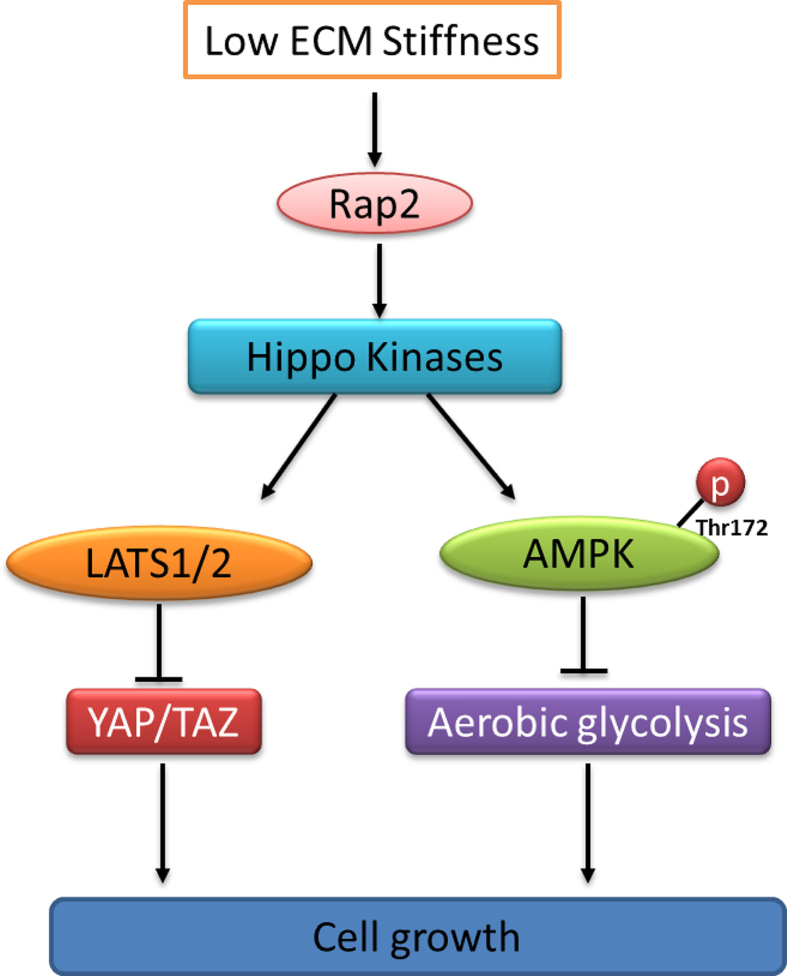
The adenosine monophosphate (AMP)-activated protein kinase (AMPK) sits at a central node in the regulation of energy metabolism and tumor progression. AMPK is best known to sense high cellular ADP or AMP levels, which indicate the depletion of energy stores. Previous studies have shown that the low expression of phosphorylated AMPK is associated with a poor prognosis of pancreatic cancer. In this study, we report that AMPK is also highly sensitive to extracellular matrix (ECM) stiffness. We found that AMPK is activated in cells when cultured under low ECM stiffness conditions and is functionally required for the metabolic switch induced by ECM stiffness. This regulation of AMPK requires the Hippo kinases but not LKB1/CaMKKβ. Hippo kinases directly phosphorylate AMPKα at Thr172 to activate AMPK at low ECM stiffness. Furthermore, we found AMPK activity is inhibited in patients with pancreatic ductal adenocarcinoma (PDAC) with high ECM stiffness and is associated with a poor survival outcome. The activation of Hippo kinases by ROCK inhibitor Y-27632 in combination with the mitochondrial inhibitor metformin synergistically activates AMPK and dramatically inhibits PDAC growth. Together, these findings establish a novel model for AMPK regulation by the mechanical properties of ECMs and provide a rationale for simultaneously targeting the ECM stiffness-Hippo kinases-AMPK signaling and low glucose-LKB1-AMPK signaling pathways as an effective therapeutic strategy against PDAC.
腺苷单磷酸(AMP)激活的蛋白激酶(AMPK)处于能量代谢和肿瘤进展调节的中心节点。AMPK最广为人知的是能感知细胞内高ADP或AMP水平,这表明能量储备的消耗。先前的研究表明,磷酸化AMPK的低表达与胰腺癌的不良预后相关。在本研究中,我们报告AMPK对细胞外基质(ECM)硬度也高度敏感。我们发现,当在低ECM硬度条件下培养时,AMPK在细胞中被激活,并且是ECM硬度诱导的代谢转换所必需的功能蛋白。AMPK的这种调节需要Hippo激酶而不是LKB1/CaMKKβ。Hippo激酶在低ECM硬度下直接将AMPKα的苏氨酸172位点磷酸化以激活AMPK。此外,我们发现,在具有高ECM硬度的胰腺导管腺癌(PDAC)患者中,AMPK活性受到抑制,并且与不良生存结果相关。通过ROCK抑制剂Y-27632激活Hippo激酶并联合线粒体抑制剂二甲双胍可协同激活AMPK并显著抑制PDAC生长。总之,这些发现建立了一种由ECM机械特性调节AMPK的新模型,并为同时靶向ECM硬度-Hippo激酶-AMPK信号通路和低葡萄糖-LKB1-AMPK信号通路作为对抗PDAC的有效治疗策略提供了理论依据。