Max Planck Institute for Terrestrial Microbiology, Karl-von-Frisch-Str. 10, 35043 Marburg, Germany.
Center for Synthetic Microbiology, Philipps-University Marburg, Karl-von-Frisch-Str. 14, 35032 Marburg, Germany.
ACS Synth Biol. 2024 Feb 16;13(2):457-465. doi: 10.1021/acssynbio.3c00522. Epub 2024 Jan 31.
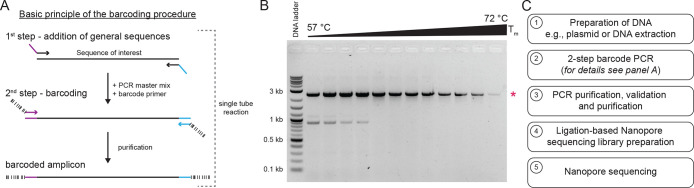
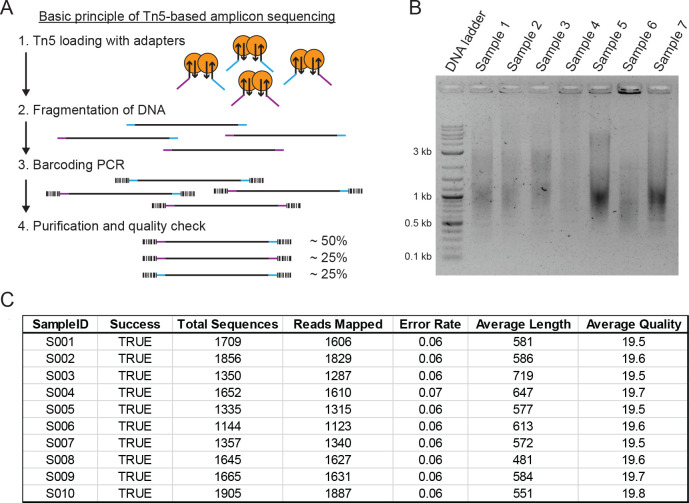
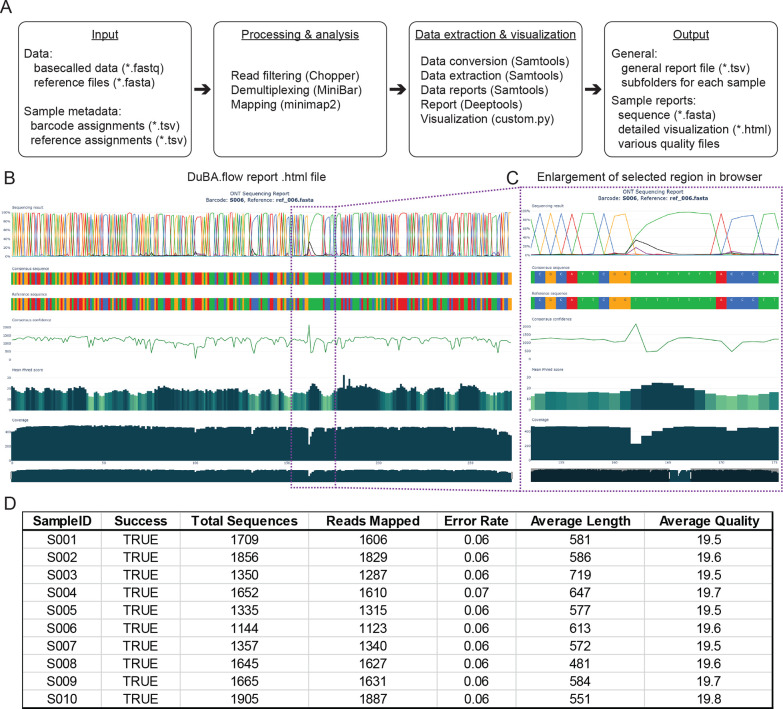
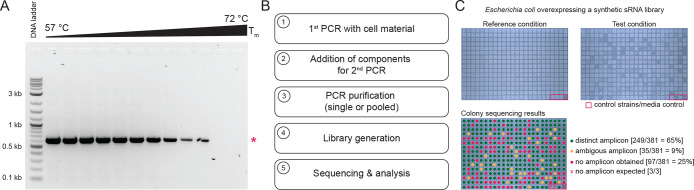
Modern biological science, especially synthetic biology, relies heavily on the construction of DNA elements, often in the form of plasmids. Plasmids are used for a variety of applications, including the expression of proteins for subsequent purification, the expression of heterologous pathways for the production of valuable compounds, and the study of biological functions and mechanisms. For all applications, a critical step after the construction of a plasmid is its sequence validation. The traditional method for sequence determination is Sanger sequencing, which is limited to approximately 1000 bp per reaction. Here, we present a highly scalable in-house method for rapid validation of amplified DNA sequences using long-read Nanopore sequencing. We developed two-step amplicon and transposase strategies to provide maximum flexibility for dual barcode sequencing. We also provide an automated analysis pipeline to quickly and reliably analyze sequencing results and provide easy-to-interpret results for each sample. The user-friendly DuBA.flow start-to-finish pipeline is widely applicable. Furthermore, we show that construct validation using DuBA.flow can be performed by barcoded colony PCR amplicon sequencing, thus accelerating research.
现代生物学,特别是合成生物学,严重依赖于 DNA 元件的构建,这些元件通常以质粒的形式存在。质粒有多种用途,包括表达蛋白质进行后续纯化,表达异源途径生产有价值的化合物,以及研究生物功能和机制。对于所有应用,质粒构建后的关键步骤是其序列验证。传统的序列测定方法是 Sanger 测序,每次反应的长度限制在 1000bp 左右。在这里,我们提出了一种使用长读长纳米孔测序快速验证扩增 DNA 序列的高度可扩展的内部方法。我们开发了两步扩增子和转座酶策略,为双条形码测序提供最大的灵活性。我们还提供了一个自动化分析管道,用于快速可靠地分析测序结果,并为每个样本提供易于解释的结果。用户友好的 DuBA.flow 从开始到结束的管道具有广泛的适用性。此外,我们表明,使用 DuBA.flow 进行的构建验证可以通过带有条形码的菌落 PCR 扩增子测序来完成,从而加速了研究。