Department of Cardiology, University Medical Center Groningen, University of Groningen, Groningen, the Netherlands.
Department of Oncology, University Medical Center Groningen, University of Groningen, Groningen, the Netherlands.
Redox Biol. 2024 Apr;70:103046. doi: 10.1016/j.redox.2024.103046. Epub 2024 Jan 26.
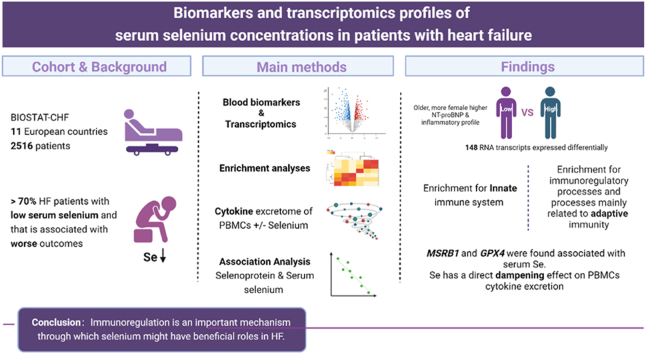
Low selenium concentrations are associated with worse outcomes in heart failure (HF). However, the underlying pathophysiologic mechanisms remain incompletely understood. Therefore, we aimed to contrast serum selenium concentrations to blood biomarker and transcriptomic profiles in patients with HF.
Circulating biomarkers, whole blood transcriptomics and serum selenium measurements in a cohort of 2328 patients with HF were utilized. Penalized linear regression and gene expression analysis were used to assess biomarker and transcriptomics profiles, respectively. As a proof-of-principle, potential causal effects of selenium on excreted cytokines concentrations were investigated using human peripheral blood mononuclear cells (PBMCs).
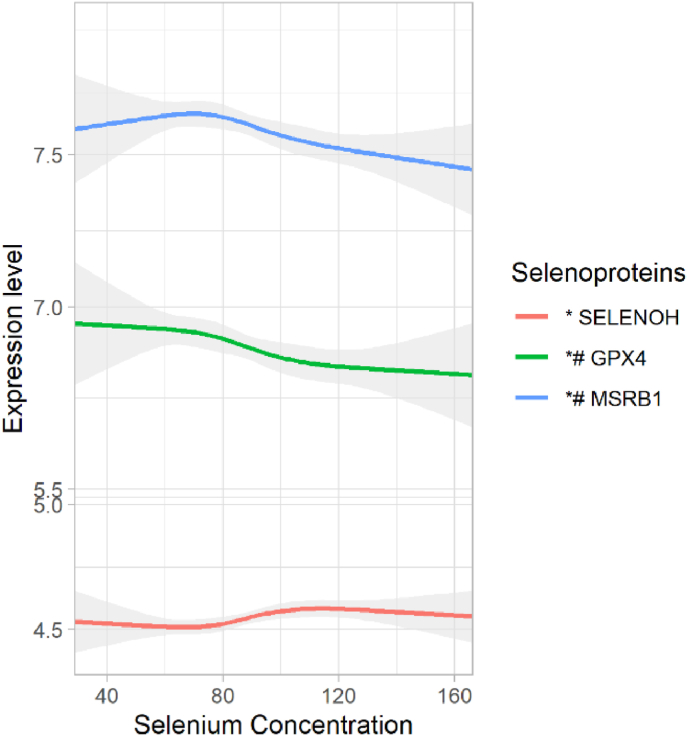
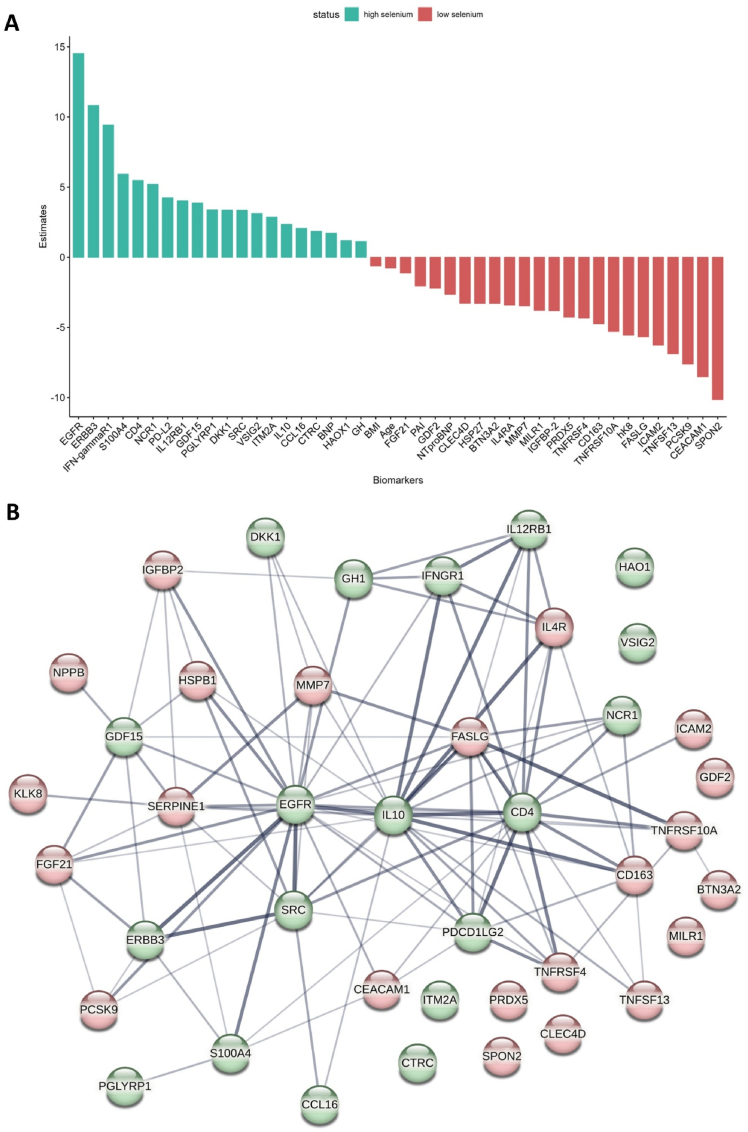
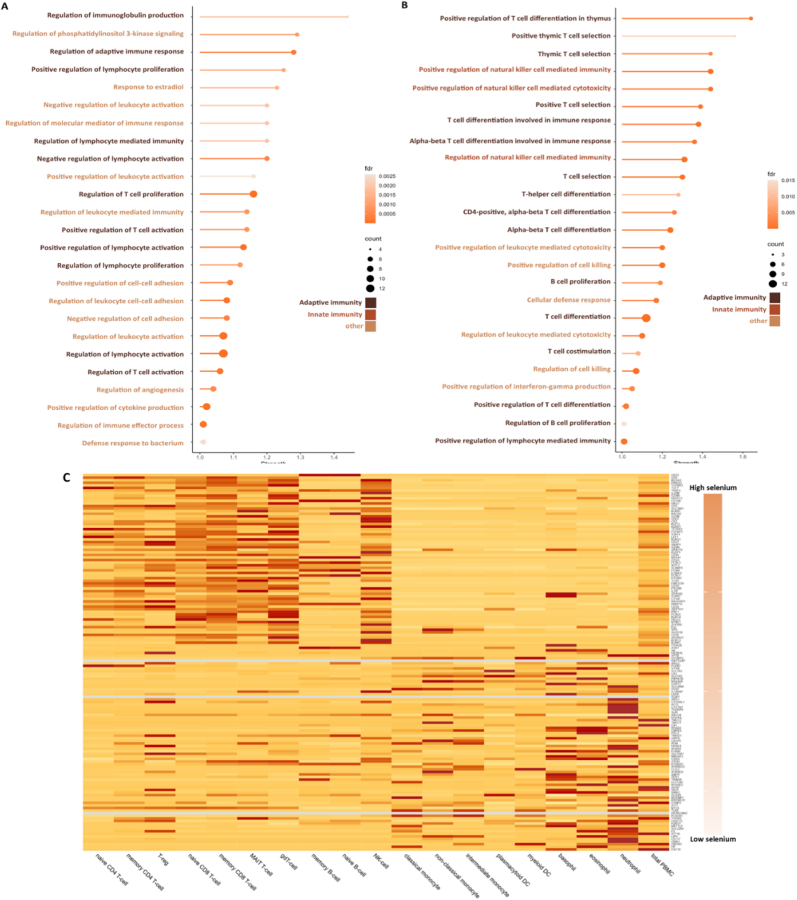
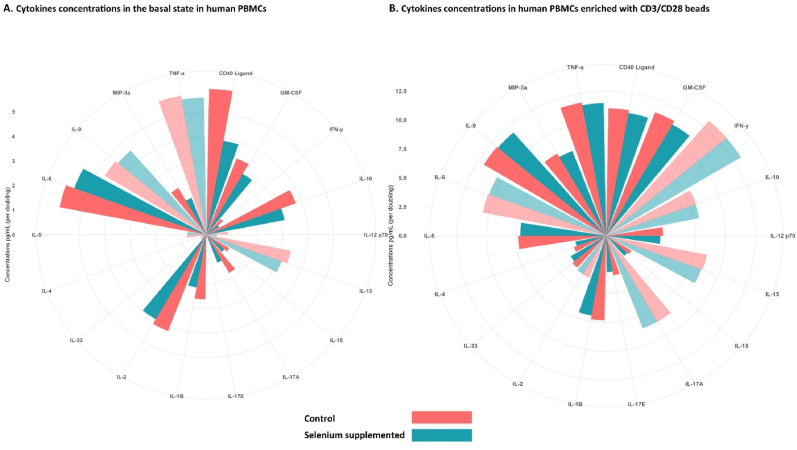
Mean selenium levels were 60.6 μg/L in Q1 and 122.0 μg/L in Q4. From 356 biomarkers and 20 clinical features, the penalized linear regression model yielded 44 variables with <5 % marginal false discovery rate as predictors of serum selenium. Biomarkers associated positively with selenium concentrations included: epidermal growth factor receptor (EGFR), IFN-gamma-R1, CD4, GDF15, and IL10. Biomarkers associated negatively with selenium concentrations included: PCSK9, TNFSF13, FGF21 and PAI. Additionally, 148 RNA transcripts were found differentially expressed between high and low selenium status (P<0.05; log-fold-change<|0.25|). Enrichment analyses of the selected biomarkers and RNA transcripts identified similar enriched processes, including regulation processes of leukocyte differentiation and activation, as well as cytokines production. The mRNA expression of two selenoproteins (MSRB1 and GPX4) were strongly correlated with serum selenium, while GPX4, SELENOK, and SELENOS were associated with prognosis. In the in-vitro setting, PBMCs supplemented with selenium showed significantly lower abundance of several (pro-)inflammatory cytokines.
These data suggest that immunoregulation is an important mechanism through which selenium might have beneficial roles in HF. The beneficial effects of higher serum selenium concentrations are likely because of global immunomodulatory effects on the abundance of cytokines. MSRB1 and GPX4 are potential modulators of and should be pursued in future research.
低硒浓度与心力衰竭(HF)的预后不良有关。然而,其潜在的病理生理机制仍不完全清楚。因此,我们旨在对比 HF 患者的血清硒浓度与血液生物标志物和转录组谱。
利用 2328 例 HF 患者的循环生物标志物、全血转录组学和血清硒测量值。分别使用惩罚线性回归和基因表达分析来评估生物标志物和转录组谱。作为原理验证,使用人外周血单核细胞(PBMCs)研究硒对细胞因子排泄浓度的潜在因果作用。
Q1 的平均硒水平为 60.6μg/L,Q4 为 122.0μg/L。从 356 种生物标志物和 20 种临床特征中,惩罚线性回归模型产生了 44 个变量,这些变量的边缘错误发现率<5%,可作为血清硒的预测因子。与硒浓度呈正相关的生物标志物包括:表皮生长因子受体(EGFR)、IFN-γ-R1、CD4、GDF15 和 IL10。与硒浓度呈负相关的生物标志物包括:PCSK9、TNFSF13、FGF21 和 PAI。此外,高硒和低硒状态之间发现了 148 个 RNA 转录本差异表达(P<0.05;log-fold-change<|0.25|)。对所选生物标志物和 RNA 转录本的富集分析确定了相似的富集过程,包括白细胞分化和激活的调节过程,以及细胞因子的产生。两种硒蛋白(MSRB1 和 GPX4)的 mRNA 表达与血清硒呈强相关,而 GPX4、SELENOK 和 SELENOS 与预后相关。在体外环境中,用硒补充的 PBMCs 显示出几种(前)炎症细胞因子的丰度显著降低。
这些数据表明,免疫调节是硒可能在 HF 中发挥有益作用的重要机制。较高的血清硒浓度的有益效果可能是由于对细胞因子丰度的整体免疫调节作用。MSRB1 和 GPX4 是潜在的调节剂,应在未来的研究中进一步研究。