Wang Yan, Wu Yilong, Chen Taixia, Wu Xiaoyun, Yuan Wenjuan, Zhu Qiangqiang, Wang Xuanjun, Zi Chengting
Key Laboratory of Pu-erh Tea Science, Ministry of Education, College of Food Science and Technology, Yunnan Agricultural University, Kunming 650201, China.
Research Center for Agricultural Chemistry, College of Science, Yunnan Agricultural University, Kunming 650201, China.
Molecules. 2025 Jan 21;30(3):437. doi: 10.3390/molecules30030437.
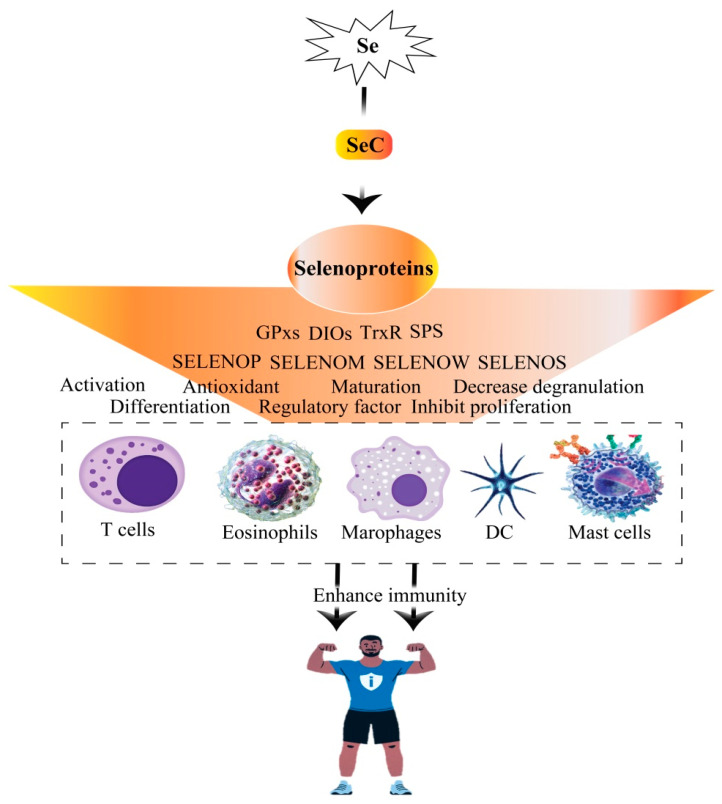
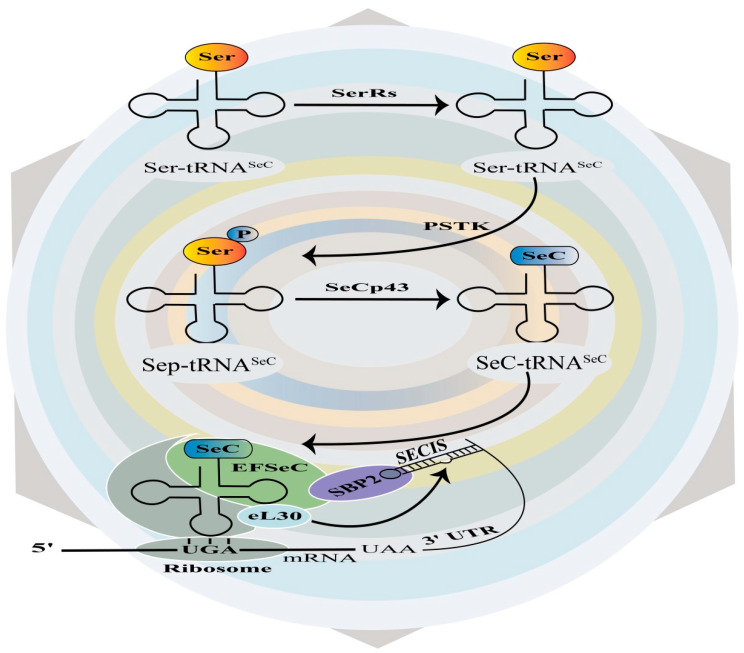
Selenium (Se) is an essential trace element crucial for human health that primarily functions as an immunonutrient. It is incorporated into polypeptides such as selenocysteine (SeC) and selenomethionine (SeMet), two key amino acids involved in various biochemical processes. All living organisms can convert inorganic Se into biologically active organic forms, with SeMet being the predominant form and a precursor for SeC production in humans and animals. The human genome encodes 25 selenoprotein genes, which incorporate low-molecular-weight Se compounds in the form of SeC. Organic Se, especially in the form of selenoproteins, is more efficiently absorbed than inorganic Se, driving the demand for selenoprotein-based health products, such as functional foods. Se-enriched functional foods offer a practical means of delivering bioavailable Se and are associated with enhanced antioxidant properties and various health benefits. Recent advancements in selenoprotein synthesis have improved our understanding of their roles in antioxidant defense, cancer prevention, immune regulation, anti-inflammation, hypoglycemia, cardiovascular health, Alzheimer's disease, fertility, and COVID-19. This review highlights key selenoproteins and their biological functions, biosynthetic pathways, and emerging applications while highlighting the need for further research.
硒(Se)是一种对人体健康至关重要的必需微量元素,主要作为免疫营养素发挥作用。它被整合到多肽中,如硒代半胱氨酸(SeC)和硒代蛋氨酸(SeMet),这两种关键氨基酸参与各种生化过程。所有生物都能将无机硒转化为具有生物活性的有机形式,SeMet是人类和动物中主要的形式,也是SeC产生的前体。人类基因组编码25个硒蛋白基因,这些基因以SeC的形式整合低分子量的硒化合物。有机硒,尤其是硒蛋白形式的有机硒,比无机硒更易被吸收,这推动了对基于硒蛋白的健康产品(如功能性食品)的需求。富硒功能性食品提供了一种输送生物可利用硒的实用方法,并具有增强的抗氧化性能和各种健康益处。硒蛋白合成方面的最新进展提高了我们对其在抗氧化防御、癌症预防、免疫调节、抗炎、降血糖、心血管健康、阿尔茨海默病、生育以及新冠病毒疾病方面作用的理解。本综述重点介绍了关键的硒蛋白及其生物学功能、生物合成途径和新兴应用,同时强调了进一步研究的必要性。