
基于移动应用的谵妄临床决策支持系统的开发和可用性测试:随机交叉试验。
Development and Usability Testing of a Mobile App-Based Clinical Decision Support System for Delirium: Randomized Crossover Trial.
机构信息
School of Nursing, Beijing University of Chinese Medicine, Beijing, China.
School of Nursing, Capital Medical University, Beijing, China.
出版信息
JMIR Aging. 2024 Jan 24;7:e51264. doi: 10.2196/51264.
BACKGROUND
The 3-Minute Diagnostic Interview for Confusion Assessment Method-Defined Delirium (3D-CAM) is an instrument specially developed for the assessment of delirium in general wards, with high reported sensitivity and specificity. However, the use of the 3D-CAM by bedside nurses in routine practice showed relatively poor usability, with multiple human errors during assessment.
OBJECTIVE
This study aimed to develop a mobile app-based delirium assessment tool based on the 3D-CAM and evaluate its usability among older patients by bedside nurses.
METHODS
The Delirium Assessment Tool With Decision Support Based on the 3D-CAM (3D-DST) was developed to address existing issues of the 3D-CAM and optimize the assessment process. Following a randomized crossover design, questionnaires were used to evaluate the usability of the 3D-DST among older adults by bedside nurses. Meanwhile, the performances of both the 3D-DST and the 3D-CAM paper version, including the assessment completion rate, time required for completing the assessment, and the number of human errors made by nurses during assessment, were recorded, and their differences were compared.
RESULTS
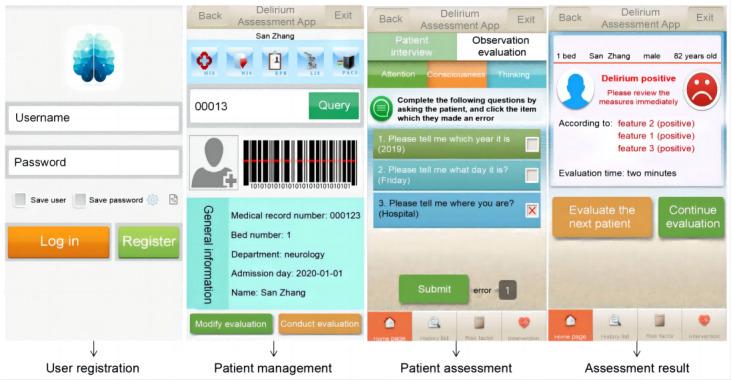
The 3D-DST included 3 assessment modules, 9 evaluation interfaces, and 16 results interfaces, with built-in reminders to guide nurses in completing the delirium assessment. In the usability testing, a total of 432 delirium assessments (216 pairs) on 148 older adults were performed by 72 bedside nurses with the 3D-CAM paper version and the 3D-DST. Compared to the 3D-CAM paper version, the mean usability score was significantly higher when using the 3D-DST (4.35 vs 3.40; P<.001). The median scores of the 6 domains of the satisfactory evaluation questionnaire for nurses using the 3D-CAM paper version and the 3D-DST were above 2.83 and 4.33 points, respectively (P<.001). The average time for completing the assessment reduced by 2.1 minutes (4.4 vs 2.3 min; P<.001) when the 3D-DST was used.
CONCLUSIONS
This study demonstrated that the 3D-DST significantly improved the efficiency of delirium assessment and was considered highly acceptable by bedside nurses.
背景
三分钟诊断性谵妄评估法-定义性谵妄(3D-CAM)是一种专为普通病房评估谵妄而专门开发的工具,具有较高的报告敏感性和特异性。然而,床边护士在常规实践中使用 3D-CAM 时,其可用性相对较差,评估过程中多次出现人为错误。
目的
本研究旨在开发一种基于 3D-CAM 的移动应用程序为基础的谵妄评估工具,并评估其在老年患者中的可用性。
方法
为了解决 3D-CAM 存在的问题并优化评估流程,开发了基于 3D-CAM 的谵妄评估工具与决策支持(3D-DST)。采用随机交叉设计,通过问卷调查评估床边护士对老年患者使用 3D-DST 的可用性。同时,记录 3D-DST 和 3D-CAM 纸质版的性能,包括评估完成率、完成评估所需的时间以及护士在评估过程中出现的人为错误数量,并比较它们之间的差异。
结果
3D-DST 包括 3 个评估模块、9 个评估界面和 16 个结果界面,内置提醒功能以指导护士完成谵妄评估。在可用性测试中,共对 148 名老年患者进行了 432 次(216 对)的 3D-CAM 纸质版和 3D-DST 评估,由 72 名床边护士完成。与 3D-CAM 纸质版相比,使用 3D-DST 时,可用性评分的平均值显著更高(4.35 比 3.40;P<.001)。护士对 3D-CAM 纸质版和 3D-DST 满意评估问卷的 6 个领域的中位数评分均高于 2.83 和 4.33 分(P<.001)。使用 3D-DST 时,完成评估的平均时间减少了 2.1 分钟(4.4 比 2.3 分钟;P<.001)。
结论
本研究表明,3D-DST 显著提高了谵妄评估的效率,并且得到了床边护士的高度认可。

 Zotero 插件