Institute for Liver and Digestive Diseases, Hallym University, Chuncheon, Republic of Korea.
Department of Life Science, Gachon University, Sungnam, Republic of Korea.
Gut Microbes. 2024 Jan-Dec;16(1):2307568. doi: 10.1080/19490976.2024.2307568. Epub 2024 Feb 1.
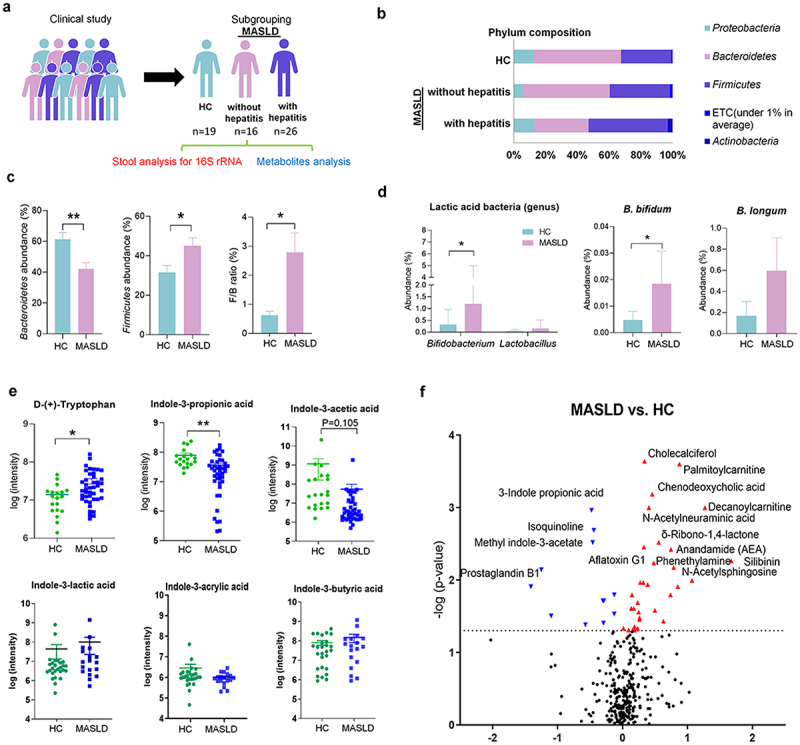
Metabolic dysfunction-associated steatotic liver disease (MASLD) is the most common chronic liver disease, and its prevalence has increased worldwide in recent years. Additionally, there is a close relationship between MASLD and gut microbiota-derived metabolites. However, the mechanisms of MASLD and its metabolites are still unclear. We demonstrated decreased indole-3-propionic acid (IPA) and indole-3-acetic acid (IAA) in the feces of patients with hepatic steatosis compared to healthy controls. Here, IPA and IAA administration ameliorated hepatic steatosis and inflammation in an animal model of WD-induced MASLD by suppressing the NF-κB signaling pathway through a reduction in endotoxin levels and inactivation of macrophages. metabolizes tryptophan to produce IAA, and effectively prevents hepatic steatosis and inflammation through the production of IAA. Our study demonstrates that IPA and IAA derived from the gut microbiota have novel preventive or therapeutic potential for MASLD treatment.
代谢相关脂肪性肝病(MASLD)是最常见的慢性肝病,近年来在全球范围内其患病率有所增加。此外,MASLD 与肠道微生物衍生代谢物之间存在密切关系。然而,MASLD 及其代谢物的机制仍不清楚。我们发现与健康对照组相比,肝脂肪变性患者粪便中的吲哚-3-丙酸(IPA)和吲哚-3-乙酸(IAA)水平降低。在这里,IPA 和 IAA 通过降低内毒素水平和使巨噬细胞失活来抑制 NF-κB 信号通路,从而改善 WD 诱导的 MASLD 动物模型中的肝脂肪变性和炎症。 代谢色氨酸产生 IAA,通过产生 IAA 有效预防肝脂肪变性和炎症。我们的研究表明,源自肠道微生物组的 IPA 和 IAA 对 MASLD 的治疗具有新的预防或治疗潜力。