Department of Physical and Rehabilitation Medicine, Samsung Kangbuk Hospital, Sungkyunkwan University School of Medicine, Seoul, Republic of Korea.
Department of Rehabilitation Medicine, Seoul National University College of Medicine, Seoul National University Bundang Hospital, Seongnam, Republic of Korea.
Sci Rep. 2024 Feb 1;14(1):2714. doi: 10.1038/s41598-024-51769-2.
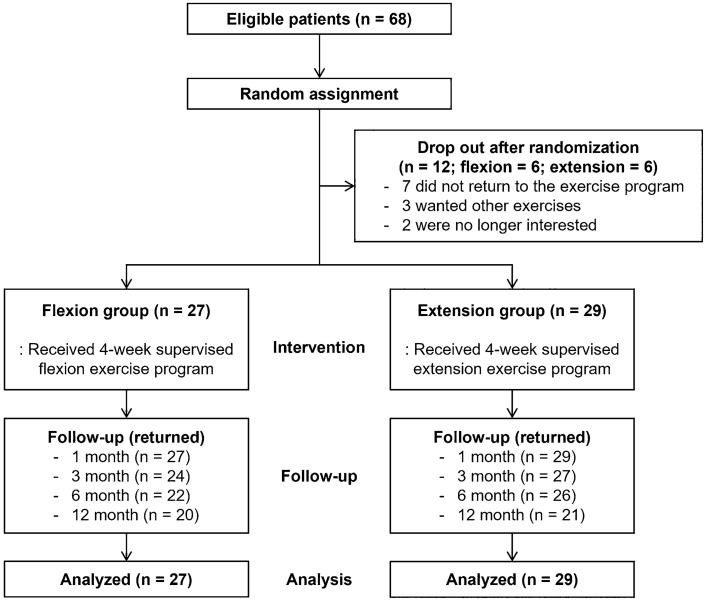
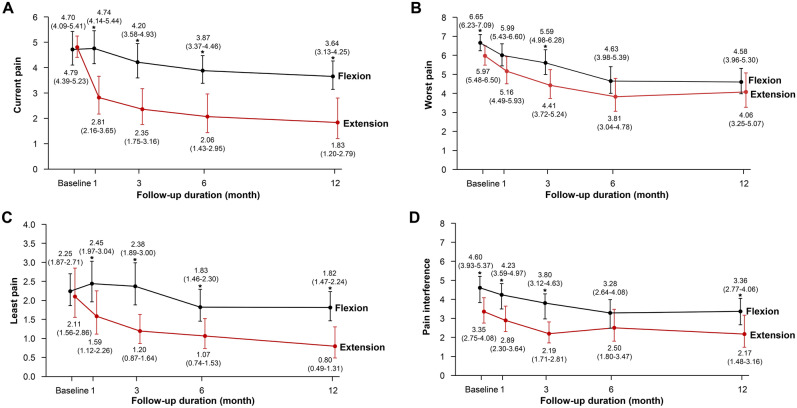
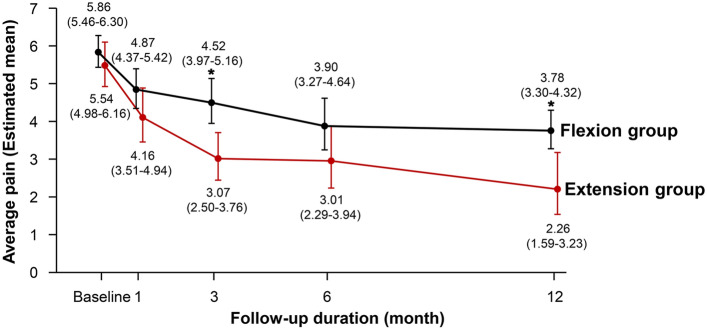
This study aimed to compare the long-term effects of flexion- and extension-based lumbar exercises on chronic axial low back pain (LBP). This was a 1-year follow-up of a prospective, assessor-blind, randomized controlled trial. Patients with axial LBP (intensity ≥ 5/10) for > 6 months allocated to the flexion or extension exercise group. Patients underwent four sessions of a supervised treatment program and were required to perform their assigned exercises daily at home. Clinical outcomes were obtained at baseline, 1, 3, 6 months, and 1-year. A total of 56 patients (age, 54.3 years) were included, with 27 and 29 in the flexion and extension groups, respectively. Baseline pain and functional scales were similar between both groups. The mean (± standard deviation) baseline average back pain was 6.00 ± 1.00 and 5.83 ± 1.20 in the flexion and extension groups, respectively. At 1-year, the average pain was 3.78 ± 1.40 and 2.26 ± 2.62 (mean between-group difference, 1.52; 95% confidence interval 0.56-2.47; p = 0.002), favoring extension exercise. The extension group tended to have more improvements in current pain, least pain, and pain interference than the flexion group at 1-year. However, there was no group difference in worst pain and functional scales. In this controlled trial involving patients with chronic axial LBP, extension-based lumbar exercise was more effective in reducing pain than flexion-based exercises at 1-year, advocating lumbar extension movement pattern as a component for therapeutic exercise for chronic LBP.Clinical Trial Registration No.: NCT02938689 (Registered on www.clinicaltrial.gov ; first registration date was 19/10/2016).
本研究旨在比较基于屈伸的腰椎运动对慢性轴向腰痛(LBP)的长期疗效。这是一项前瞻性、评估者盲法、随机对照试验的 1 年随访。将轴向 LBP(强度≥5/10)持续时间超过 6 个月的患者分配到屈伸运动组。患者接受了 4 次监督治疗方案,并要求在家中每天进行指定的运动。在基线、1、3、6 个月和 1 年时获得临床结果。共纳入 56 例患者(年龄 54.3 岁),屈伸组分别为 27 例和 29 例。两组基线疼痛和功能量表相似。两组平均(±标准差)基线平均背痛分别为 6.00±1.00 和 5.83±1.20。在 1 年时,平均疼痛分别为 3.78±1.40 和 2.26±2.62(组间平均差异,1.52;95%置信区间 0.56-2.47;p=0.002),屈伸运动组更优。与屈伸组相比,1 年时,伸展组当前疼痛、最低疼痛和疼痛干扰方面的改善趋势更明显。然而,两组在最痛和功能量表方面没有差异。在这项涉及慢性轴向 LBP 患者的对照试验中,与屈伸运动相比,基于伸展的腰椎运动在 1 年内更能有效减轻疼痛,提倡将腰椎伸展运动模式作为慢性 LBP 治疗性运动的组成部分。临床试验注册号:NCT02938689(在 www.clinicaltrial.gov 注册;首次注册日期为 2016 年 10 月 19 日)。