Chen Wenxin, Li Yueying, Wang Weifeng, Xue Yingjun, Qian Jianxin, Liu Weiwei, Hu Xiaobo
Department of Laboratory Medicine, Longhua Hospital Shanghai University of Traditional Chinese Medicine Shanghai China.
Department of Laboratory Medicine and Central Laboratory, Shanghai Tenth People's Hospital Tongji University School of Medicine Shanghai China.
Health Sci Rep. 2024 Jan 31;7(2):e1553. doi: 10.1002/hsr2.1553. eCollection 2024 Feb.
The occurrence, growth, and metastasis of colorectal cancer (CRC) are connected to the hypercoagulable state of blood (CRC). This study aimed to identify significant coagulation factors to predict metastasis and prognosis of CRC.
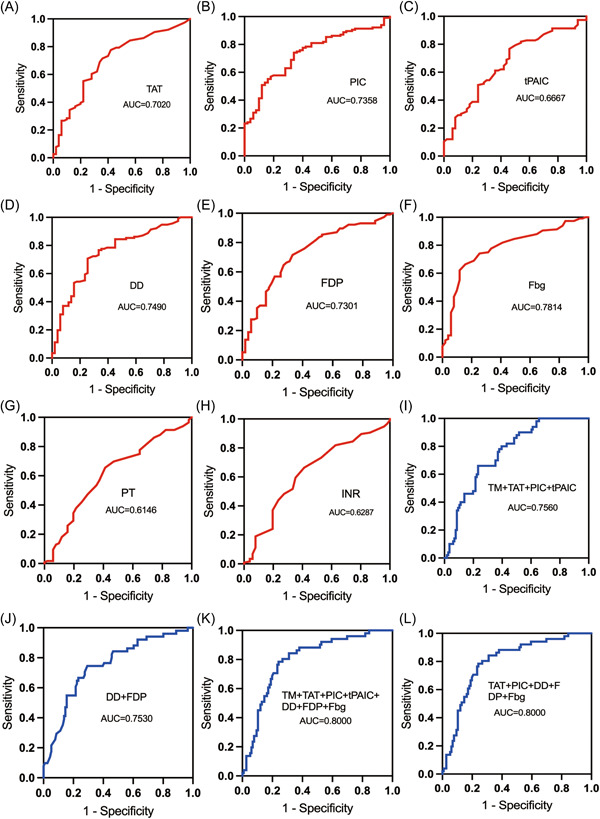
Thrombomodulin (TM), thrombin-antithrombin complex (TAT), α2-plasmininhibitor-plasmin complex (PIC), and tissue plasminogen activator-inhibitor complex (t-PAIC) were detected by chemiluminescence immunoassay using Sysmex HISCL5000 automated analyzers. The Sysmex CS 5100 automatic blood coagulation analyzer was used to detect d-dimer (DD), fibrin degradation product (FDP), prothrombin time (PT), thrombin time (TT), international normalized ratio (INR), fibrinogen (Fbg), and activated partial thromboplastin time (APTT). Area under the curve (AUC) and the receiver operating characteristic curve (ROC) were used to assess the diagnostic efficacy of markers. Kaplan-Meier analysis was used to calculate survival probabilities. Independent prognostic factors and the nomogram were developed using single-factor and multifactor cox regression analysis model.
The following indicators (TM, TAT, PIC, t-PAIC, DD, FDP, PT, INR, APTT, and Fbg) were markedly higher in CRC patients than in healthy controls, and they were higher in the metastasis (M) group than in the nonmetastasis (NM) group. The combination "TAT + PIC + DD + FDP + Fbg" can distinguish M from NM with exceptional sensitivity and specificity. Patients with CRC who had high levels of TAT, PIC, DD, FDP, Fbg, TM, tPAIC, PT, and INR had significantly shorter survival.
The prognosis of CRC patients can be predicted by coagulation indicators. The independent predictive variables for overall survival were found to be TM and DD. To forecast CRC patient survival, a nomogram was created.
结直肠癌(CRC)的发生、生长和转移与血液的高凝状态有关。本研究旨在确定预测CRC转移和预后的重要凝血因子。
采用Sysmex HISCL5000自动分析仪通过化学发光免疫分析法检测血栓调节蛋白(TM)、凝血酶 - 抗凝血酶复合物(TAT)、α2 - 纤溶酶抑制物 - 纤溶酶复合物(PIC)和组织纤溶酶原激活物 - 抑制物复合物(t - PAIC)。使用Sysmex CS 5100自动凝血分析仪检测D - 二聚体(DD)、纤维蛋白降解产物(FDP)、凝血酶原时间(PT)、凝血酶时间(TT)、国际标准化比值(INR)、纤维蛋白原(Fbg)和活化部分凝血活酶时间(APTT)。曲线下面积(AUC)和受试者工作特征曲线(ROC)用于评估标志物的诊断效能。采用Kaplan - Meier分析计算生存概率。使用单因素和多因素cox回归分析模型确定独立预后因素并绘制列线图。
CRC患者的以下指标(TM、TAT、PIC、t - PAIC、DD、FDP、PT、INR、APTT和Fbg)明显高于健康对照组,且转移(M)组高于非转移(NM)组。“TAT + PIC + DD + FDP + Fbg”组合能够以极高的敏感性和特异性区分M组和NM组。TAT、PIC、DD、FDP、Fbg、TM、tPAIC、PT和INR水平高的CRC患者生存时间明显较短。
凝血指标可预测CRC患者的预后。发现总体生存的独立预测变量为TM和DD。为预测CRC患者的生存情况,绘制了列线图。