Smith Laura J, Wilkinson David, Bodani Mayur, Surenthiran S S
Centre for Preventative Neurology, Wolfson Institute of Population Health, Queen Mary University of London, London, United Kingdom.
School of Psychology, Keynes College, University of Kent, Kent, United Kingdom.
Front Neurol. 2024 Jan 18;15:1159174. doi: 10.3389/fneur.2024.1159174. eCollection 2024.
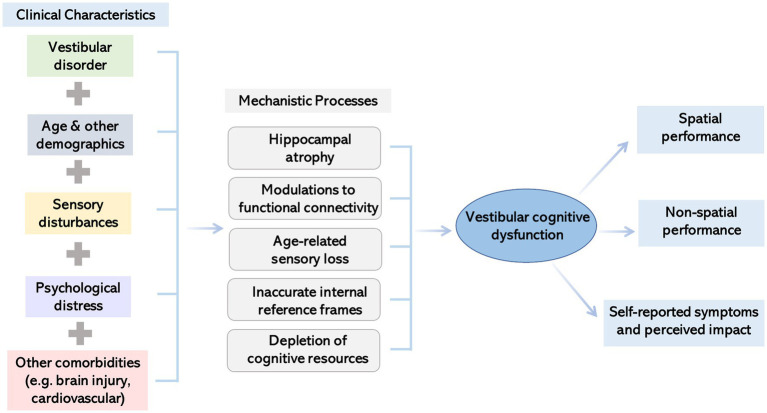
Vestibular disorders are prevalent and debilitating conditions of the inner ear and brain which affect balance, coordination, and the integration of multisensory inputs. A growing body of research has linked vestibular disorders to cognitive problems, most notably attention, visuospatial perception, spatial memory, and executive function. However, the mechanistic bases of these cognitive sequelae remain poorly defined, and there is a gap between our theoretical understanding of vestibular cognitive dysfunction, and how best to identify and manage this within clinical practice. This article takes stock of these shortcomings and provides recommendations and priorities for healthcare professionals who assess and treat vestibular disorders, and for researchers developing cognitive models and rehabilitation interventions. We highlight the importance of multidisciplinary collaboration for developing and evaluating clinically relevant theoretical models of vestibular cognition, to advance research and treatment.
前庭障碍是内耳和大脑普遍存在且使人衰弱的病症,会影响平衡、协调以及多感官输入的整合。越来越多的研究已将前庭障碍与认知问题联系起来,最显著的是注意力、视觉空间感知、空间记忆和执行功能。然而,这些认知后遗症的机制基础仍不清楚,而且我们对前庭认知功能障碍的理论理解与在临床实践中如何最好地识别和管理这一问题之间存在差距。本文评估了这些不足之处,并为评估和治疗前庭障碍的医疗保健专业人员以及开发认知模型和康复干预措施的研究人员提供了建议和优先事项。我们强调多学科合作对于开发和评估临床相关的前庭认知理论模型以推进研究和治疗的重要性。