Wan Rui, Li Weihua, Wang Zhijie, Zhong Jia, Lin Lin, Duan Jianchun, Wang Jie
State Key Laboratory of Molecular Oncology, CAMS Key Laboratory of Translational Research on Lung Cancer, Department of Medical Oncology, National Cancer Center/National Clinical Research Center for Cancer/Cancer Hospital, Chinese Academy of Medical Sciences & Peking Union Medical College, Beijing, China.
Department of Pathology, National Cancer Center/National Clinical Research Center for Cancer/Cancer Hospital, Chinese Academy of Medical Sciences and Peking Union Medical College, Beijing, China.
Heliyon. 2024 Jan 18;10(2):e24796. doi: 10.1016/j.heliyon.2024.e24796. eCollection 2024 Jan 30.
Rearranged during transfection () gene fusion is a target for non-small cell lung cancer (NSCLC) treatment, and RET inhibitors are approved for advanced NSCLC. The role of immune checkpoint inhibitors (ICIs) in fusion-positive NSCLC remains controversial. This retrospective study analyzed the efficacy of ICIs and RET inhibitors in Chinese patients with fusion-positive NSCLC.
Data from patients diagnosed with advanced NSCLC harboring fusion from Jan 2017 to Sep 2021 were analyzed. Clinicopathological characteristics and outcomes of ICIs and RET inhibitors treatments were collected.
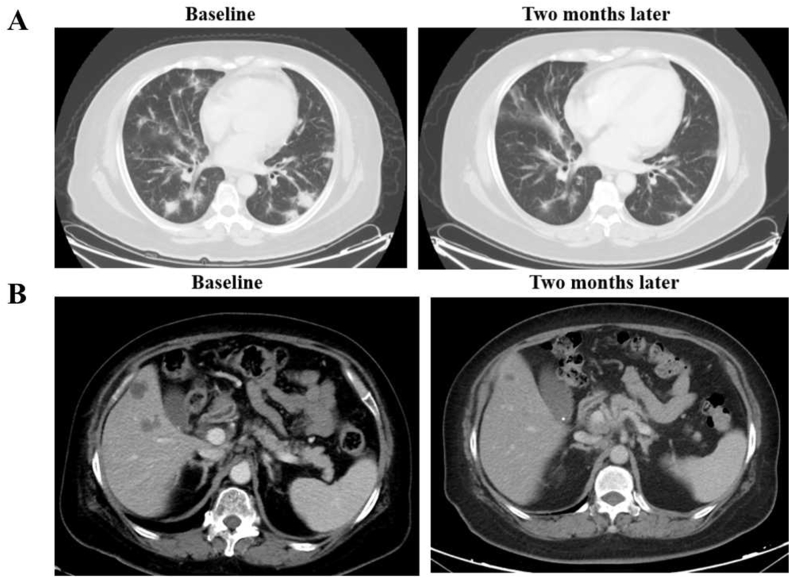
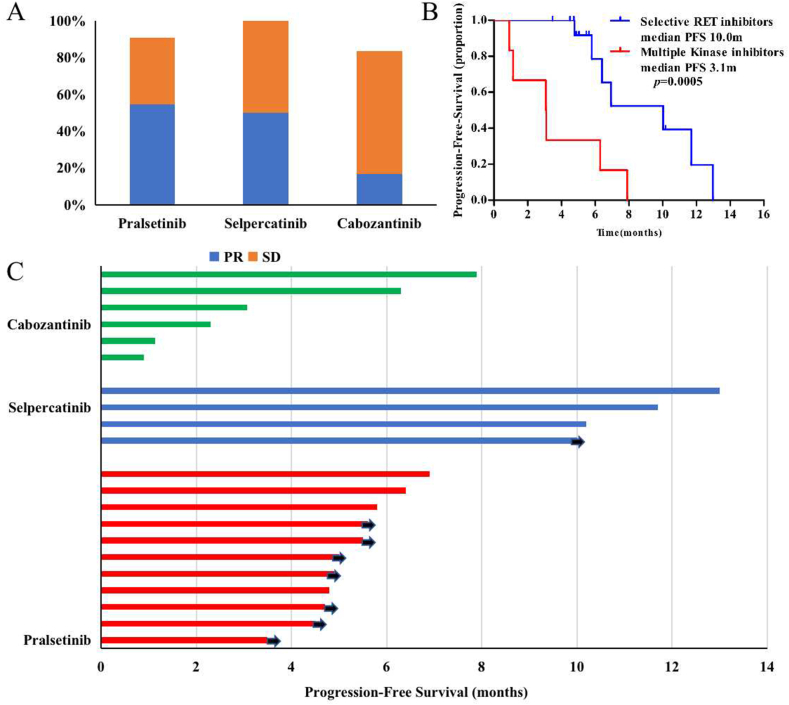
Seventy-five patients with fusion-positive advanced NSCLC were identified. The median age of patients was 57 years, half of the patients were female (50.3%), and most were non-smokers or light smokers (72%). Of the cancer types diagnosed in study patients, the fusion subtype accounted for 73.3% (55/75), twelve patients (16%) had fusion, and three (4%) had fusion. Sixteen patients were treated with ICIs. In previously untreated patients, we observed an objective response rate (ORR) of 71.4% and median progression free survival (PFS) of 7.5 months in seven assessable patients. Of four patients with PD-L1 overexpression (>50%) one received pembrolizumab and the other three patients received pemetrexed, carboplatin, and pembrolizumab or camrelizumab. In these patients, the ORR was 75% and disease control rate was 100%. Fifteen patients received selective RET inhibitors (pralsetinib and selpercatinib), resulting in an ORR of 53.3% (8/15) and median PFS of 10.0 months (95% CI 5.2-14.9).
ICIs for PD-L overexpression and treatment naive patients offer comparable benefits for fusion-positive NSCLC, warranting further investigation.
转染期间重排(RET)基因融合是非小细胞肺癌(NSCLC)治疗的靶点,RET抑制剂已被批准用于晚期NSCLC。免疫检查点抑制剂(ICI)在RET融合阳性NSCLC中的作用仍存在争议。本回顾性研究分析了ICI和RET抑制剂在中国RET融合阳性NSCLC患者中的疗效。
分析2017年1月至2021年9月诊断为晚期NSCLC且伴有RET融合的患者数据。收集ICI和RET抑制剂治疗的临床病理特征及结果。
共确定75例RET融合阳性晚期NSCLC患者。患者中位年龄为57岁,半数患者为女性(50.3%),大多数为不吸烟者或轻度吸烟者(72%)。在研究患者诊断的癌症类型中,RET融合亚型占73.3%(55/75),12例患者(16%)有NTRK融合,3例(4%)有ROS1融合。16例患者接受ICI治疗。在既往未治疗的患者中,我们观察到7例可评估患者的客观缓解率(ORR)为71.4%,中位无进展生存期(PFS)为7.5个月。在4例PD-L1过表达(>50%)的患者中,1例接受帕博利珠单抗治疗,其他3例患者接受培美曲塞、卡铂以及帕博利珠单抗或卡瑞利珠单抗治疗。在这些患者中,ORR为75%,疾病控制率为100%。15例患者接受选择性RET抑制剂(普拉替尼和塞尔帕替尼)治疗,ORR为53.3%(8/15),中位PFS为10.0个月(95%CI 5.2-14.9)。
对于PD-L过表达且未接受过治疗的患者,ICI对RET融合阳性NSCLC具有相似的疗效,值得进一步研究。