
为了具有价值,高通量表型分析方法的比较需要进行偏差和方差的统计检验。
To have value, comparisons of high-throughput phenotyping methods need statistical tests of bias and variance.
作者信息
McGrath Justin M, Siebers Matthew H, Fu Peng, Long Stephen P, Bernacchi Carl J
机构信息
Global Change and Photosynthesis Research Unit, USDA-Agricultural Research Service (ARS), Urbana, IL, United States.
Department of Plant Biology, University of Illinois, Urbana-Champaign, Urbana, IL, United States.
出版信息
Front Plant Sci. 2024 Jan 19;14:1325221. doi: 10.3389/fpls.2023.1325221. eCollection 2023.
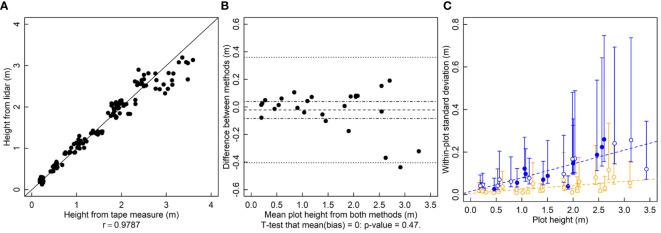
The gap between genomics and phenomics is narrowing. The rate at which it is narrowing, however, is being slowed by improper statistical comparison of methods. Quantification using Pearson's correlation coefficient () is commonly used to assess method quality, but it is an often misleading statistic for this purpose as it is unable to provide information about the relative quality of two methods. Using can both erroneously discount methods that are inherently more precise and validate methods that are less accurate. These errors occur because of logical flaws inherent in the use of when comparing methods, not as a problem of limited sample size or the unavoidable possibility of a type I error. A popular alternative to using is to measure the limits of agreement (LOA). However both and LOA fail to identify which instrument is more or less variable than the other and can lead to incorrect conclusions about method quality. An alternative approach, comparing variances of methods, requires repeated measurements of the same subject, but avoids incorrect conclusions. Variance comparison is arguably the most important component of method validation and, thus, when repeated measurements are possible, variance comparison provides considerable value to these studies. Statistical tests to compare variances presented here are well established, easy to interpret and ubiquitously available. The widespread use of has potentially led to numerous incorrect conclusions about method quality, hampering development, and the approach described here would be useful to advance high throughput phenotyping methods but can also extend into any branch of science. The adoption of the statistical techniques outlined in this paper will help speed the adoption of new high throughput phenotyping techniques by indicating when one should reject a new method, outright replace an old method or conditionally use a new method.
基因组学与表型组学之间的差距正在缩小。然而,这种缩小的速度因方法的不当统计比较而放缓。使用皮尔逊相关系数()进行量化通常用于评估方法质量,但它对于此目的往往是一个误导性的统计量,因为它无法提供有关两种方法相对质量的信息。使用可能会错误地否定本质上更精确的方法,并验证准确性较低的方法。这些错误的出现是因为在比较方法时使用存在固有的逻辑缺陷,而不是样本量有限或I型错误不可避免的问题。使用的一种流行替代方法是测量一致性界限(LOA)。然而,和LOA都无法确定哪种仪器比另一种仪器更具或更不具可变性,并且可能导致关于方法质量的错误结论。一种替代方法,即比较方法的方差,需要对同一受试者进行重复测量,但可以避免错误结论。方差比较可以说是方法验证的最重要组成部分,因此,当可以进行重复测量时,方差比较为这些研究提供了相当大的价值。本文介绍的用于比较方差的统计检验已经确立,易于解释且普遍可用。的广泛使用可能导致了关于方法质量的众多错误结论,阻碍了发展,而这里描述的方法将有助于推进高通量表型分析方法,但也可以扩展到任何科学领域。采用本文概述的统计技术将有助于通过指示何时应直接拒绝一种新方法、完全替换旧方法或有条件地使用新方法来加速新的高通量表型技术的采用。


 Zotero 插件