Zaini Aula, Jawad Hayder Edrees, Hadi Najah Rayish
Department of Pharmacology and Therapeutics, Faculty of Medicine, University of Kufa, Najaf, Iraq.
Karbala Health Directorate, Alhindiyah General Hospital, Karbala, Iraq.
J Med Life. 2023 Oct;16(10):1488-1498. doi: 10.25122/jml-2023-0064.
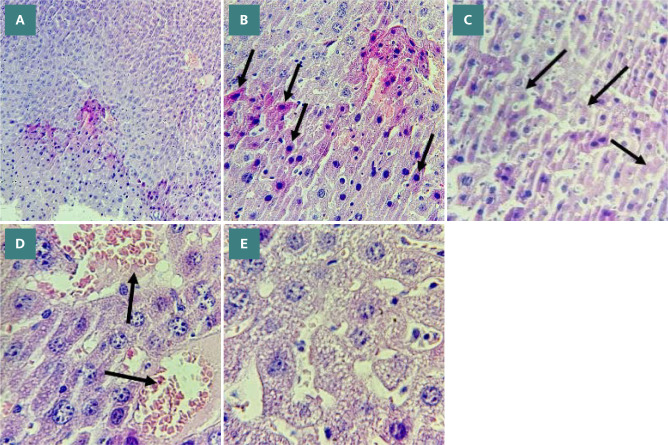
Sepsis, a life-threatening condition resulting from an uncontrolled host response to infection, often leads to severe liver damage and remains a significant cause of mortality in critically ill patients despite advances in antibiotic therapy and resuscitation. Bevacizumab, a neutralizing antibody targeting vascular endothelial growth factor (VEGF), is approved for treating certain cancers. However, its potential impact on sepsis-related liver injury is not well understood. This study aimed to explore the potential hepatoprotective effect of Bevacizumab on sepsis-induced liver injury. Twenty-four mice were divided into four groups: a sham group subjected to a midline incision only, a cecal ligation and puncture induction (CLP) group, a vehicle-treated group that received a vehicle one hour before CLP induction, and a Bevacizumab-treated group that received Bevacizumab one hour before CLP induction. Blood samples were collected, and angiopoietin-2 (ANGPT2), alanine transaminase (ALT), and aspartate transaminase (AST) serum levels were measured. Liver tissue homogenates were analyzed for IL-6, TNFα, intracellular adhesion molecule (ICAM-1), macrophage inhibitory factor (MIF), vascular endothelial growth factor (VEGF), F2-isoprostane, and caspase-11 levels. A histological examination was performed to assess the extent of liver damage. Mice exposed to CLP had high levels of the biomarkers mentioned above with a high degree of liver injury compared to the sham group. In contrast, treatment with Bevacizumab notably reduced these markers and mitigated liver damage. In conclusion, Bevacizumab may be a protective agent against sepsis-induced liver injury.
脓毒症是一种因宿主对感染的失控反应而危及生命的病症,尽管抗生素治疗和复苏技术有所进步,但它仍常导致严重的肝损伤,并且仍是重症患者死亡的重要原因。贝伐单抗是一种靶向血管内皮生长因子(VEGF)的中和抗体,已被批准用于治疗某些癌症。然而,其对脓毒症相关肝损伤的潜在影响尚不清楚。本研究旨在探讨贝伐单抗对脓毒症诱导的肝损伤的潜在肝保护作用。将24只小鼠分为四组:仅接受中线切口的假手术组、盲肠结扎和穿刺诱导(CLP)组、在CLP诱导前1小时接受载体治疗的载体处理组以及在CLP诱导前1小时接受贝伐单抗治疗的贝伐单抗处理组。采集血样,测量血管生成素-2(ANGPT2)、丙氨酸转氨酶(ALT)和天冬氨酸转氨酶(AST)的血清水平。分析肝组织匀浆中的白细胞介素-6(IL-6)、肿瘤坏死因子α(TNFα)、细胞间黏附分子(ICAM-1)、巨噬细胞抑制因子(MIF)、血管内皮生长因子(VEGF)、F2-异前列腺素和半胱天冬酶-11水平。进行组织学检查以评估肝损伤程度。与假手术组相比,暴露于CLP的小鼠上述生物标志物水平较高,肝损伤程度也较高。相比之下,贝伐单抗治疗显著降低了这些标志物水平并减轻了肝损伤。总之,贝伐单抗可能是一种预防脓毒症诱导肝损伤的保护剂。