
腹腔镜扩大全腹膜外修补术治疗腹疝时保留疝囊以预防腹横肌松解:应对严峻挑战的简约解决方案
Hernia Sac Preservation for Prevention of Transversus Abdominis Release in Laparoscopic Extended-Totally Extra Peritoneal Repair of Ventral Hernia: A Minimalistic Solution for a Formidable Challenge.
作者信息
Balachandran Premkumar, Tirunelveli Sivagnanam Subbiah, Swathika V C
机构信息
Institutes of Hernia Surgery and Abdominal Wall Reconstruction, Apollo Hospitals, Chennai, India.
Department of General Surgery, Apollo Speciality Hospital, Chennai, India.
出版信息
J Abdom Wall Surg. 2022 Nov 17;1:10634. doi: 10.3389/jaws.2022.10634. eCollection 2022.
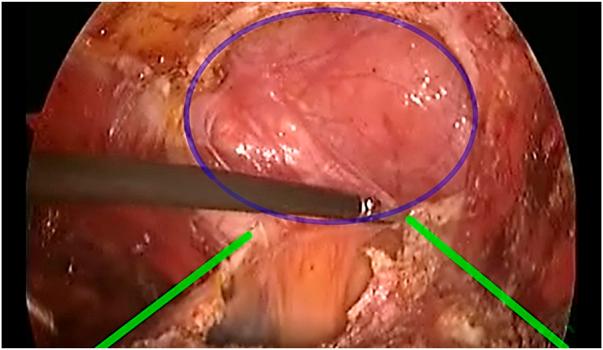
Ventral hernia repair has always been an extensive and challenging surgery. The laparoscopic extended-Totally Extraperitoneal (E-TEP) technique of ventral hernia repair is gaining popularity due to the advantage of placing a large mesh in the retro rectus plane. When done through a Laparoscopic approach, the difficulty of the procedure is compounded by multiple factors such as obtaining retro muscular access, maintaining the retro muscular plane, crossing over to the contralateral retro muscular plane without entering intraperitoneally, suturing in a limited space, and manipulation of a large mesh in a constricted space for placement. In cases of large midline incisional hernias, dense adhesions to the previous surgical scar are often present. Despite having extremely satisfying outcomes, the aforementioned factors make the laparoscopic extended-total extraperitoneal repair of large midline ventral and incisional hernias an exceptionally challenging procedure. A tension-free midline approximation is the benchmark of ventral/incisional hernia surgery. In certain cases, this can be difficult to achieve due to multiple factors. For the purpose of attaining tension-free midline closure, component separation techniques (CST) have been explored and implemented. Of these, the posterior component separation technique of Transversus Abdominis Release (TAR) has gained popularity for reducing the tension of posterior rectus sheath during posterior midline closure in retro muscular repairs by adding a few centimetres of medial advancement. The main pitfall of TAR is its technical complexity, which may result in morbid complications when implemented incorrectly. Performing TAR laparoscopically compounds the complexity manyfold. Hence, to obviate the necessity to perform Laparoscopic TAR in cases of Laparoscopic E-TEP repair of large midline ventral and incisional hernias, we present that the technique of hernial sac preservation should be pre-emptively carried for all Laparoscopic ETEP repairs so that the necessity of performing TAR in select cases is reduced by aiding in the addition of final crucial centimetres of lengthening to the posterior rectus sheath for achieving posterior midline closure. This aids in the success of the procedure by preventing an additional complex procedure of TAR from being performed in an already challenging hernia repair technique of Laparoscopic E-TEP repair. We hereby report three cases of Ventral hernia repair in which Laparoscopic E-TEP repair was carried out and Hernial sac preservation technique was implemented successfully. Midline closure of the posterior rectus sheath was attained under reduced tension and a medium-weight macroporous polypropylene mesh was placed in the retro-rectus plane after measurement of the potential space. Patients were discharged uneventfully. Patients were followed up for up to 6 months postoperatively and were found to have no complications. In Laparoscopic E-TEP repair of midline ventral hernias, preservation of the hernial sac along with the posterior rectus sheath might aid in the prevention of performing a TAR in selected cases where posterior layer tension is present. Hernia sac preservation thereby aids in reducing operative time and preventing potential morbid complications.
腹疝修补术一直是一项广泛且具有挑战性的手术。腹疝修补的腹腔镜扩大完全腹膜外(E - TEP)技术因能在腹直肌后平面放置大补片的优势而越来越受欢迎。当通过腹腔镜途径进行时,该手术的难度因多种因素而增加,比如获得肌后间隙、维持肌后平面、在不进入腹腔的情况下跨越到对侧肌后平面、在有限空间内缝合以及在狭窄空间内操作大补片以进行放置。在大型中线切口疝病例中,通常会与先前手术瘢痕形成致密粘连。尽管有非常令人满意的结果,但上述因素使得腹腔镜扩大完全腹膜外修补大型中线腹疝和切口疝成为一项极具挑战性的手术。无张力中线对合是腹疝/切口疝手术的基准。在某些情况下,由于多种因素,这可能难以实现。为了实现无张力中线闭合,人们探索并实施了成分分离技术(CST)。其中,腹横肌松解(TAR)的后成分分离技术因在肌后修补的后中线闭合过程中通过增加几厘米的内侧推进来降低腹直肌后鞘的张力而受到欢迎。TAR的主要缺陷是其技术复杂性,如果实施不当可能导致严重并发症。腹腔镜下进行TAR会使复杂性增加许多倍。因此,为了在腹腔镜E - TEP修补大型中线腹疝和切口疝的情况下避免进行腹腔镜TAR的必要性,我们提出对于所有腹腔镜E - TEP修补术都应预先采用疝囊保留技术,以便通过帮助为腹直肌后鞘增加最后的关键几厘米延长来实现后中线闭合,从而减少在特定病例中进行TAR的必要性。这有助于手术成功,因为避免了在已经具有挑战性的腹腔镜E - TEP疝修补技术中额外进行复杂的TAR手术。我们在此报告三例腹疝修补病例,其中成功进行了腹腔镜E - TEP修补并实施了疝囊保留技术。在降低张力的情况下实现了腹直肌后鞘的中线闭合,并在测量潜在间隙后将中等重量的大孔聚丙烯补片放置在腹直肌后平面。患者顺利出院。术后对患者进行了长达6个月的随访,未发现并发症。在腹腔镜E - TEP修补中线腹疝时,保留疝囊以及腹直肌后鞘可能有助于在存在后层张力的特定病例中避免进行TAR。因此,疝囊保留有助于减少手术时间并预防潜在的严重并发症。

 Zotero 插件