
解析角膜上皮伤口愈合中lncRNAs的复杂网络:深入了解linc17500的调控作用
Unraveling the Intricate Network of lncRNAs in Corneal Epithelial Wound Healing: Insights Into the Regulatory Role of linc17500.
作者信息
Cao Qiongjie, Peng Dewei, Wang Jiao, Reinach Peter S, Yan Dongsheng
机构信息
State Key Laboratory of Ophthalmology, Optometry and Vision Science, Eye Hospital, Wenzhou Medical University, Wenzhou, China.
出版信息
Transl Vis Sci Technol. 2024 Feb 1;13(2):4. doi: 10.1167/tvst.13.2.4.
PURPOSE
Epigenetic mechanisms orchestrate a harmonious process of corneal epithelial wound healing (CEWH). However, the precise role of long non-coding RNAs (lncRNAs) as key epigenetic regulators in mediating CEWH remains elusive. Here, we aimed to elucidate the functional contribution of lncRNAs in regulating CEWH.
METHODS
We used a microarray to characterize lncRNA expression profiling during mouse CEWH. Subsequently, the aberrant lncRNAs and their cis-associated genes were subjected to comprehensive Gene Ontology (GO) enrichment and Kyoto Encyclopedia of Genes and Genomes (KEGG) pathway analyses. Quantitative reverse transcription-polymerase chain reaction (RT-qPCR) and western blot analyses were performed to determine the expression profiles of key markers during CEWH. The in vivo effects of linc17500 on this process were investigated through targeted small interfering RNA (siRNA) injection. Post-siRNA treatment, corneal re-epithelialization was assessed, alongside the expression of cytokeratins 12 and 14 (Krt12 and Krt14) and Ki67. Effects of linc17500 on mouse corneal epithelial cell (TKE2) proliferation, cell cycle, and migration were assessed by multicellular tumor spheroids (MTS), 5-ethynyl-2'-deoxyuridine (EdU), flow cytometry, and scratch-wound assay, respectively.
RESULTS
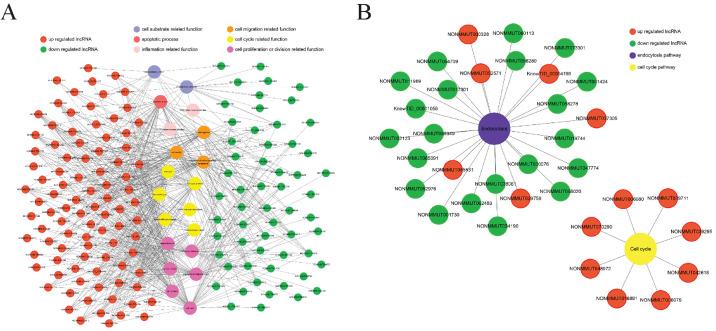
Microarray analysis revealed dysregulation of numerous lncRNA candidates during CEWH. Bioinformatic analysis provided valuable annotations regarding the cis-associated genes of these lncRNAs. In vivo experiments demonstrated that knockdown of linc17500 resulted in delayed CEWH. Furthermore, the knockdown of linc17500 and its cis-associated gene, CDC28 protein kinase regulatory subunit 2 (Cks2), was found to impede TKE2 cell proliferation and migration. Notably, downregulation of linc17500 in TKE2 cells led to suppression of the activation status of Akt and Rb.
CONCLUSIONS
This study sheds light on the significant involvement of lncRNAs in mediating CEWH and highlights the regulatory role of linc17500 on TKE2 cell behavior.
TRANSLATIONAL RELEVANCE
These findings provide valuable insights for future therapeutic research aimed at addressing corneal wound complications.
目的
表观遗传机制协调角膜上皮伤口愈合(CEWH)的和谐过程。然而,长链非编码RNA(lncRNA)作为关键表观遗传调节因子在介导CEWH中的精确作用仍不清楚。在此,我们旨在阐明lncRNA在调节CEWH中的功能作用。
方法
我们使用微阵列来表征小鼠CEWH过程中的lncRNA表达谱。随后,对异常lncRNA及其顺式相关基因进行全面的基因本体论(GO)富集和京都基因与基因组百科全书(KEGG)通路分析。进行定量逆转录-聚合酶链反应(RT-qPCR)和蛋白质免疫印迹分析以确定CEWH过程中关键标志物的表达谱。通过靶向小干扰RNA(siRNA)注射研究linc17500在此过程中的体内作用。siRNA处理后,评估角膜再上皮化情况,以及细胞角蛋白12和14(Krt12和Krt14)和Ki67的表达。分别通过多细胞肿瘤球体(MTS)、5-乙炔基-2'-脱氧尿苷(EdU)、流式细胞术和划痕试验评估linc17500对小鼠角膜上皮细胞(TKE2)增殖、细胞周期和迁移的影响。
结果
微阵列分析揭示了CEWH过程中众多lncRNA候选物的失调。生物信息学分析为这些lncRNA的顺式相关基因提供了有价值的注释。体内实验表明,linc17500的敲低导致CEWH延迟。此外,发现linc17500及其顺式相关基因细胞分裂周期蛋白28蛋白激酶调节亚基2(Cks2)的敲低会阻碍TKE2细胞的增殖和迁移。值得注意的是,TKE2细胞中linc17500的下调导致Akt和Rb激活状态的抑制。
结论
本研究揭示了lncRNA在介导CEWH中的重要作用,并突出了linc17500对TKE2细胞行为的调节作用。
转化相关性
这些发现为未来旨在解决角膜伤口并发症的治疗研究提供了有价值的见解。




 Zotero 插件