Li Bo, Luan Song, Chen Jing, Zhou Yue, Wang Tingting, Li Zhijuan, Fu Yili, Zhai Aixia, Bi Changlong
Department of Endocrinology, The Fourth Affiliated Hospital of Harbin Medical University, Harbin 150001, People's Republic of China.
The 2(nd) Department of General, The Fourth Affiliated Hospital of Harbin Medical University, Harbin 150001, People's Republic of China.
Mol Ther Nucleic Acids. 2020 Mar 6;19:814-826. doi: 10.1016/j.omtn.2019.11.034. Epub 2019 Dec 14.
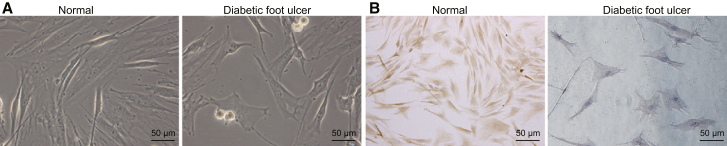
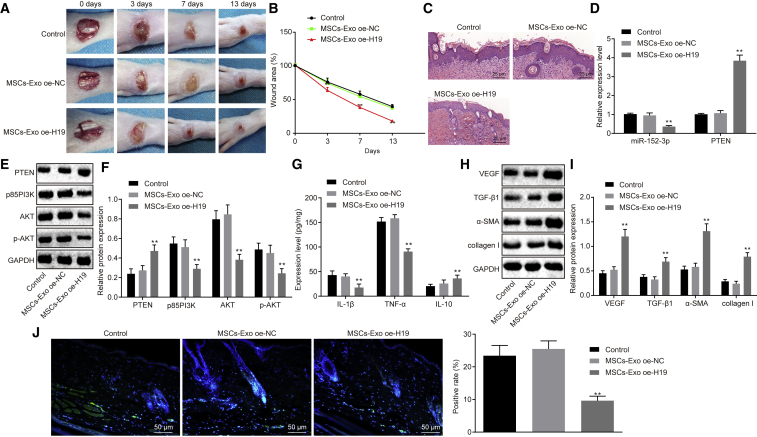
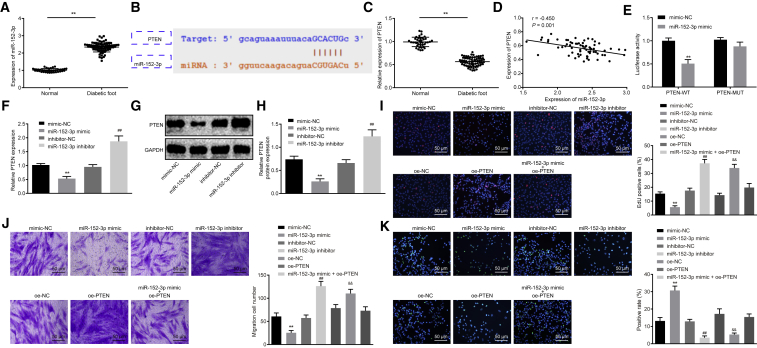
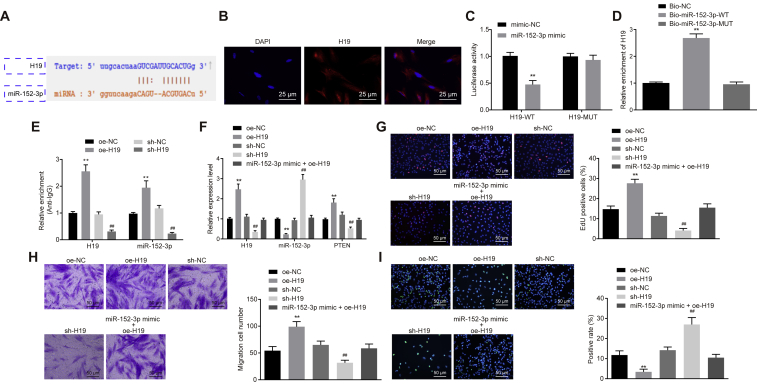
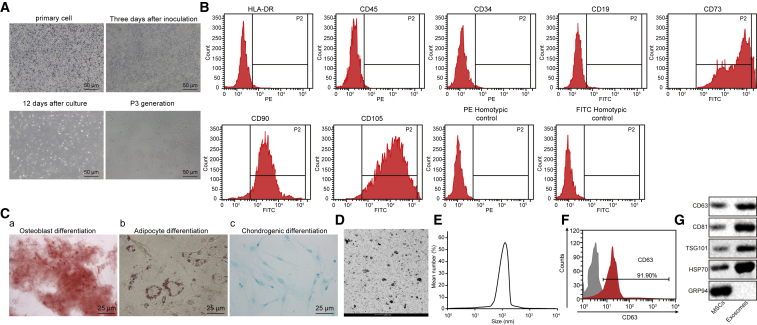
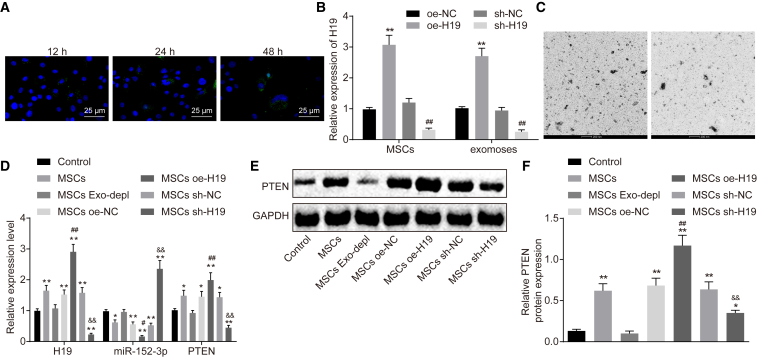
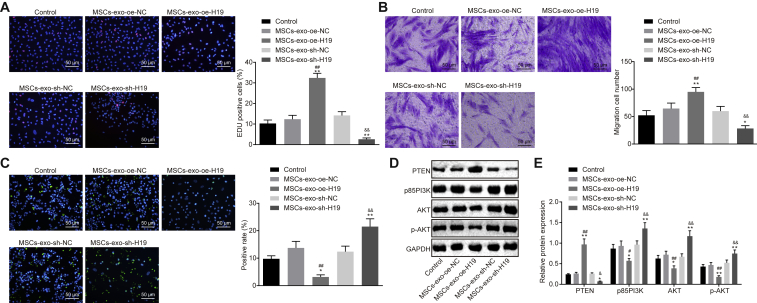
Mesenchymal stem cells (MSCs) have been reported to hold promise to accelerate the wound-healing process in diabetic foot ulcer (DFU) due to the multilineage differentiation potential. Hence, this study intended to explore the wound healing role of MSC-derived exosomes containing long noncoding RNA (lncRNA) H19 in DFU. lncRNA H19 was predicated to bind to microRNA-152-3p (miR-152-3p), which targeted phosphatase and tensin homolog (PTEN) deleted on chromosome ten. Fibroblasts in DFU samples exhibited highly expressed miR-152-3p and poorly expressed lncRNA H19 and PTEN, along with an activated phosphatidylinositol-4,5-bisphosphate 3-kinase (PI3K)/protein kinase B (Akt1) signaling pathway. The fibroblasts were cocultured with lncRNA H19-transfected MSCs and MSC-derived exosomes to assess the effect of the lncRNA H19/miR-152-3p/PTEN axis on the biological activities and inflammation in fibroblasts. Mouse models of DFU were developed by streptozotocin, which was injected with MSC-derived exosomes overexpressing lncRNA H19. lncRNA H19 in MSCs was transferred through exosomes to fibroblasts, the mechanism of which improved wound healing in DFU, corresponded to promoted fibroblast proliferation and migration, as well as suppressed apoptosis and inflammation. Wound healing in mice with DFU was facilitated following the injection of MSC-derived exosomes overexpressing lncRNA H19. Taken together, MSC-derived exosomal lncRNA H19 prevented the apoptosis and inflammation of fibroblasts by impairing miR-152-3p-mediated PTEN inhibition, leading to the stimulated wound-healing process in DFU.
据报道,间充质干细胞(MSCs)由于具有多向分化潜能,有望加速糖尿病足溃疡(DFU)的伤口愈合过程。因此,本研究旨在探讨含有长链非编码RNA(lncRNA)H19的MSC来源外泌体在DFU中的伤口愈合作用。预测lncRNA H19与靶向第10号染色体上缺失的磷酸酶和张力蛋白同源物(PTEN)的微小RNA-152-3p(miR-152-3p)结合。DFU样本中的成纤维细胞表现出miR-152-3p高表达、lncRNA H19和PTEN低表达,同时磷脂酰肌醇-4,5-二磷酸3-激酶(PI3K)/蛋白激酶B(Akt1)信号通路激活。将成纤维细胞与lncRNA H19转染的MSCs和MSC来源的外泌体共培养,以评估lncRNA H19/miR-152-3p/PTEN轴对成纤维细胞生物学活性和炎症的影响。通过链脲佐菌素建立DFU小鼠模型,并注射过表达lncRNA H19的MSC来源外泌体。MSCs中的lncRNA H19通过外泌体转移至成纤维细胞,其机制改善了DFU的伤口愈合,表现为促进成纤维细胞增殖和迁移,以及抑制细胞凋亡和炎症。注射过表达lncRNA H19的MSC来源外泌体后,DFU小鼠的伤口愈合得到促进。综上所述,MSC来源的外泌体lncRNA H19通过削弱miR-152-3p介导的PTEN抑制作用,防止成纤维细胞凋亡和炎症,从而促进DFU的伤口愈合过程。