Plant Health and Protection Laboratory, Division of Crop Biotechnics, Department of Biosystems, KU Leuven, Willem de Croylaan 42, B-3001 Leuven, Belgium.
KU Leuven Plant Institute, Kasteelpark Arenberg 31, B-3001 Leuven, Belgium.
FEMS Microbiol Ecol. 2024 Feb 14;100(3). doi: 10.1093/femsec/fiae010.
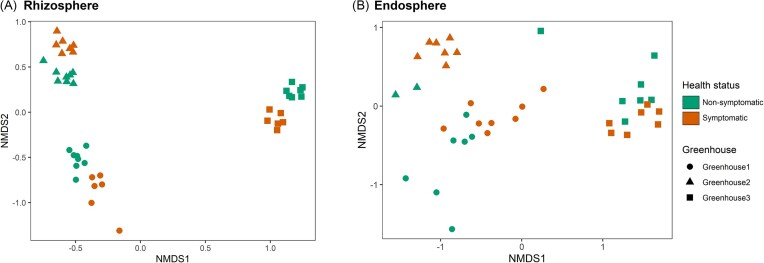
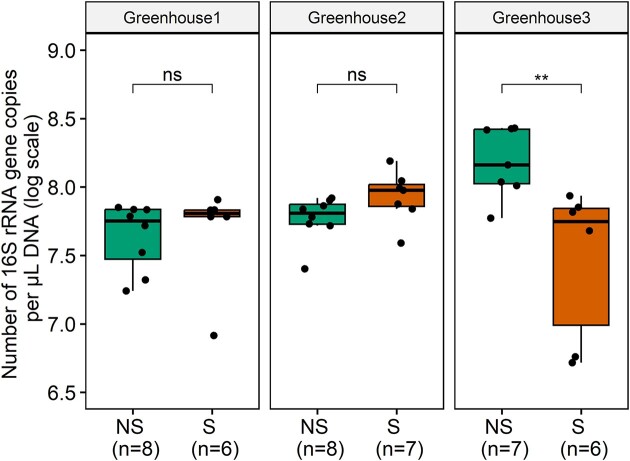
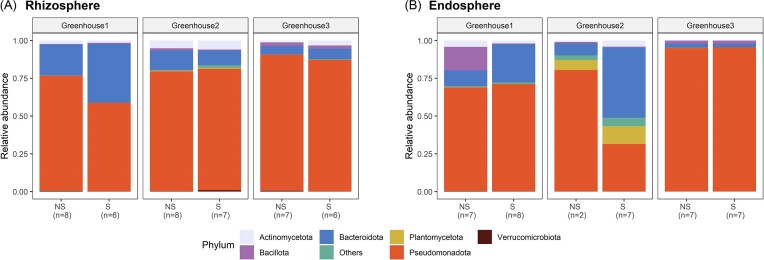
Understanding the complex interactions between plants and their associated microorganisms is crucial for optimizing plant health and productivity. While microbiomes of soil-bound cultivated crops are extensively studied, microbiomes of hydroponically cultivated crops have received limited attention. To address this knowledge gap, we investigated the rhizosphere and root endosphere of hydroponically cultivated lettuce. Additionally, we sought to explore the potential impact of the oomycete pathogen Phytophthora cryptogea on these microbiomes. Root samples were collected from symptomatic and nonsymptomatic plants in three different greenhouses. Amplicon sequencing of the bacterial 16S rRNA gene revealed significant alterations in the bacterial community upon P. cryptogea infection, particularly in the rhizosphere. Permutational multivariate analysis of variance (perMANOVA) revealed significant differences in microbial communities between plants from the three greenhouses, and between symptomatic and nonsymptomatic plants. Further analysis uncovered differentially abundant zero-radius operational taxonomic units (zOTUs) between symptomatic and nonsymptomatic plants. Interestingly, members of Pseudomonas and Flavobacterium were positively associated with symptomatic plants. Overall, this study provides valuable insights into the microbiome of hydroponically cultivated plants and highlights the influence of pathogen invasion on plant-associated microbial communities. Further research is required to elucidate the potential role of Pseudomonas and Flavobacterium spp. in controlling P. cryptogea infections within hydroponically cultivated lettuce greenhouses.
了解植物与其相关微生物之间的复杂相互作用对于优化植物健康和生产力至关重要。虽然土壤栽培作物的微生物组得到了广泛研究,但水培作物的微生物组却受到了有限的关注。为了弥补这一知识空白,我们调查了水培生菜的根际和根内区微生物组。此外,我们还试图探索卵菌病原体腐霉对这些微生物组的潜在影响。从三个不同温室的有症状和无症状植物中采集根样本。对细菌 16S rRNA 基因的扩增子测序表明,在腐霉感染后,细菌群落发生了显著变化,特别是在根际。基于置换多元方差分析(perMANOVA)的分析揭示了来自三个温室的植物之间以及有症状和无症状植物之间微生物群落的显著差异。进一步的分析揭示了有症状和无症状植物之间零半径操作分类单元(zOTU)的差异丰度。有趣的是,假单胞菌和黄杆菌属的成员与有症状的植物呈正相关。总的来说,本研究深入了解了水培植物的微生物组,并强调了病原体入侵对植物相关微生物群落的影响。需要进一步的研究来阐明假单胞菌和黄杆菌属在控制水培生菜温室中腐霉感染中的潜在作用。