
肾功能与身体机能衰退:肾脏病中的大脑(BRINK)队列研究
Kidney Function and Physical Performance Decline: The Brain in Kidney Disease (BRINK) Cohort Study.
作者信息
Hart Allyson, Horak Kayla, Roetker Nicholas S, Farnum Ashley, Murray Anne, Johansen Kirsten L
机构信息
Nephrology Division, Department of Medicine, Hennepin Healthcare, Minneapolis, MN, USA.
Chronic Disease Research Group, Hennepin Healthcare Research Institute, Minneapolis, MN, USA.
出版信息
Kidney Med. 2023 Dec 5;6(2):100770. doi: 10.1016/j.xkme.2023.100770. eCollection 2024 Feb.
RATIONALE & OBJECTIVE: Patients with kidney failure have poor physical performance, but its trajectory is less clear. We examined physical function over the course of kidney disease, including the transition to dialysis.
STUDY DESIGN
Observational cohort.
SETTING & PARTICIPANTS: Community-dwelling adults aged ≥45 years in the Brain in Kidney Disease (BRINK) cohort study.
PREDICTORS
Estimated glomerular filtration rate (eGFR) and urine albumin to creatinine ratio (UACR).
OUTCOMES
Change in physical performance using the Short Physical Performance Battery (SPPB) (primary) and gait speed (secondary).
ANALYTICAL APPROACH
Linear mixed effects regression models.
RESULTS
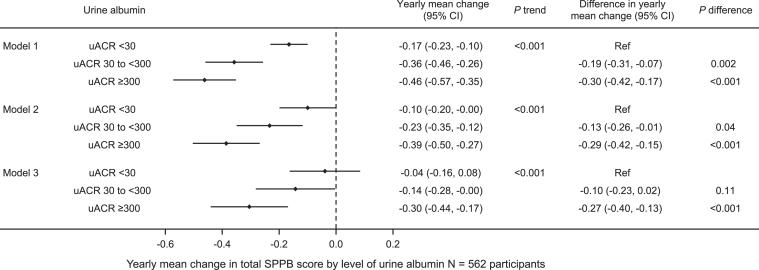
The analytical cohort included 562 participants with mean age of 69.3 (SD, 9.8) years followed for up to 63 months. In total, 49.8% were women. In addition, 79.9% self-identified as White, and 15.3% self-identified as Black. In total, 48.8% had diabetes. Mean eGFR at baseline was 48.1 (SD, 24.3) mL/min/1.73 m. In unadjusted analysis, lower eGFR was associated with greater decline in SPPB score ( trend < 0.001). The decline in SPPB score was larger among participants with lower eGFR, with a gradient from -0.15 (95% CI, -0.23 to -0.07) points per year for participants with eGFR ≥60 mL/min/1.73 m to -0.56 (95% CI, -0.84 to -0.27) for participants with eGFR <15 mL/min/1.73 m and -0.61 (95% CI, -0.90 to -0.33) after dialysis initiation. In covariate-adjusted models, SPPB did not continue to decline after dialysis initiation. In secondary analyses evaluating change in gait speed, gait speed continued to decline after dialysis initiation. Higher UACR was also associated with a greater decline in SPPB score and gait speed in unadjusted and adjusted models.
LIMITATIONS
Small number of participants started dialysis.
CONCLUSIONS
We found a graded association of chronic kidney disease stage and albuminuria with decline in physical performance. The decline in SPPB was not accelerated after dialysis initiation in covariate-adjusted models, whereas gait speed continued to decline.
原理与目的
肾衰竭患者身体机能较差,但其发展轨迹尚不清楚。我们研究了肾病过程中的身体功能,包括向透析过渡的阶段。
研究设计
观察性队列研究。
研究地点与参与者
“肾病中的大脑”(BRINK)队列研究中年龄≥45岁的社区居住成年人。
预测因素
估计肾小球滤过率(eGFR)和尿白蛋白肌酐比值(UACR)。
结果
使用简短身体机能量表(SPPB)评估身体机能变化(主要指标)和步速(次要指标)。
分析方法
线性混合效应回归模型。
结果
分析队列包括562名参与者,平均年龄69.3(标准差9.8)岁,随访时间长达63个月。其中,49.8%为女性。此外,79.9%自我认定为白人,15.3%自我认定为黑人。共有48.8%的人患有糖尿病。基线时的平均eGFR为48.1(标准差24.3)mL/min/1.73m²。在未调整分析中,较低的eGFR与SPPB评分更大幅度的下降相关(趋势<0.001)。eGFR较低的参与者中SPPB评分下降幅度更大,eGFR≥60mL/min/1.73m²的参与者每年下降-0.15(95%置信区间,-0.23至-0.07)分,eGFR<15mL/min/1.73m²的参与者为-0.56(95%置信区间,-0.84至-0.27)分,透析开始后为-0.61(95%置信区间,-0.90至-0.33)分。在协变量调整模型中,透析开始后SPPB评分未继续下降。在评估步速变化的次要分析中,透析开始后步速继续下降。在未调整和调整模型中,较高的UACR也与SPPB评分和步速更大幅度的下降相关。
局限性
开始透析的参与者数量较少。
结论
我们发现慢性肾病分期和蛋白尿与身体机能下降呈分级关联。在协变量调整模型中,透析开始后SPPB评分下降未加速,而步速继续下降。


 Zotero 插件