Department of Urology, Peking University First Hospital, Beijing, China.
Institute of Urology, Peking University, Beijing, China.
BMJ Open. 2024 Feb 6;14(2):e071923. doi: 10.1136/bmjopen-2023-071923.
The use of minimally invasive endoluminal treatment for urethral strictures has been a subject for debate for several decades. The aim of this study was to review and discuss the safety, efficacy and factors influencing the clinical application of balloon dilation for the treatment of male urethral strictures.
Systematic review and meta-analysis.
Embase, Medline, Web of Science, Cochrane Library and Scopus were searched for publications published before 17 July 2022.
Two independent researchers screened and assessed the results, and all clinical studies on balloon dilation for the treatment of urethral strictures in men were included.
The success rate, rate of adverse events, International Prostate Symptom Scores, maximum uroflow (Qmax) and postvoid residual urine volume were the main outcomes. Stata V.14.0 was used for statistical analysis.
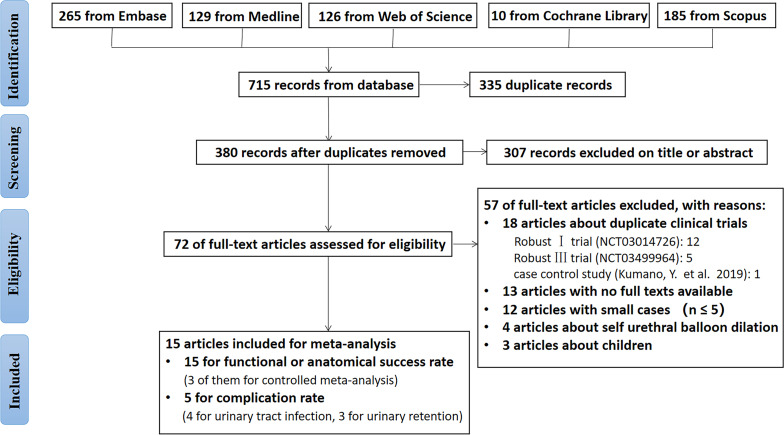
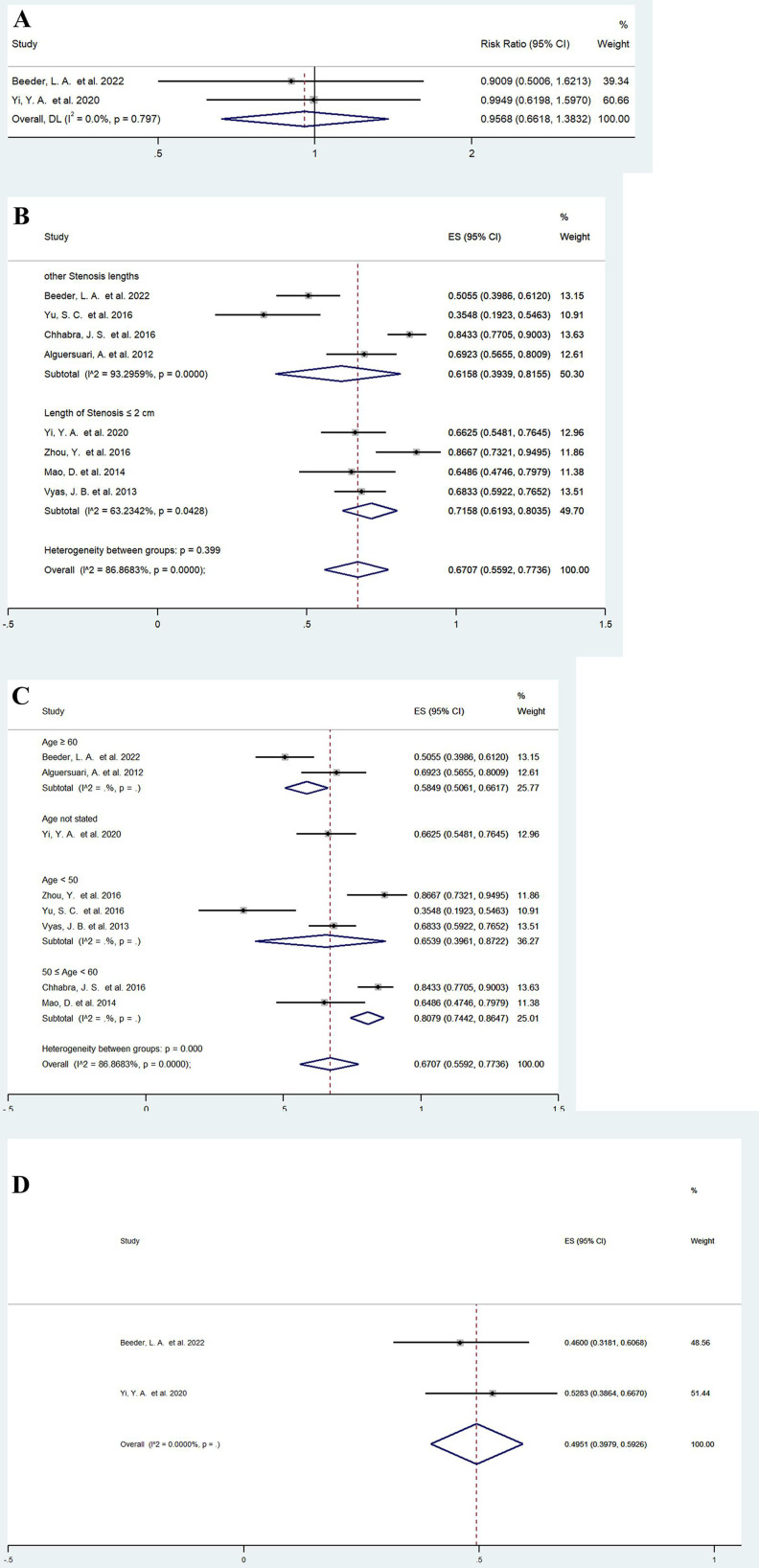
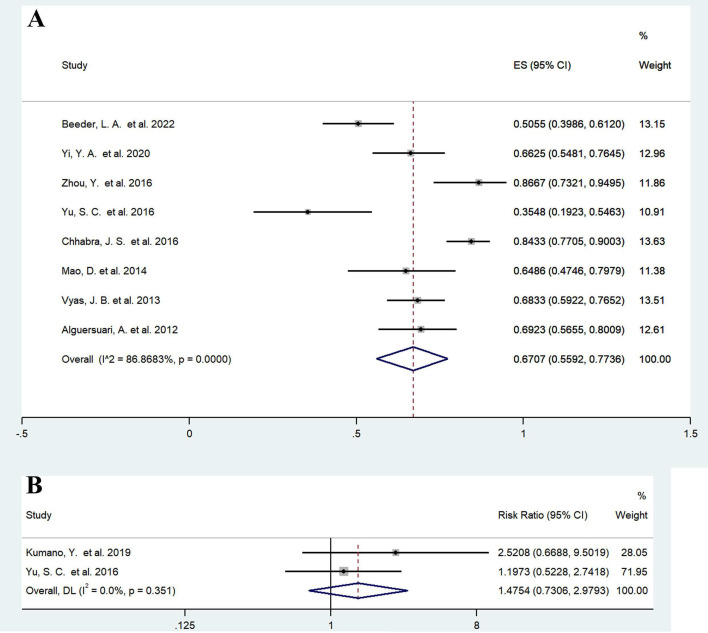
Fifteen studies with 715 patients were ultimately included in this systematic review. The pooled results of eight studies showed that the reported success rate of simple balloon dilation for male urethral strictures was 67.07% (95% confidence interval [CI]: 55.92% to 77.36%). The maximum urinary flow rate at 3 months (risk ratio [RR]= 2.6510, 95% CI: 1.0681 to 4.2338, p<0.01) and the maximum urinary flow rate at 1 year (RR= 1.6637, 95% CI: 1.1837 to 2.1437, p<0.05) were significantly different after dilation. There is insufficient evidence to suggest that balloon dilation is superior to optical internal urethrotomy or direct visual internal urethrotomy (DVIU) (RR= 1.4754, 95% CI: 0.7306 to 2.9793, p=0.278).
Balloon dilation may be an intermediate step before urethroplasty and is a promising alternative therapy to simple dilation and DVIU. The balloon is a promising drug delivery tool, and paclitaxel drug-coated balloon dilation is effective in reducing retreatment rates in patients with recurrent anterior urethral strictures. The aetiology, location, length, previous treatment of urethral stricture may be associated with the efficacy of balloon dilation.
CRD42022334403.
经内腔微创治疗尿道狭窄已有数十年的争论。本研究旨在回顾和讨论球囊扩张治疗男性尿道狭窄的安全性、有效性及影响临床应用的因素。
系统评价和荟萃分析。
2022 年 7 月 17 日前在 Embase、Medline、Web of Science、Cochrane 图书馆和 Scopus 检索发表的文献。
两名独立的研究人员筛选和评估结果,纳入所有关于球囊扩张治疗男性尿道狭窄的临床研究。
主要结局为成功率、不良事件发生率、国际前列腺症状评分、最大尿流率(Qmax)和残余尿量。采用 Stata V.14.0 进行统计学分析。
最终纳入 15 项研究,共 715 例患者。8 项研究的汇总结果显示,单纯球囊扩张治疗男性尿道狭窄的报道成功率为 67.07%(95%可信区间:55.92%77.36%)。3 个月时最大尿流率(风险比[RR]=2.6510,95%可信区间:1.06814.2338,p<0.01)和 1 年时最大尿流率(RR=1.6637,95%可信区间:1.18372.1437,p<0.05)差异有统计学意义。但没有足够的证据表明球囊扩张优于光学尿道内切开术或直接可视尿道内切开术(RR=1.4754,95%可信区间:0.73062.9793,p=0.278)。
球囊扩张可能是尿道成形术之前的一个中间步骤,是单纯扩张和 DVIU 的一种有前途的替代治疗方法。球囊是一种有前途的药物输送工具,紫杉醇药物涂层球囊扩张可有效降低复发性前尿道狭窄患者的再治疗率。尿道狭窄的病因、部位、长度、既往治疗可能与球囊扩张的疗效有关。
CRD42022334403。