Department of Biochemistry and Molecular Biology, School of Basic Medical Sciences, Capital Medical University, Beijing 100069, China.
Department of Microbiology, School of Basic Medical Sciences, Capital Medical University, Beijing 100069, China.
EBioMedicine. 2024 Mar;101:104993. doi: 10.1016/j.ebiom.2024.104993. Epub 2024 Feb 6.
Macrophages are innate immune cells whose phagocytosis function is critical to the prognosis of stroke and peritonitis. cis-aconitic decarboxylase immune-responsive gene 1 (Irg1) and its metabolic product itaconate inhibit bacterial infection, intracellular viral replication, and inflammation in macrophages. Here we explore whether itaconate regulates phagocytosis.
Phagocytosis of macrophages was investigated by time-lapse video recording, flow cytometry, and immunofluorescence staining in macrophage/microglia cultures isolated from mouse tissue. Unbiased RNA-sequencing and ChIP-sequencing assays were used to explore the underlying mechanisms. The effects of Irg1/itaconate axis on the prognosis of intracerebral hemorrhagic stroke (ICH) and peritonitis was observed in transgenic (Irg1; Cx3cr1, cKO) mice or control mice in vivo.
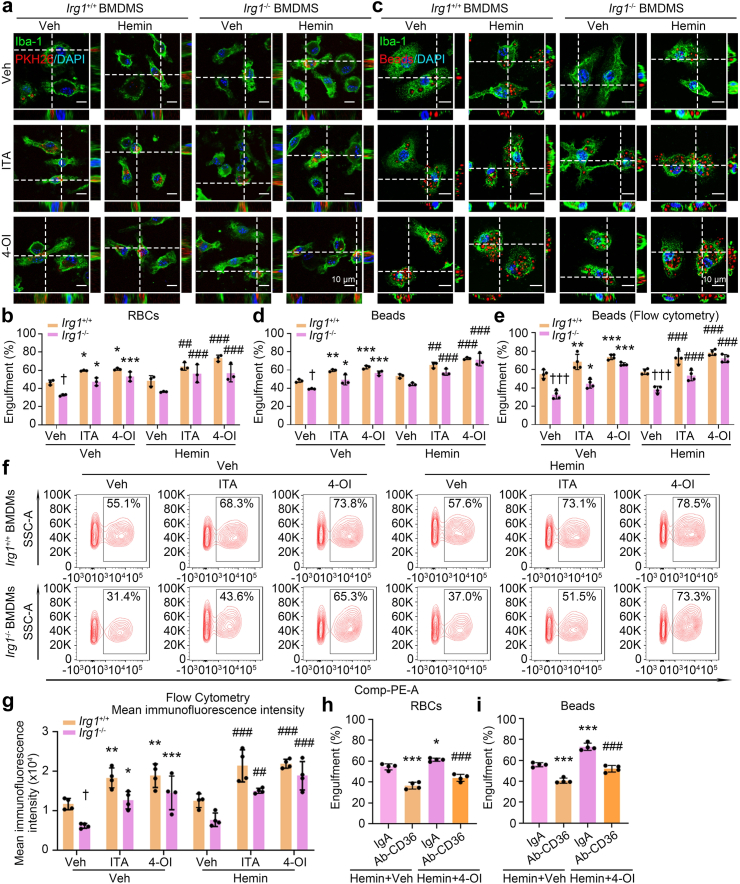
In a mouse model of ICH, depletion of Irg1 in macrophage/microglia decreased its phagocytosis of erythrocytes, thereby exacerbating outcomes (n = 10 animals/group, p < 0.05). Administration of sodium itaconate/4-octyl itaconate (4-OI) promoted macrophage phagocytosis (n = 7 animals/group, p < 0.05). In addition, in a mouse model of peritonitis, Irg1 deficiency in macrophages also inhibited phagocytosis of Staphylococcus aureus (n = 5 animals/group, p < 0.05) and aggravated outcomes (n = 9 animals/group, p < 0.05). Mechanistically, 4-OI alkylated cysteine 155 on the Kelch-like ECH-associated protein 1 (Keap1), consequent in nuclear translocation of nuclear factor erythroid 2-related factor 2 (Nrf2) and transcriptional activation of Cd36 gene. Blocking the function of CD36 completely abolished the phagocytosis-promoting effects of Irg1/itaconate axis in vitro and in vivo.
Our findings provide a potential therapeutic target for phagocytosis-deficiency disorders, supporting further development towards clinical application for the benefit of stroke and peritonitis patients.
The National Natural Science Foundation of China (32070735, 82371321 to Q. Li, 82271240 to F. Yang) and the Beijing Natural Science Foundation Program and Scientific Research Key Program of Beijing Municipal Commission of Education (KZ202010025033 to Q. Li).
巨噬细胞是先天免疫细胞,其吞噬功能对中风和腹膜炎的预后至关重要。顺乌头酸脱羧酶免疫反应基因 1(Irg1)及其代谢产物衣康酸可抑制巨噬细胞中的细菌感染、细胞内病毒复制和炎症。本研究旨在探讨衣康酸是否调节吞噬作用。
利用活细胞延时拍摄、流式细胞术和免疫荧光染色技术,在小鼠组织中分离的巨噬细胞/小胶质细胞培养物中研究巨噬细胞的吞噬作用。利用无偏 RNA 测序和 ChIP 测序实验来探讨潜在的机制。在体内观察 Irg1/衣康酸轴对脑出血(ICH)和腹膜炎预后的影响,实验对象为 Irg1 基因敲除(Irg1; Cx3cr1, cKO)转基因小鼠或对照小鼠。
在 ICH 小鼠模型中,巨噬细胞/小胶质细胞中 Irg1 的缺失会降低其对红细胞的吞噬作用,从而加重预后(每组 10 只动物,p<0.05)。衣康酸钠/4-辛基衣康酸(4-OI)的给药促进了巨噬细胞的吞噬作用(每组 7 只动物,p<0.05)。此外,在腹膜炎小鼠模型中,巨噬细胞中 Irg1 的缺失也抑制了金黄色葡萄球菌的吞噬作用(每组 5 只动物,p<0.05)并加重了预后(每组 9 只动物,p<0.05)。机制上,4-OI 使 Kelch 样 ECH 相关蛋白 1(Keap1)上的半胱氨酸 155 发生烷基化,导致核转录因子红细胞 2 相关因子 2(Nrf2)核转位和 CD36 基因的转录激活。阻断 CD36 的功能完全消除了 Irg1/衣康酸轴在体外和体内对吞噬作用的促进作用。
我们的发现为吞噬作用缺陷疾病提供了一个潜在的治疗靶点,支持进一步开发用于中风和腹膜炎患者的临床应用。
国家自然科学基金(32070735,82371321 给李全强,82271240 给杨芳)和北京市自然科学基金计划及北京市教委科研重点项目(KZ202010025033 给李全强)。