Yang Yue, Fu Kan-Zuo, Pan Gu
Department of Gastroenterology III, Heilongjiang Provincial Hospital, Harbin 150036, Heilongjiang Province, China.
Department of Nursing, The Second Hospital of Harbin, Harbin 150056, Heilongjiang Province, China.
World J Gastrointest Surg. 2024 Jan 27;16(1):228-238. doi: 10.4240/wjgs.v16.i1.228.
Oncostatin M (OSM) is a pleiotropic cytokine which is implicated in the pathogenesis of inflammatory bowel disease (IBD).
To evaluate the prognostic role of OSM in IBD patients.
Literature search was conducted in electronic databases (Google Scholar, Embase, PubMed, Science Direct, Springer, and Wiley). Studies were selected if they reported prognostic information about OSM in IBD patients. Outcome data were synthesized, and meta-analyses were performed to estimate standardized mean differences (SMDs) in OSM levels between treatment responders and non-responders and to seek overall correlations of OSM with other inflammatory biomarkers.
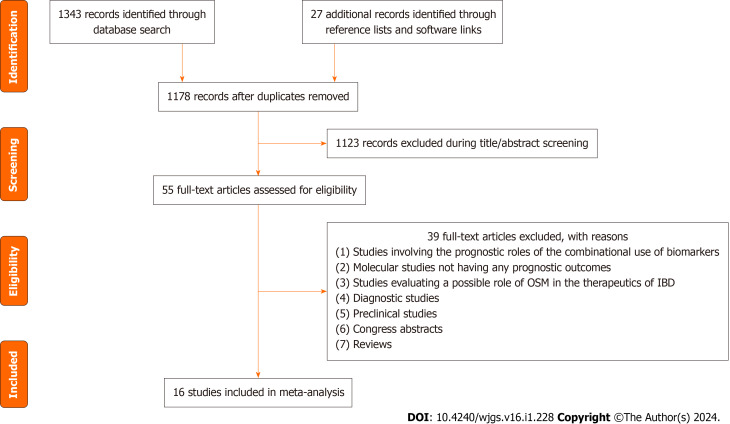
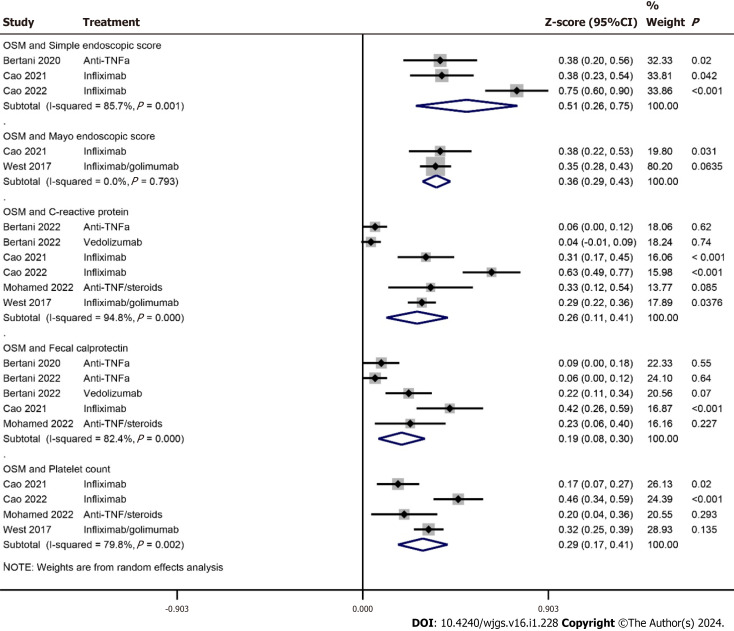
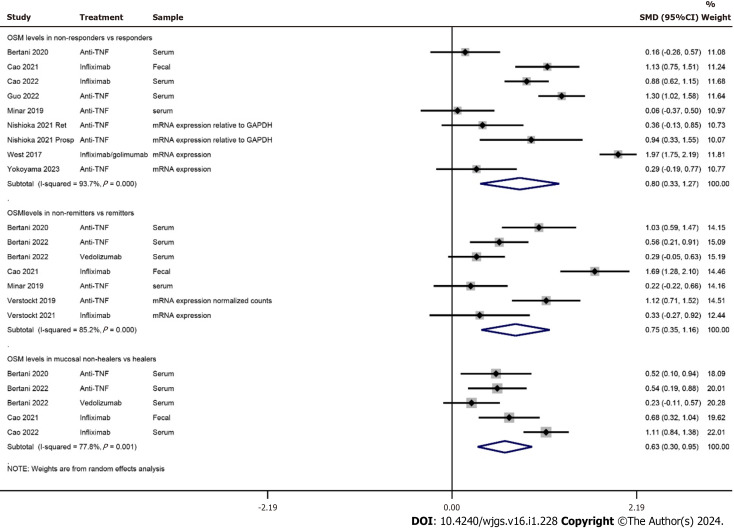
Sixteen studies (818 Crohn's disease and 686 ulcerative colitis patients treated with anti-tumor necrosis factor-based therapies) were included. OSM levels were associated with IBD severity. A meta-analysis found significantly higher OSM levels in non-responders than in responders to therapy [SMD 0.80 (0.33, 1.27); = 0.001], in non-remitters than in remitters [SMD 0.75 (95%CI: 0.35 to 1.16); < 0.0001] and in patients with no mucosal healing than in those with mucosal healing [SMD 0.63 (0.30, 0.95); < 0.0001]. Area under receiver operator curve values showed considerable variability between studies but in general higher OSM levels were associated with poor prognosis. OSM had significant correlations with Simple Endoscopic Score of Crohn's disease [ = 0.47 (95%CI: 0.25 to 0.64); < 0.0001], Mayo Endoscopic Score [ = 0.35 (95%CI: 0.28 to 0.41); < 0.0001], fecal calprotectin [ = 0.19 (95%CI: 0.08 to 0.3); = 0.001], C-reactive protein [ = 0.25 (95%CI: 0.11 to 0.39); < 0.0001], and platelet count [ = 0.28 (95%CI: 0.17 to 0.39); < 0.0001].
OSM is a potential candidate for determining the severity of disease and predicting the outcomes of anti-tumor necrosis factor-based therapies in IBD patients.
抑瘤素M(OSM)是一种多效性细胞因子,与炎症性肠病(IBD)的发病机制有关。
评估OSM在IBD患者中的预后作用。
在电子数据库(谷歌学术、Embase、PubMed、科学Direct、Springer和Wiley)中进行文献检索。如果研究报告了IBD患者中OSM的预后信息,则将其纳入。对结果数据进行综合分析,并进行荟萃分析,以估计治疗反应者和无反应者之间OSM水平的标准化平均差异(SMD),并寻找OSM与其他炎症生物标志物的总体相关性。
纳入了16项研究(818例克罗恩病患者和686例接受基于抗肿瘤坏死因子治疗的溃疡性结肠炎患者)。OSM水平与IBD严重程度相关。荟萃分析发现,治疗无反应者的OSM水平显著高于反应者[SMD 0.80(0.33,1.27);P = 0.001],未缓解者高于缓解者[SMD 0.75(95%CI:0.35至1.16);P < 0.0001],无黏膜愈合者高于有黏膜愈合者[SMD 0.63(0.30,0.95);P < 0.0001]。受试者工作特征曲线下面积值在各研究之间存在相当大的差异,但总体而言,较高的OSM水平与预后不良相关。OSM与克罗恩病简单内镜评分[P = 0.47(95%CI:0.25至0.64);P < 0.0001]、梅奥内镜评分[P = 0.35(95%CI:0.28至0.41);P < 0.0001]、粪便钙卫蛋白[P = 0.19(95%CI:0.08至0.3);P = 0.001]、C反应蛋白[P = 0.25(95%CI:0.11至0.39);P < 0.0001]和血小板计数[P = 0.28(95%CI:0.17至0.39);P < 0.0001]显著相关。
OSM是确定IBD患者疾病严重程度和预测基于抗肿瘤坏死因子治疗结果的潜在候选指标。