
美国人不会基于种族来选择他们的医生。
Americans do not select their doctors based on race.
作者信息
Olinger Reilly, Matejka Benjamin, Chakravarty Rohan, Johnston Margaret, Ornelas Eliana, Draves Julia, Jain Nishi, Hentschel Jane, Owen William, Ma Yuchuan, Marx William, Freitag Joshua, Zhang Nicholas, Guage Cameron, Crabtree Charles
机构信息
Dartmouth College, Hanover, NH, United States.
出版信息
Front Sociol. 2024 Jan 24;8:1191080. doi: 10.3389/fsoc.2023.1191080. eCollection 2023.
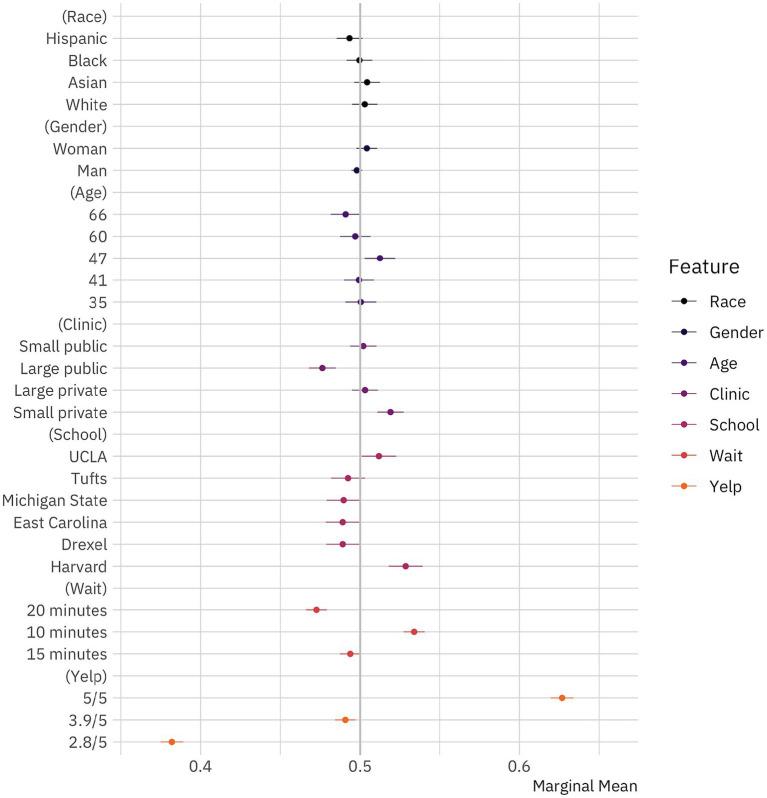
To what extent do Americans racially discriminate against doctors? While a large literature shows that racial biases pervade the American healthcare system, there has been no systematic examination of these biases in terms of who patients select for medical treatment. We examine this question in the context of the ongoing global COVID-19 pandemic, where a wealth of qualitative evidence suggests that discrimination against some historically marginalized communities, particularly Asians, has increased throughout the United States. Conducting a well-powered conjoint experiment with a national sample of 1,498 Americans, we find that respondents do not, on average, discriminate against Asian or doctors from other systematically minoritized groups. We also find no consistent evidence of treatment effect heterogeneity; Americans of all types appear not to care about the racial identity of their doctor, at least in our study. This finding has important implications for the potential limits of American prejudice.
美国人在多大程度上对医生存在种族歧视?虽然大量文献表明种族偏见在美国医疗体系中普遍存在,但尚未有人从患者选择医疗服务提供者的角度对这些偏见进行系统研究。我们在当前全球新冠疫情的背景下研究了这个问题,大量定性证据表明,在美国,针对一些历史上处于边缘地位的群体,尤其是亚裔的歧视有所增加。我们对1498名美国成年人进行了一项具有充分效力的联合实验,发现受访者总体上没有歧视亚裔医生或其他系统性边缘化群体的医生。我们也没有找到治疗效果存在异质性的一致证据;至少在我们的研究中,各类美国人似乎都不在意他们医生的种族身份。这一发现对美国偏见的潜在局限性具有重要意义。


 Zotero 插件