Lewis Krystina B, Smith Maureen, Stacey Dawn, Carley Meg, Graham Ian D
School of Nursing, Faculty of Health Sciences, University of Ottawa, Ottawa, ON, Canada.
Knowledge User, Ottawa, ON, Canada.
Res Involv Engagem. 2024 Feb 9;10(1):21. doi: 10.1186/s40900-024-00550-w.
When people who can use or benefit from research findings are engaged as partners on study teams, the quality and impact of findings are better. These people can include patients/consumers and clinicians who do not identify as researchers. They are referred to as "knowledge users". This partnered approach is called integrated knowledge translation (IKT). We know little about knowledge users' involvement in the conduct of systematic reviews. We aimed to evaluate team members' degree of meaningful engagement and their perceptions of having used an IKT approach when updating the Cochrane Review of Patient Decision Aids.
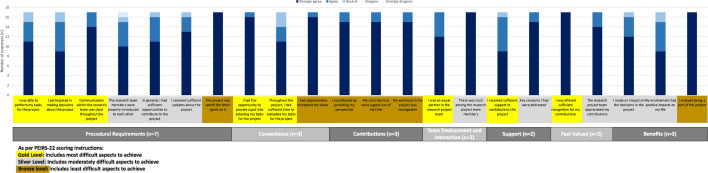
We conducted a pre-post mixed methods study. We surveyed all team members at two time points. Before systematic review conduct, all participating team members indicated their preferred level of involvement within each of the 12 steps of the systematic review process from "Screen titles/abstracts" to "Provide feedback on draft article". After, they reported on their degree of satisfaction with their achieved level of engagement across each step and the degree of meaningful engagement using the Patient Engagement In Research Scale (PEIRS-22) across 7 domains scored from 100 (extremely meaningful engagement) to 0 (no meaningful engagement). We solicited their experiences with the IKT approach using open-ended questions. We analyzed quantitative data descriptively and qualitative data using content analysis. We triangulated data at the level of study design and interpretation.
Of 21 team members, 20 completed the baseline survey (95.2% response rate) and 17/20 (85.0% response rate) the follow-up survey. There were 11 (55%) researchers, 3 (15%) patients/consumers, 5 (25%) clinician-researchers, and 1 (5%) graduate student. At baseline, preferred level of involvement in the 12 systematic review steps varied from n = 3 (15%) (search grey literature sources) to n = 20 (100%) (provide feedback on the systematic review article). At follow-up, 16 (94.1%) participants were totally or very satisfied with the extent to which they were involved in these steps. All (17, 100%) agreed that the process was co-production. Total PEIRS-22 scores revealed most participants reported extremely (13, 76.4%) or very (2, 11.8%) meaningful degree of engagement. Triangulated data revealed that participants indicated benefit to having been engaged in an authentic research process that incorporated diverse perspectives, resulting in better and more relevant outputs. Reported challenges were about time, resources, and the logistics of collaborating with a large group.
Following the use of an IKT approach during the conduct of a systematic review, team members reported high levels of meaningful engagement. These results contribute to our understanding of ways to co-produce systematic reviews.
当能够使用研究结果或从中受益的人作为研究团队的合作伙伴参与其中时,研究结果的质量和影响力会更高。这些人可以包括患者/消费者以及不被视为研究人员的临床医生。他们被称为“知识使用者”。这种合作方式被称为整合知识转化(IKT)。我们对知识使用者参与系统评价实施的情况了解甚少。我们旨在评估团队成员有意义参与的程度以及他们在更新《Cochrane患者决策辅助工具综述》时对采用IKT方法的看法。
我们进行了一项前后混合方法研究。我们在两个时间点对所有团队成员进行了调查。在系统评价开展之前,所有参与的团队成员表明了他们在系统评价过程从“筛选标题/摘要”到“对文章草稿提供反馈”这12个步骤中各自偏好的参与程度。之后,他们报告了对自己在每个步骤中实际参与程度的满意度,以及使用患者研究参与量表(PEIRS - 22)在7个领域中从100分(极其有意义的参与)到0分(无有意义的参与)进行评分的有意义参与程度。我们通过开放式问题征求他们对IKT方法的体验。我们对定量数据进行描述性分析,并对定性数据进行内容分析。我们在研究设计和解释层面进行数据三角验证。
21名团队成员中,20名完成了基线调查(回复率95.2%),17/20(回复率85.0%)完成了随访调查。有11名(55%)研究人员、3名(15%)患者/消费者、5名(25%)临床研究人员和1名(5%)研究生。在基线时,在12个系统评价步骤中偏好的参与程度从n = 3(15%)(搜索灰色文献来源)到n = 20(100%)(对系统评价文章提供反馈)不等。在随访时,16名(94.1%)参与者对他们在这些步骤中的参与程度完全或非常满意。所有(17名,100%)参与者都认为这个过程是共同生产。PEIRS - 22总分显示,大多数参与者报告参与程度极其(13名,76.4%)或非常(2名,11.8%)有意义。数据三角验证显示,参与者表示参与一个纳入了不同观点的真实研究过程有好处,从而产生了更好且更相关的成果。报告的挑战涉及时间、资源以及与一大群人合作的后勤问题。
在系统评价实施过程中采用IKT方法后,团队成员报告有很高程度的有意义参与。这些结果有助于我们理解共同生产系统评价的方式。