Wu Shu-I, Huang Yu-Hsin, Kao Kai-Liang, Lin Yu-Wen, Tsai Po-Li, Chiu Nan-Chang, Chung Ching-Hu, Chen Chie-Pein
Department of Medicine, MacKay Medical College, #46, Sec. 3, Zhongzheng Rd, Sanzhi Dist., New Taipei City, 252, Taiwan.
Department of Psychiatry, MacKay Memorial Hospital, Taipei, Taiwan.
Child Adolesc Psychiatry Ment Health. 2024 Feb 8;18(1):23. doi: 10.1186/s13034-024-00714-2.
Marginally low birth weight (MLBW) is defined as a birth weight of 2000 ~ 2499 g. Inconsistent findings have been reported on whether children with low birth weight had higher rates of neurological, attention, or cognitive symptoms. No studies have explored the occurrence of clinically diagnosed psychiatric disorders in term- born MLBW infants. We aimed to investigate the risk of subsequent psychiatric disorders in term-born children with MLBW.
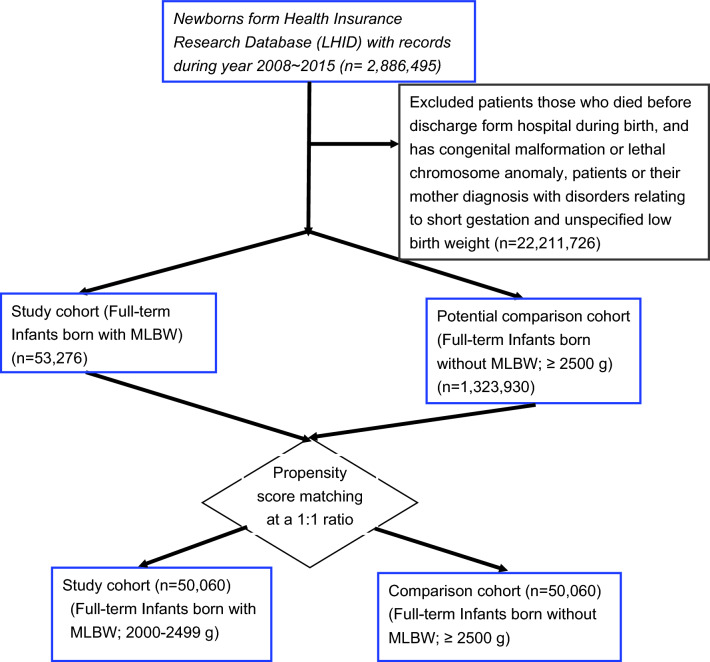
This is a nationwide retrospective cohort study, by analysing the data from Taiwan's National Health Insurance Research Database from 2008 to 2018. The study population includes propensity-score-matched term-born infants with MLBW and those without MLBW (birth weight ≥ 2500 g). Cox proportional hazard analysis was used after adjustment for potential demographic and perinatal comorbidity confounders. Incidence rates and hazard ratios (HR) of 11 psychiatric clinical diagnoses were evaluated.
A total of 53,276 term-born MLBW infants and 1,323,930 term-born infants without MLBW were included in the study. After propensity score matching for demographic variables and perinatal comorbidities, we determined that the term-born MLBW infants (n = 50,060) were more likely to have attention deficit and hyperactivity disorder (HR = 1.26, 95% confidence interval (CI) [1.20, 1.33]), autism spectrum disorder (HR = 1.26, 95% CI [1.14, 1.40]), conduct disorder (HR = 1.25, 95% CI [1.03, 1.51]), emotional disturbance (HR: = 1.13, 95% CI [1.02, 1.26]), or specific developmental delays (HR = 1.38, 95% CI [1.33, 1.43]) than term-born infants without MLBW (n = 50,060).
MLBW was significantly associated with the risk of subsequent psychiatric disorder development among term-born infants. The study findings demonstrate that further attention to mental health and neurodevelopment issues may be necessary in term-born children with MLBW. However, possibilities of misclassification in exposures or outcomes, and risks of residual and unmeasured confounding should be concerned when interpreting our data.
边缘低出生体重(MLBW)定义为出生体重2000~2499克。关于低出生体重儿童是否有更高的神经、注意力或认知症状发生率,已有不一致的研究结果报道。尚无研究探讨足月出生的MLBW婴儿临床诊断精神障碍的发生情况。我们旨在调查足月出生的MLBW儿童后续发生精神障碍的风险。
这是一项全国性回顾性队列研究,通过分析2008年至2018年台湾国民健康保险研究数据库的数据。研究人群包括倾向得分匹配的足月出生的MLBW婴儿和非MLBW婴儿(出生体重≥2500克)。在对潜在的人口统计学和围产期合并症混杂因素进行调整后,采用Cox比例风险分析。评估了11种精神科临床诊断的发病率和风险比(HR)。
本研究共纳入53276例足月出生的MLBW婴儿和1323930例足月出生的非MLBW婴儿。在对人口统计学变量和围产期合并症进行倾向得分匹配后,我们确定足月出生的MLBW婴儿(n = 50060)比足月出生的非MLBW婴儿(n = 50060)更易患注意力缺陷多动障碍(HR = 1.26,95%置信区间(CI)[1.20,1.33])、自闭症谱系障碍(HR = 1.26,95%CI [1.14,1.40])、品行障碍(HR = 1.25,95%CI [1.03,1.51])、情绪障碍(HR = 1.13,95%CI [1.02,1.26])或特定发育迟缓(HR = 1.38,95%CI [1.33,1.43])。
MLBW与足月出生婴儿后续发生精神障碍的风险显著相关。研究结果表明,对于足月出生的MLBW儿童,可能需要进一步关注其心理健康和神经发育问题。然而,在解释我们的数据时,应考虑暴露或结局分类错误的可能性,以及残留和未测量混杂因素的风险。