Hildenbrand Aimee K, Amaro Christina M, Bear Benjamin, Soprano Catherine M, Salamon Katherine S
Center for Healthcare Delivery Science, Nemours Children's Health, Wilmington, DE, USA.
Division of Behavioral Health, Nemours Children's Hospital Delaware, Wilmington, DE, USA.
J Pain Res. 2024 Feb 3;17:525-533. doi: 10.2147/JPR.S430411. eCollection 2024.
We examine referral sources and clinical characteristics for youth presenting to an outpatient interdisciplinary pediatric chronic pain program.
Referral data were extracted from the electronic health record. PROMIS Pediatric Anxiety and Pain Interference Scales were administered at an initial evaluation visit.
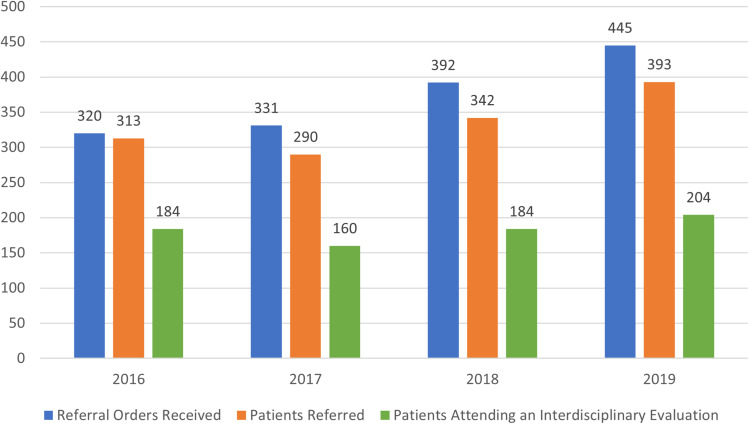
The program received 1488 referrals between 2016 and 2019, representing 1338 patients, with increasing volume of referrals over time. Referrals were primarily from orthopedics (19.6%), physical medicine and rehabilitation (18.8%), neurology (14.4%), and rheumatology (12.6%). Patients referred were primarily female (75.4%), White (80.1%), English-speaking (98.4%) adolescents (median=15.0 years). Of those referred, 732 (54.7%) attended an interdisciplinary evaluation (ie, with ≥2 disciplines). Adolescent anxiety was within the expected range by self-report (N=327, M=55.67) and parent proxy-report (N=354, M=57.70). Pain interference was moderately elevated by self-report (N=323, M=61.52) and parent proxy-report (N=356, M=64.02). There were no differences between patients referred who attended versus did not attend an interdisciplinary evaluation based on age, sex, ethnicity, or language. A smaller than expected proportion of referred Black patients (44%, =0.02) and patients referred from orthopedics (40%) or pulmonology (11%) attended an evaluation, whereas a larger than expected proportion of those referred from physical medicine and rehabilitation (78%) were evaluated (<0.001).
Results highlight the demand for outpatient interdisciplinary pediatric chronic pain treatment. Findings can inform decisions related to staffing and service design for pediatric hospitals that aim to establish or grow outpatient pediatric chronic pain programs.
我们研究了前往门诊跨学科儿科慢性疼痛项目就诊的青少年的转诊来源和临床特征。
从电子健康记录中提取转诊数据。在初次评估就诊时使用患者报告结果测量信息系统(PROMIS)儿科焦虑和疼痛干扰量表。
该项目在2016年至2019年期间共收到1488例转诊,涉及1338名患者,转诊量随时间增加。转诊主要来自骨科(19.6%)、物理医学与康复科(18.8%)、神经科(14.4%)和风湿科(12.6%)。转诊患者主要为女性(75.4%)、白人(80.1%)、说英语(98.4%)的青少年(中位数=15.0岁)。在转诊患者中,732例(54.7%)接受了跨学科评估(即涉及≥2个学科)。青少年焦虑自评(N=327,M=55.67)和家长代理报告(N=354,M=57.70)均在预期范围内。疼痛干扰自评(N=323,M=61.52)和家长代理报告(N=356,M=64.02)均中度升高。基于年龄、性别、种族或语言,接受与未接受跨学科评估的转诊患者之间无差异。转诊的黑人患者(44%,P=0.02)以及来自骨科(40%)或肺病科(11%)的转诊患者接受评估的比例低于预期,而来自物理医学与康复科的转诊患者接受评估的比例(78%)高于预期(P<0.001)。
结果凸显了门诊跨学科儿科慢性疼痛治疗的需求。研究结果可为旨在建立或扩大门诊儿科慢性疼痛项目的儿童医院的人员配备和服务设计决策提供参考。