Department of Psychology, University of Essex, Colchester CO4 3SQ, United Kingdom.
ArtScience Interfaculty, Royal Academy of Art, Royal Conservatory, The Hague 2514 AN, Netherlands.
Soc Cogn Affect Neurosci. 2024 Feb 15;19(1). doi: 10.1093/scan/nsae013.
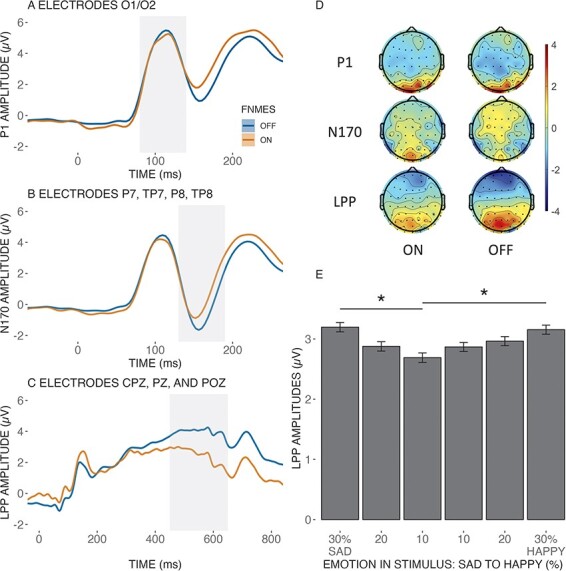
The role of facial feedback in facial emotion recognition remains controversial, partly due to limitations of the existing methods to manipulate the activation of facial muscles, such as voluntary posing of facial expressions or holding a pen in the mouth. These procedures are indeed limited in their control over which muscles are (de)activated when and to what degree. To overcome these limitations and investigate in a more controlled way if facial emotion recognition is modulated by one's facial muscle activity, we used computer-controlled facial neuromuscular electrical stimulation (fNMES). In a pre-registered EEG experiment, ambiguous facial expressions were categorised as happy or sad by 47 participants. In half of the trials, weak smiling was induced through fNMES delivered to the bilateral Zygomaticus Major muscle for 500 ms. The likelihood of categorising ambiguous facial expressions as happy was significantly increased with fNMES, as shown with frequentist and Bayesian linear mixed models. Further, fNMES resulted in a reduction of P1, N170 and LPP amplitudes. These findings suggest that fNMES-induced facial feedback can bias facial emotion recognition and modulate the neural correlates of face processing. We conclude that fNMES has potential as a tool for studying the effects of facial feedback.
面部反馈对面部情绪识别的作用仍然存在争议,部分原因是现有方法在操纵面部肌肉激活方面存在局限性,例如自愿摆出面部表情或在口中衔笔。这些程序确实在控制何时以及在何种程度上激活(或不激活)哪些肌肉方面存在局限性。为了克服这些局限性,并以更受控的方式研究面部肌肉活动是否会调节面部情绪识别,我们使用了计算机控制的面部神经肌肉电刺激 (fNMES)。在一项预先注册的 EEG 实验中,47 名参与者将模棱两可的面部表情归类为快乐或悲伤。在一半的试验中,通过向双侧颧大肌施加 500ms 的 fNMES 来诱导微弱的微笑。如频率主义和贝叶斯线性混合模型所示,fNMES 显著增加了将模棱两可的面部表情归类为快乐的可能性。此外,fNMES 导致 P1、N170 和 LPP 幅度减小。这些发现表明,fNMES 诱导的面部反馈可以影响面部情绪识别,并调节面部处理的神经相关性。我们得出结论,fNMES 作为研究面部反馈影响的工具具有潜力。