Center for Psycho-oncology and Palliative Care, Nagoya City University Hospital, Nagoya, Japan.
Department of Psychiatry and Cognitive-Behavioral Medicine, Nagoya City University Graduate School of Medical Sciences, Nagoya, Japan.
Jpn J Clin Oncol. 2024 May 7;54(5):507-515. doi: 10.1093/jjco/hyae006.
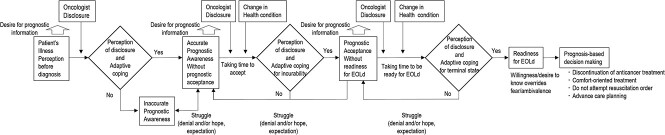
Most patients with advanced cancer initially express a desire to be informed of their prognosis, and prognostic discussions between patients and their oncologists can trigger the subsequent trajectory of prognostic cognitions. On the continuum of prognostic cognition, including inaccurate/accurate prognostic awareness (awareness of incurability of cancer, terminal nature of illness or life expectancy) and prognostic acceptance (accepting one's prognosis), patients' perceptions of being informed of their prognosis by oncologists and patients' coping strategy for serious medical conditions regulate prognostic cognitions. However, nearly half of the patients with advanced cancer have poor prognostic awareness, and few patients achieve prognostic acceptance. These phenomena partly act as barriers to participation in advance care planning. When oncologists engage in advance care planning conversations, they must assess the patient's prognostic cognition and readiness for advance care planning. Considering the inaccurate prognostic awareness in a non-negligible proportion of patients and that astatic patients' preferences for future treatment and care are influenced by prognostic cognition, more research on decision-making support processes for high-quality and goal-concordant end-of-life care is needed along with research of advance care planning. In addition to making decisions regarding future medical treatment and care, oncologists must engage in continuous and dynamic goal-of-care conversations with empathic communication skills and compassion from diagnosis to end-of-life care.
大多数晚期癌症患者最初都表示希望了解自己的预后情况,而患者与肿瘤医生之间的预后讨论可能会引发随后的预后认知轨迹。在预后认知的连续体中,包括不准确/准确的预后意识(意识到癌症不可治愈、疾病终末期或预期寿命)和预后接受(接受自己的预后),患者对肿瘤医生告知其预后的感知以及患者对严重疾病的应对策略调节预后认知。然而,近一半的晚期癌症患者预后意识差,很少有患者能够接受预后。这些现象在一定程度上成为参与预先护理计划的障碍。当肿瘤医生进行预先护理计划对话时,他们必须评估患者的预后认知和预先护理计划的准备情况。考虑到相当一部分患者存在不准确的预后意识,以及静态患者对未来治疗和护理的偏好受到预后认知的影响,除了预先护理计划的研究外,还需要更多关于高质量和目标一致的临终关怀决策支持过程的研究。除了对未来的医疗治疗和护理做出决策外,肿瘤医生还必须从诊断到临终关怀,运用同理心沟通技巧和同情心,与患者进行持续和动态的关怀目标对话。