Division of Neuroscience, The University of Sheffield, Sheffield, UK.
Sheffield Centre for Health and Related Research (SCHARR), The University of Sheffield, Sheffield, UK, and.
Amyotroph Lateral Scler Frontotemporal Degener. 2024 May;25(3-4):290-298. doi: 10.1080/21678421.2024.2314061. Epub 2024 Feb 9.
Understand the practice and beliefs of healthcare professionals (HCPs) supporting the decision-making of people with MND (pwMND) about gastrostomy placement, including identifying differences between professions.
An online cross-sectional survey disseminated to HCPs who support the decision-making of pwMND about gastrostomy placement.
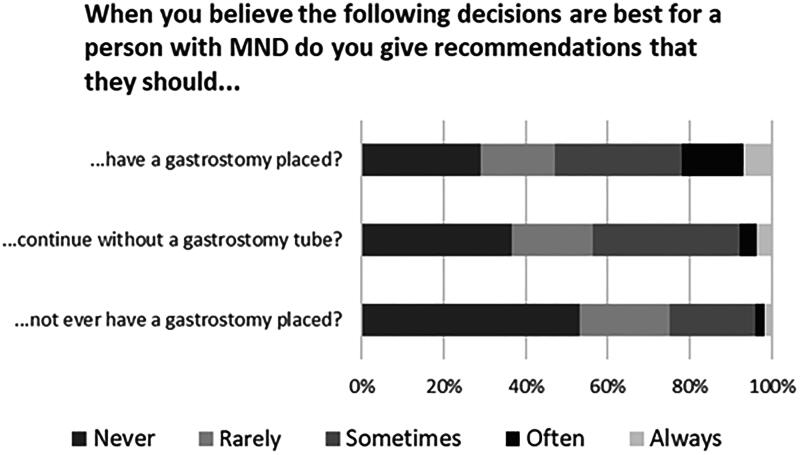
A total of 139 participants completed the survey including representation from a range of healthcare professions. A third (36/101, 36%) initiated discussions about gastrostomy later in practice than they believed was ideal. In relation to the outcome of declining compared to accepting gastrostomy, participants were more likely to discuss aspiration (80% vs. 68%), choking (76% vs. 58%) and prognosis (36% vs. 22%). Participants believed gastrostomies should be placed after a mean 8.1% weight loss since symptom-onset. More participants favored gastrostomy placement before pwMND presented with respiratory symptoms (45%) compared to onset of dysphagia (11%). Half believed pwMND placed gastrostomies too late. Participants were more likely to 'often'/'always' recommend pwMND to have a gastrostomy (23%) than continue without (7%) or decline (4%) gastrostomy, when believing these were the best option for pwMND. Nurses and dietitians discussed the broadest range of information, while doctors were more likely to discuss mortality risk and prognosis.
There is variation in HCPs practice and beliefs about initiating discussions, the sharing of information and recommendations, and timing, about gastrostomy placement. The information shared varies by profession and there is evidence of sub-optimal communication between HCPs. Further research is required to understand how these findings may impact on the decision-making of pwMND about gastrostomy.
了解支持肌萎缩侧索硬化症(ALS)患者(pwMND)进行胃造口术决策的医疗保健专业人员(HCPs)的实践和信念,包括确定不同专业之间的差异。
一项在线横断面调查,向支持 pwMND 进行胃造口术决策的 HCPs 分发。
共有 139 名参与者完成了调查,包括来自各种医疗保健专业的代表。三分之一(36/101,36%)在实践中开始讨论胃造口术的时间晚于他们认为理想的时间。与拒绝接受胃造口术相比,参与者更有可能讨论吸入(80% vs. 68%)、窒息(76% vs. 58%)和预后(36% vs. 22%)。参与者认为胃造口术应在症状发作后平均体重减轻 8.1%时放置。与吞咽困难(11%)相比,更多参与者赞成在 pwMND 出现呼吸症状(45%)之前放置胃造口术。一半的人认为 pwMND 放置胃造口术太晚了。当参与者认为这是 pwMND 的最佳选择时,他们更有可能“经常”/“总是”建议 pwMND 进行胃造口术(23%),而不是不进行(7%)或拒绝(4%)胃造口术。护士和营养师讨论的信息范围最广,而医生更可能讨论死亡率风险和预后。
HCPs 在开始讨论、分享信息和建议以及胃造口术时机方面的实践和信念存在差异。所分享的信息因专业而异,并且证据表明 HCPs 之间存在沟通不畅的情况。需要进一步研究以了解这些发现如何影响 pwMND 对胃造口术的决策。