Department of Neurology, Haukeland University Hospital, Jonas Lies vei 71, 5053 Bergen, Norway.
Department of Clinical Medicine, University of Bergen, 5021 Bergen, Norway.
Int J Mol Sci. 2024 Jan 26;25(3):1520. doi: 10.3390/ijms25031520.
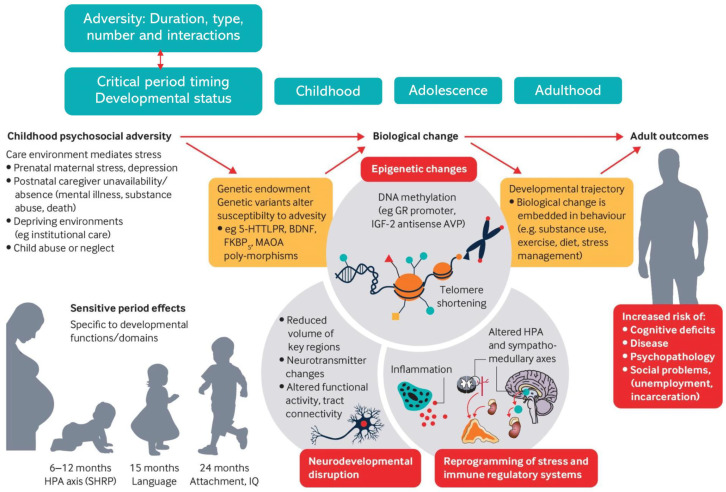
Adverse childhood experiences (ACEs), such as abuse, neglect, and household dysfunction, contribute to long-term systemic toxic stress and inflammation that may last well into adulthood. Such early-life stressors have been associated with increased susceptibility to multiple sclerosis (MS) in observational studies and with the development of experimental autoimmune encephalomyelitis in animal models. In this review, we summarize the evidence for an ACE-mediated increase in MS risk, as well as the potential mechanisms for this association. ACEs dysregulate neurodevelopment, stress responses, and immune reactivity; they also alter the interplay between the immune system and neural networks. All of this may be relevant for MS risk. We further discuss how ACEs induce epigenetic changes and how the toxic stress caused by ACEs may reactivate the Epstein-Barr Virus (EBV), a key risk factor for MS. We conclude by suggesting new initiatives to obtain further insights into this topic.
不良的童年经历(ACEs),如虐待、忽视和家庭功能障碍,会导致长期的系统性毒性应激和炎症,这种情况可能会持续到成年。在观察性研究中,这种早期生活压力与多发性硬化症(MS)的易感性增加有关,也与动物模型中实验性自身免疫性脑脊髓炎的发展有关。在这篇综述中,我们总结了 ACE 介导的 MS 风险增加的证据,以及这种关联的潜在机制。ACE 会使神经发育、应激反应和免疫反应失调;它们还会改变免疫系统和神经网络之间的相互作用。所有这些都可能与 MS 风险有关。我们进一步讨论了 ACE 如何诱导表观遗传变化,以及 ACE 引起的毒性应激如何重新激活 Epstein-Barr 病毒(EBV),EBV 是 MS 的一个关键风险因素。最后,我们提出了新的举措,以进一步深入了解这一主题。