Department of Biological Chemistry, Medical School, National and Kapodistrian University of Athens, 11527 Athens, Greece.
Department of Oncological Sciences, Icahn School of Medicine at Mount Sinai, New York, NY 10029, USA.
Int J Mol Sci. 2024 Jan 28;25(3):1631. doi: 10.3390/ijms25031631.
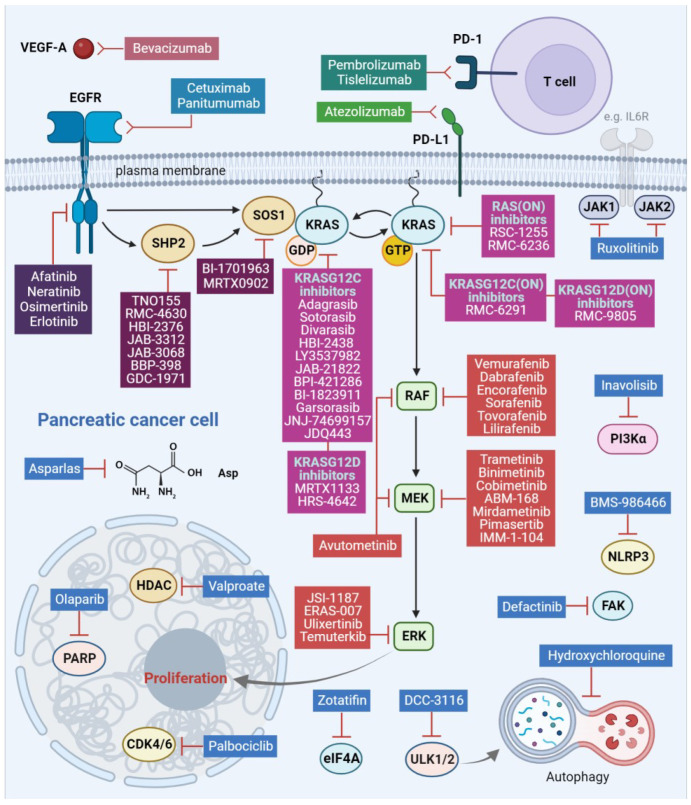
Pancreatic cancer represents a formidable challenge in oncology, primarily due to its aggressive nature and limited therapeutic options. The prognosis of patients with pancreatic ductal adenocarcinoma (PDAC), the main form of pancreatic cancer, remains disappointingly poor with a 5-year overall survival of only 5%. Almost 95% of PDAC patients harbor Kirsten rat sarcoma virus (KRAS) oncogenic mutations. KRAS activates downstream intracellular pathways, most notably the rapidly accelerated fibrosarcoma (RAF)/mitogen-activated protein kinase kinase (MEK)/extracellular signal-regulated kinase (ERK) signaling axis. Dysregulation of the RAF/MEK/ERK pathway is a crucial feature of pancreatic cancer and therefore its main components, RAF, MEK and ERK kinases, have been targeted pharmacologically, largely by small-molecule inhibitors. The recent advances in the development of inhibitors not only directly targeting the RAF/MEK/ERK pathway but also indirectly through inhibition of its regulators, such as Src homology-containing protein tyrosine phosphatase 2 (SHP2) and Son of sevenless homolog 1 (SOS1), provide new therapeutic opportunities. Moreover, the discovery of allele-specific small-molecule inhibitors against mutant KRAS variants has brought excitement for successful innovations in the battle against pancreatic cancer. Herein, we review the recent advances in targeted therapy and combinatorial strategies with focus on the current preclinical and clinical approaches, providing critical insight, underscoring the potential of these efforts and supporting their promise to improve the lives of patients with PDAC.
胰腺癌是肿瘤学领域面临的一项严峻挑战,主要归因于其侵袭性和有限的治疗选择。胰腺导管腺癌(PDAC)是胰腺癌的主要形式,患者的预后仍然令人失望,总体 5 年生存率仅为 5%。几乎 95%的 PDAC 患者携带 Kirsten 鼠肉瘤病毒(KRAS)致癌突变。KRAS 激活下游细胞内途径,特别是快速加速纤维肉瘤(RAF)/丝裂原激活蛋白激酶激酶(MEK)/细胞外信号调节激酶(ERK)信号轴。RAF/MEK/ERK 途径的失调是胰腺癌的一个关键特征,因此其主要成分 RAF、MEK 和 ERK 激酶已被药理学靶向,主要是通过小分子抑制剂。最近在开发抑制剂方面的进展不仅直接靶向 RAF/MEK/ERK 途径,而且通过抑制其调节剂,如 SRC 同源性蛋白酪氨酸磷酸酶 2(SHP2)和 SIX 同源物 1(SOS1),为治疗提供了新的机会。此外,针对突变型 KRAS 变体的等位基因特异性小分子抑制剂的发现为对抗胰腺癌的成功创新带来了兴奋。在此,我们综述了靶向治疗和联合策略的最新进展,重点关注当前的临床前和临床方法,提供了关键的见解,强调了这些努力的潜力,并支持它们改善 PDAC 患者生活的承诺。