Brock Briana A, Mir Hina, Flenaugh Eric L, Oprea-Ilies Gabriela, Singh Rajesh, Singh Shailesh
Department of Microbiology, Biochemistry and Immunology, Morehouse School of Medicine, Atlanta, GA 30310, USA.
Division of Pulmonary Medicine, Morehouse School of Medicine, Atlanta, GA 30310, USA.
Cancers (Basel). 2024 Jan 31;16(3):612. doi: 10.3390/cancers16030612.
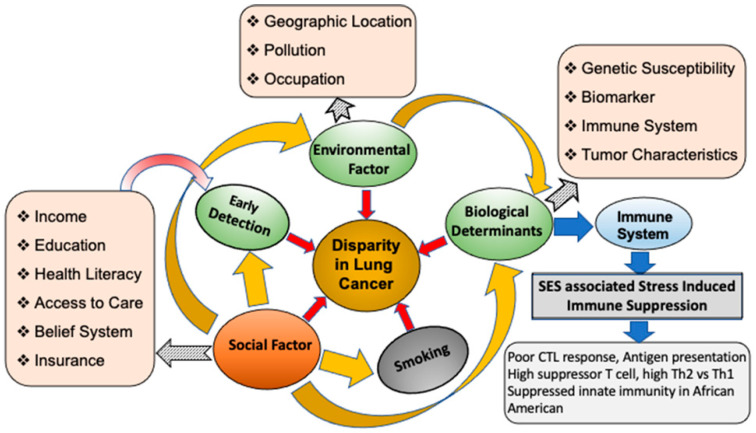
Lung cancer remains a leading cause of death in the United States and globally, despite progress in treatment and screening efforts. While mortality rates have decreased in recent years, long-term survival of patients with lung cancer continues to be a challenge. Notably, African American (AA) men experience significant disparities in lung cancer compared to European Americans (EA) in terms of incidence, treatment, and survival. Previous studies have explored factors such as smoking patterns and complex social determinants, including socioeconomic status, personal beliefs, and systemic racism, indicating their role in these disparities. In addition to social factors, emerging evidence points to variations in tumor biology, immunity, and comorbid conditions contributing to racial disparities in this disease. This review emphasizes differences in smoking patterns, screening, and early detection and the intricate interplay of social, biological, and environmental conditions that make African Americans more susceptible to developing lung cancer and experiencing poorer outcomes.
尽管在治疗和筛查方面取得了进展,但肺癌在美国乃至全球仍然是主要的死亡原因。虽然近年来死亡率有所下降,但肺癌患者的长期生存仍然是一项挑战。值得注意的是,非裔美国(AA)男性在肺癌的发病率、治疗和生存方面与欧裔美国(EA)男性相比存在显著差异。先前的研究探讨了吸烟模式和复杂的社会决定因素,包括社会经济地位、个人信仰和系统性种族主义等因素,表明它们在这些差异中所起的作用。除了社会因素外,新出现的证据表明肿瘤生物学、免疫和合并症的差异也导致了该疾病的种族差异。本综述强调了吸烟模式、筛查和早期检测方面的差异,以及社会、生物学和环境条件之间的复杂相互作用,这些因素使得非裔美国人更容易患肺癌且预后更差。