Centre for Infectious Disease Control, National Institute for Public Health and the Environment, Bilthoven, Netherlands.
Department of Epidemiology and Data Science, Amsterdam University Medical Centre (UMC), Location VU University medical centre (VUmc), Amsterdam, Netherlands.
Front Immunol. 2024 Jan 26;15:1327770. doi: 10.3389/fimmu.2024.1327770. eCollection 2024.
This longitudinal cohort study describes the kinetics in antibody levels after two doses of the bivalent human papillomavirus (HPV) vaccine in girls (birth cohort 2001) vaccinated in the routine Dutch vaccination program at 12 years of age, up to 7.5 years post-vaccination. Also, the antibody response one month post-vaccination of the first cohort of boys (birth cohort 2012, vaccinated at 10 years of age) eligible for HPV vaccination in the Netherlands is presented.
Blood samples and questionnaire data were collected of girls and boys. HPV type-specific antibody concentrations (LU/mL) against HPV16/18/31/33/45/52/58 were assessed using a validated virus-like particle (VLP) multiplex immunoassay. For girls, antibody decays over time were modelled using the modified power-law decay model and the exponential decay model.
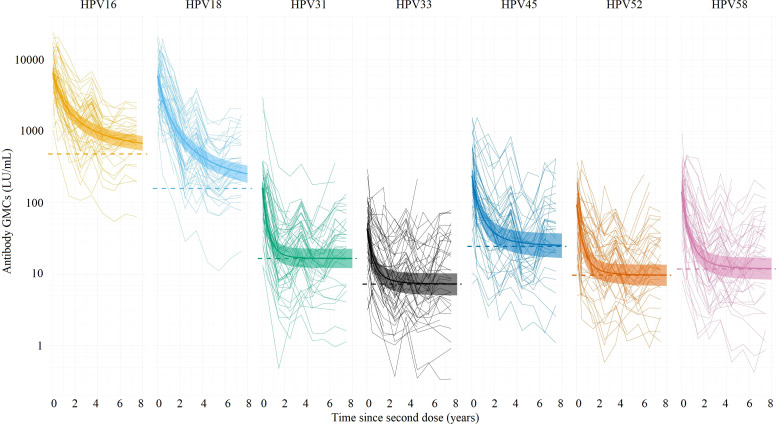
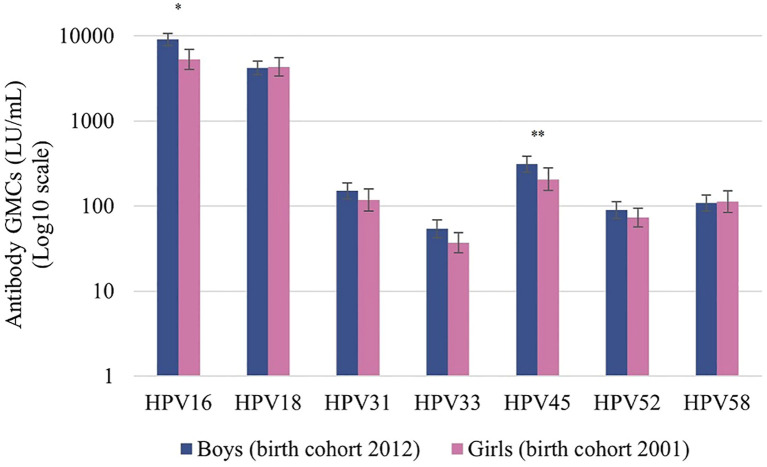
The Geometric Mean Concentrations (GMCs) remained higher for HPV16/18 than for HPV types 31, 33, 45, 52, and 58 among girls up to 7.5 years post-vaccination. The antibody levels of HPV16 and HPV18 reached plateau values of 482 and 159 LU/mL, respectively. Mathematical modelling showed that the half-life values of HPV16/18 were 2.4- to 4.5-fold higher compared with the half-life values of the other HPV types. Among boys (aged 10 years), the GMC for HPV16 was significantly higher than among girls one month post-vaccination (aged 12 years).
The GMCs of all HPV types declined over time, although the GMCs of HPV16/18 remained relatively high up to 7.5 years post-vaccination. The GMCs for HPV16/18 among boys were at least equally high as the GMCs among girls at one month post-vaccination. Further follow-up of the cohort of boys is needed to gain knowledge on long-term immune responses of young boys following bivalent HPV vaccination.
本纵向队列研究描述了在常规荷兰疫苗接种计划中,12 岁女孩(出生队列 2001 年)接种二价人乳头瘤病毒(HPV)疫苗后,2 剂疫苗后的抗体水平动力学,直至接种后 7.5 年。此外,还介绍了荷兰符合 HPV 疫苗接种条件的首批男孩(出生队列 2012 年,10 岁时接种)在接种第一剂疫苗后一个月的抗体反应。
收集女孩和男孩的血样和问卷调查数据。使用经过验证的病毒样颗粒(VLP)多重免疫测定法评估 HPV16/18/31/33/45/52/58 型 HPV 型特异性抗体浓度(LU/mL)。对于女孩,使用修正后的幂律衰减模型和指数衰减模型对随时间的抗体衰减进行建模。
在接种后 7.5 年内,HPV16/18 的几何平均浓度(GMC)一直高于 HPV31、33、45、52 和 58。HPV16 和 HPV18 的抗体水平分别达到 482 和 159 LU/mL 的平台值。数学建模表明,HPV16/18 的半衰期值比其他 HPV 型的半衰期值高 2.4 至 4.5 倍。在 10 岁的男孩中,HPV16 的 GMC 明显高于 12 岁女孩接种后一个月的 GMC。
所有 HPV 型的 GMC 随时间下降,但 HPV16/18 的 GMC 在接种后 7.5 年内仍相对较高。10 岁男孩的 HPV16/18 的 GMC 至少与 12 岁女孩接种后一个月的 GMC 一样高。需要对男孩队列进行进一步随访,以了解年轻男孩接种二价 HPV 疫苗后的长期免疫反应。