Wang Jiao, Liu Xuyuan, Lan Yue, Que Tengcheng, Li Jing, Yue Bisong, Fan Zhenxin
Key Laboratory of Bioresources and Eco-Environment (Ministry of Education), College of Life Sciences Sichuan University Sichuan Chengdu China.
Sichuan Key Laboratory of Conservation Biology on Endangered Wildlife, College of Life Sciences Sichuan University Sichuan Chengdu China.
Evol Appl. 2023 Oct 12;17(2):e13604. doi: 10.1111/eva.13604. eCollection 2024 Feb.
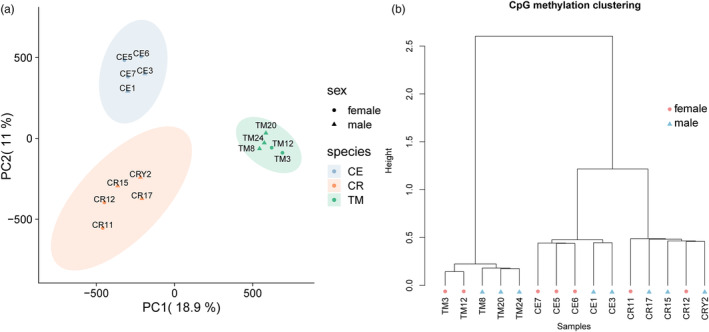
Macaques (genus ) are the most widely distributed non-human primates, and their evolutionary history, gene expression profiles, and genetic differences have been extensively studied. However, the DNA methylomes of macaque species are not available in public databases, which hampers understanding of epigenetic differences among macaque species. Epigenetic modifications can potentially affect development, physiology, behavior, and evolution. Here, we investigated the methylation patterns of the Tibetan macaque (; TM), Chinese rhesus macaque (; CR), and crab-eating macaque (; CE) through whole-genome bisulfite sequencing from peripheral blood. We compared genome-wide methylation site information for the three species. We identified 12,128 (CR vs. CE), 59,165 (CR vs. TM), and 39,751 (CE vs. TM) differentially methylated regions (DMRs) in the three macaques. Furthermore, we obtained the differentially expressed genes (DEGs) among the three macaque species. The differences between CR and CE were smaller at both the methylome and transcriptome levels than compared with TM (CR vs. TM and CE vs. TM). We also found a change in the density of single nucleotide mutations in DMRs relative to their flanking regions, indicating a potential mechanism through which genomic alterations may modulate methylation landscapes, thereby influencing the transcriptome. Functional enrichment analyses showed the DMR-related genes were enriched in developmental processes and neurological functions, such as the growth hormone-related pathway, insulin secretion pathway, thyroid hormone synthesis pathway, morphine addiction, and GABAergic synapses. These differences may be associated with variations in physiology and habitat among the macaques. Our study provides one of the first genome-wide comparisons of genetic, gene expression, and epigenetic variations across different macaques. Our results should facilitate further research on comparative genomic and genetic differences in macaque species.
猕猴(属)是分布最广泛的非人灵长类动物,其进化历史、基因表达谱和遗传差异已得到广泛研究。然而,猕猴物种的DNA甲基化组在公共数据库中尚无可用信息,这阻碍了对猕猴物种间表观遗传差异的理解。表观遗传修饰可能会影响发育、生理、行为和进化。在此,我们通过对外周血进行全基因组亚硫酸氢盐测序,研究了藏猕猴(;TM)、恒河猴(;CR)和食蟹猕猴(;CE)的甲基化模式。我们比较了这三个物种全基因组的甲基化位点信息。我们在这三种猕猴中分别鉴定出12,128个(CR与CE)、59,165个(CR与TM)和39,751个(CE与TM)差异甲基化区域(DMR)。此外,我们还获得了这三种猕猴物种间的差异表达基因(DEG)。与TM相比(CR与TM以及CE与TM),CR和CE在甲基化组和转录组水平上的差异较小。我们还发现DMR中单个核苷酸突变的密度相对于其侧翼区域发生了变化,这表明基因组改变可能通过一种潜在机制调节甲基化图谱,从而影响转录组。功能富集分析表明,与DMR相关的基因在发育过程和神经功能中富集,如生长激素相关途径、胰岛素分泌途径、甲状腺激素合成途径、吗啡成瘾和GABA能突触。这些差异可能与猕猴之间生理和栖息地的变化有关。我们的研究首次对不同猕猴的遗传、基因表达和表观遗传变异进行了全基因组比较。我们的结果应有助于进一步研究猕猴物种间的比较基因组学和遗传差异。