Department of Life Sciences, Division of Food and Nutrition Science, Chalmers University of Technology, 412 96, Gothenburg, Sweden.
Department of Medical Sciences, Gastroenterology/Hepatology, Uppsala University, 75185, Uppsala, Sweden.
Metabolomics. 2024 Feb 12;20(2):21. doi: 10.1007/s11306-023-02083-x.
There is large variation in response to diet in irritable bowel syndrome (IBS) and determinants for differential response are poorly understood.
Our aim was to investigate differential clinical and molecular responses to provocation with fermentable oligo-, di-, monosaccharides, and polyols (FODMAPs) and gluten in individuals with IBS.
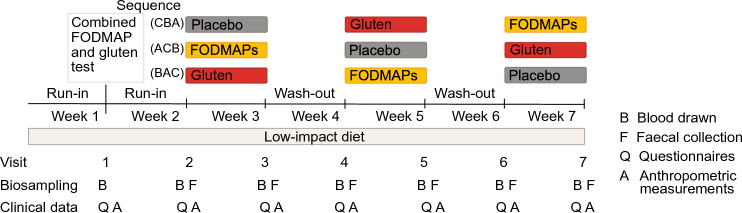
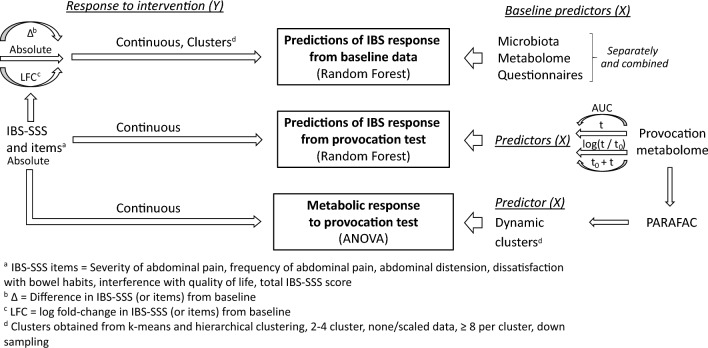
Data were used from a crossover study with week-long interventions with either FODMAPs, gluten or placebo. The study also included a rapid provocation test. Molecular data consisted of fecal microbiota, short chain fatty acids, and untargeted plasma metabolomics. IBS symptoms were evaluated with the IBS severity scoring system. IBS symptoms were modelled against molecular and baseline questionnaire data, using Random Forest (RF; regression and clustering), Parallel Factor Analysis (PARAFAC), and univariate methods.
Regression and classification RF models were in general of low predictive power (Q ≤ 0.22, classification rate < 0.73). Out of 864 clustering models, only 2 had significant associations to clusters (0.69 < CR < 0.73, p < 0.05), but with no associations to baseline clinical measures. Similarly, PARAFAC revealed no clear association between metabolome data and IBS symptoms.
Differential IBS responses to FODMAPs or gluten exposures could not be explained from clinical and molecular data despite extensive exploration with different data analytical approaches. The trial is registered at www.
gov as NCT03653689 31/08/2018.
肠易激综合征(IBS)患者对饮食的反应存在很大差异,而对差异反应的决定因素了解甚少。
本研究旨在研究 IBS 患者对发酵寡糖、二糖、单糖和多糖(FODMAPs)和麸质的刺激的临床和分子反应的差异。
本研究的数据来自一项交叉研究,研究对象接受了为期一周的 FODMAPs、麸质或安慰剂干预。该研究还包括快速激发试验。分子数据包括粪便微生物群、短链脂肪酸和非靶向血浆代谢组学。IBS 症状采用 IBS 严重程度评分系统进行评估。采用随机森林(RF;回归和聚类)、并行因子分析(PARAFAC)和单变量方法,根据分子和基线问卷数据对 IBS 症状进行建模。
回归和分类 RF 模型的预测能力普遍较低(Q≤0.22,分类率<0.73)。在 864 个聚类模型中,只有 2 个具有显著的聚类相关性(0.69<CR<0.73,p<0.05),但与基线临床指标没有相关性。同样,PARAFAC 也没有显示代谢组学数据与 IBS 症状之间有明显的关联。
尽管采用了不同的数据分析方法进行了广泛的探索,但仍无法从临床和分子数据中解释 IBS 对 FODMAPs 或麸质暴露的差异反应。该试验在 www. clinicaltrials.gov 上注册,注册号为 NCT03653689。