Geleta Daniel, Abebe Gemeda, Workneh Netsanet, Ararso Mekdes, Tilahun Tsion, Beyene Getenet
School of Medical Laboratory Sciences, Faculty of Health Sciences, Jimma University, Jimma, Oromia, Ethiopia.
Mycobacteriology Research Center, Institute of Health, Jimma University, Jimma, Oromia, Ethiopia.
J Multidiscip Healthc. 2024 Feb 8;17:541-555. doi: 10.2147/JMDH.S446303. eCollection 2024.
Neonatal sepsis made the neonatal period the most perilous time for child survival, and it continued to cause preventable mortalities worldwide. These mortalities stem from the interaction of several factors that have not been sufficiently studied and, in some cases, remain overlooked. Thus, the study aims to investigate the predictors of mortality that arise from the interaction of these factors and quantitatively determine their etiologic fraction.
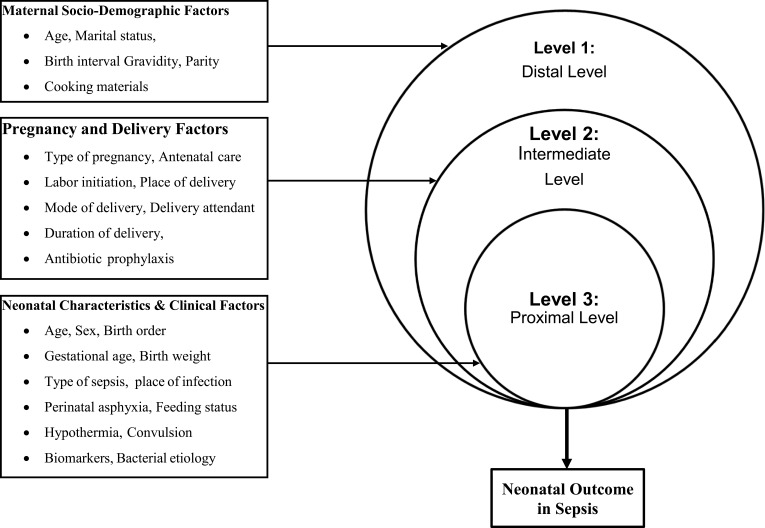
A case-control study with hierarchical data input was conducted at Jimma Medical Center (JMC) in Oromia, Ethiopia, spanning from May 2022 to July 2023. It employed logistic regression to calculate adjusted odds ratios (AORs) and their corresponding 95% confidence intervals (CI) at a significance level of p ≤ 0.05. The model adjusted odds ratios (ORs) for variables within each level and farther levels and presented an etiologic fraction (EF), indicating the proportion of neonatal mortality attributable to specific factors.
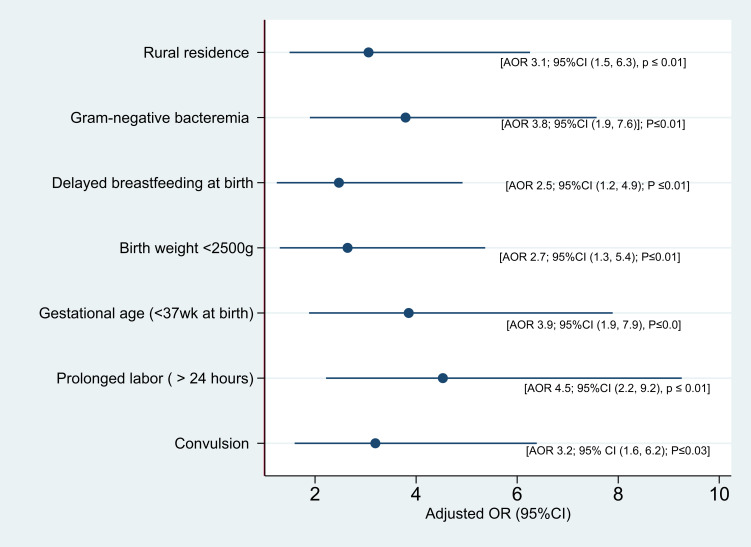
The analysis of 67 cases and 268 controls unveiled significant predictors of mortality in sepsis that emerged from distal, intermediate, and proximal levels. In the final model, thus, rural residence [AOR 3.1; 95% CI (1.5, 6.3), p ≤ 0.01], prolonged labor [AOR 4.5; 95% CI (2.2, 9.3), p ≤ 0.01], prematurity [AOR 3.9; 95% CI (1.9, 7.9), P ≤ 0.0], gram-negative bacteremia [AOR 3.8; 95% CI (1.9, 7.6); P ≤ 0.01], convulsion [AOR 3.2; 95% CI (1.6, 6.4); P ≤ 0.03], low birth weight [AOR 2.7; 95% CI (1.3, 5.4); P≤0.01], and delayed breastfeeding [AOR 2.5; 95% CI (1.2, 4.9); P ≤ 0.01] attributed a variable percentage of mortality.
Factors emerging and interacting at distal (residence), intermediate (prolonged labor), and proximal (prematurity, birth weight, convulsion, bacterial etiology, and feeding) levels influence neonatal mortality in sepsis at JMC. Therefore, concurrently improving rural family characteristics, managing labor duration, strengthening diagnostic stewardship, and promoting essential newborn care can actively prevent and reduce these mortalities.
新生儿败血症使新生儿期成为儿童生存最危险的时期,并且在全球范围内持续导致可预防的死亡。这些死亡源于几个尚未得到充分研究且在某些情况下仍被忽视的因素之间的相互作用。因此,本研究旨在调查这些因素相互作用导致的死亡预测因素,并定量确定其病因分数。
于2022年5月至2023年7月在埃塞俄比亚奥罗米亚的吉马医疗中心(JMC)进行了一项采用分层数据输入的病例对照研究。采用逻辑回归在显著性水平p≤0.05下计算调整后的优势比(AOR)及其相应的95%置信区间(CI)。该模型对每个层次及更高级别变量的优势比(OR)进行了调整,并给出了病因分数(EF),表明新生儿死亡归因于特定因素的比例。
对67例病例和268例对照的分析揭示了败血症中从远端、中间和近端层次出现的死亡显著预测因素。因此,在最终模型中,农村居住[AOR 3.1;95% CI(1.5,6.3),p≤0.01]、产程延长[AOR 4.5;95% CI(2.2,9.3),p≤0.